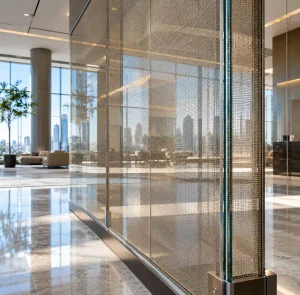
Noise pollution affects over 100 million people in urban environments worldwide, with traffic noise, construction activities, and industrial operations creating sound levels exceeding 70 decibels—well above the WHO recommended maximum of 55 dB for residential areas. For architects and building designers working on projects in dense urban settings, selecting the right glazing system isn’t just about aesthetics or energy efficiency—it’s about creating spaces where occupants can work, live, and rest without constant auditory disruption.
If you want to specify effective sound insulation for commercial buildings, residential high-rises, or mixed-use developments, then you will need to understand how laminated glass achieves superior acoustic performance compared to standard glazing. This guide explains the technical mechanisms, performance metrics, and configuration strategies that make laminated glass the preferred solution for noise control in modern architecture.
What Is Acoustic Laminated Glass?
Acoustic laminated glass is a multi-layer safety glass product specifically engineered to reduce sound transmission between interior and exterior environments. The construction consists of two or more glass panes bonded together with a viscoelastic interlayer—typically polyvinyl butyral (PVB)—that dampens sound wave vibrations as they pass through the glazing assembly.
Unlike standard laminated glass designed primarily for safety and security, acoustic laminated glass uses specialized interlayer materials with enhanced damping properties. These acoustic PVB interlayers convert sound energy into minimal amounts of heat through internal friction, significantly reducing the amount of noise that passes through the glass. This damping mechanism becomes particularly effective at the critical coincidence frequency where standard glass panels tend to transmit more sound.

How Sound Transmission Class (STC) Ratings Work
Sound Transmission Class (STC) is the standardized metric used to measure how effectively a building partition reduces airborne sound transmission. According to ASTM E90 and ASTM E413 testing standards, STC ratings are determined by measuring sound reduction across 16 different frequencies ranging from 125 Hz to 4000 Hz.
You can interpret STC ratings using this practical framework: each increase of 10 points in STC rating represents a perceived halving of loudness. For example, upgrading from STC 30 to STC 40 makes outside noise sound roughly half as loud to building occupants. However, achieving high STC performance requires careful attention to the complete glazing assembly, not just the glass itself.
STC Rating Performance Comparison
| STC Rating | Perceived Acoustic Performance | Typical Glass Configuration | Suitable Applications |
|---|---|---|---|
| STC 26-28 | Loud speech clearly understood | 6mm single pane | Non-critical interior partitions |
| STC 30-32 | Loud speech audible but not intelligible | 6mm + 6mm standard laminated | Basic residential windows |
| STC 34-36 | Loud speech heard as murmur | 8mm + 1.52mm PVB + 8mm acoustic laminated | Standard commercial glazing |
| STC 38-42 | Most speech inaudible | Asymmetric acoustic laminated (10mm + 8mm) | Urban residential, office buildings |
| STC 45-50 | Very quiet, minimal sound intrusion | Acoustic laminated + IGU with air gap | High-performance applications, recording studios |
The Role of PVB Interlayer Thickness in Acoustic Performance
Interlayer thickness directly influences acoustic damping effectiveness. Standard PVB interlayers range from 0.38mm to 0.76mm for safety applications, while acoustic-grade PVB typically measures 1.52mm or thicker. Our manufacturing experience at Zhongbo Glass shows acoustic performance improves significantly when interlayer thickness increases from 0.76mm to 1.52mm, with substantial gains in the 500-2000 Hz frequency range where human speech and urban traffic noise concentrate.
When you specify 1.52mm acoustic PVB instead of standard 0.76mm PVB, you can expect STC improvements of 2-4 points. Beyond 2.28mm thickness, additional acoustic gains diminish while costs and weight increase substantially. Acoustic-grade PVB formulations incorporate specific plasticizers and polymers that enhance damping coefficient. These specialized interlayers achieve STC ratings 3-5 points higher than standard PVB at equivalent thickness. You should specify acoustic PVB rather than standard PVB whenever sound insulation is a project priority, particularly for facades facing highways, airports, or urban commercial districts.

Asymmetric Lamination: Breaking the Coincidence Effect
One of the most effective strategies for improving acoustic performance involves asymmetric lamination—using different glass thicknesses on each side of the interlayer. This configuration disrupts the coincidence effect, a phenomenon where sound waves at specific frequencies cause the entire glass panel to vibrate sympathetically, dramatically increasing sound transmission.
Every glass thickness has a coincidence frequency where this resonance occurs. For 6mm glass, coincidence typically happens around 2000-3000 Hz. By using asymmetric configurations like 8mm + 1.52mm PVB + 6mm or 10mm + 1.52mm PVB + 8mm, you create a laminated unit where each glass layer has different coincidence frequencies. This prevents the entire assembly from resonating at any single frequency, maintaining consistent sound reduction across the spectrum.
Symmetric vs Asymmetric Laminated Glass Acoustic Performance
| Configuration | Overall STC Rating | Performance at 500 Hz | Performance at 2000 Hz | Cost Factor | Best Applications |
|---|---|---|---|---|---|
| 6mm + 6mm (Symmetric) | STC 32-33 | Good | Moderate dip at coincidence | Baseline | Budget-conscious projects |
| 8mm + 6mm (Asymmetric) | STC 35-37 | Very good | Improved at critical frequencies | +15-20% | Urban residential windows |
| 10mm + 8mm (Asymmetric) | STC 38-40 | Excellent | Consistent across spectrum | +30-40% | High-traffic urban facades |
| 12mm + 10mm (Asymmetric) | STC 41-43 | Excellent | Superior broadband performance | +50-60% | Airports, highways, premium commercial |
Our production capability at Zhongbo Glass extends to asymmetric laminated panels up to 4200mm × 28000mm, allowing for jumbo-size acoustic glazing in modern curtain wall applications without compromising performance through excessive joints.

Understanding Frequency Response in Acoustic Glazing
Sound insulation performance varies across frequency ranges. Low frequencies (below 500 Hz) from truck traffic and industrial equipment require thicker, heavier glazing for effective attenuation. Mid-frequencies (500-2000 Hz) encompass human speech and urban noise—this is where acoustic PVB interlayers provide maximum benefit through damping. High frequencies (above 2000 Hz) are easier to block but where the coincidence effect becomes problematic for standard glass. When you review acoustic test data, focus on the 500-2000 Hz range for projects where speech privacy or traffic noise control is critical.

Combining Laminated Glass with Insulated Glass Units
For maximum acoustic performance, combining acoustic laminated glass with insulated glass units (IGU) creates a system where damping and mass-air-mass resonance both contribute to sound reduction. A typical high-performance acoustic IGU consists of 10mm + 1.52mm acoustic PVB + 8mm laminated glass on the exterior, a 12-16mm air gap, and 6mm glass on the interior.
You should specify air gaps of at least 12mm to minimize negative mass-air-mass resonance at low frequencies. When acoustic laminated glass faces outward, it dampens higher-frequency sound before entering the IGU cavity. This configuration achieves STC ratings of 42-48, suitable for demanding urban environments including facades adjacent to highways or airport flight paths.

Urban Noise Control Applications and Specifications
Highway traffic generates broadband noise weighted toward low and mid frequencies, with sound levels often exceeding 75-80 dB at 50 meters from the roadway. For high-rise buildings facing major arterials, you should specify asymmetric acoustic laminated glass with STC ratings of at least 38-40 to reduce interior noise to acceptable levels below 45 dB.
Airport environments present greater challenges, with jet aircraft producing sound levels of 90-110 dB during takeoff. Buildings within airport approach zones typically require STC 45+ glazing systems with acoustic laminated IGU assemblies and maximum glass thickness. Urban commercial districts benefit from acoustic laminated glass even on upper floors, as sound reflects off adjacent buildings. You can use moderate-performance acoustic glazing (STC 35-38) for upper floors while specifying higher-performance systems (STC 40+) for lower floors exposed to street noise.

Acoustic Laminated Glass Configuration Recommendations
| Building Type | Exterior Noise Level | Minimum Recommended Configuration | Target Interior Noise Level | Expected STC Rating |
|---|---|---|---|---|
| Suburban Residential | 55-60 dB | 6mm + 0.76mm PVB + 6mm | <40 dB | STC 32-34 |
| Urban Residential | 65-70 dB | 8mm + 1.52mm acoustic PVB + 6mm | <45 dB | STC 36-38 |
| High-Traffic Urban | 70-75 dB | 10mm + 1.52mm acoustic PVB + 8mm + 12mm air + 6mm IGU | <45 dB | STC 42-45 |
| Airport Proximity | 80-90 dB | 12mm + 2.28mm acoustic PVB + 10mm + 16mm air + 8mm IGU | <50 dB | STC 48-52 |
| Recording Studios | Variable | Asymmetric laminated IGU + isolated frames | <35 dB | STC 50+ |
These configurations represent tested assemblies that deliver reliable performance. However, achieving the specified STC ratings requires proper installation with continuous perimeter sealing, isolated glazing tape, and attention to acoustic flanking paths through wall assemblies and HVAC penetrations.

Installation and Design Considerations for Maximum Performance
Even the best acoustic glazing cannot overcome poor installation. Sound follows the path of least resistance—gaps, cracks, or rigid connections between glass and frame completely undermine acoustic performance. You must specify continuous perimeter glazing gaskets with proper compression to create an airtight seal.
Frame selection significantly impacts system performance. Thermally broken aluminum frames with acoustic gasket channels provide good isolation while maintaining structural performance. Glazing tape and setting blocks should isolate the glass from direct frame contact. Rigid connections create flanking paths where vibrations transmit through the frame structure, bypassing the acoustic properties. The complete facade system must be evaluated as an acoustic assembly. When you specify STC 40 vision glass but use standard spandrel panels rated at STC 28, overall system performance will be dominated by the weaker element.
Manufacturing Capabilities and Quality Considerations
At Zhongbo Glass, our laminated glass production lines manufacture acoustic laminated panels up to 4200mm × 28000mm, with specialized autoclaves ensuring uniform pressure and temperature distribution. This capability minimizes joints in curtain wall systems—each joint represents a potential acoustic weak point requiring careful sealing.
Acoustic PVB interlayer installation requires precise thickness control and complete air removal during autoclave bonding. Even small air bubbles reduce damping effectiveness. Our CNC machining centers provide clean, precise edges that accept glazing gaskets uniformly, preventing localized air gaps that compromise acoustic sealing.

Frequently Asked Questions
What STC rating do I need for a building facing a busy highway?
For buildings within 100 meters of a major highway with traffic levels above 70 dB, specify glazing systems with minimum STC 38-40 to achieve acceptable interior noise levels below 45 dB. This typically requires asymmetric acoustic laminated glass or acoustic laminated IGU assemblies.
Is acoustic PVB more expensive than standard PVB?
Acoustic PVB typically costs 40-60% more than standard PVB due to specialized formulations. However, the acoustic performance improvement of 3-5 STC points often eliminates the need for more expensive alternatives like triple glazing, making acoustic PVB cost-effective overall.
Can I achieve good sound insulation with standard laminated glass?
Standard laminated glass with 0.76mm PVB provides moderate improvement over single-pane glass (STC 32-34), sufficient for suburban environments. For urban environments with traffic noise above 65 dB, you need acoustic-grade PVB interlayers of 1.52mm or thicker.
How does laminated glass acoustic performance compare to triple glazing?
Acoustic laminated glass in an IGU assembly typically outperforms standard triple glazing at speech frequencies due to PVB damping properties. Triple glazing excels at thermal insulation but may not provide superior acoustic performance unless one lite is acoustic laminated.
What is the coincidence effect and why does it matter?
The coincidence effect occurs when sound waves cause a glass panel to vibrate sympathetically at specific frequencies, dramatically increasing sound transmission. Asymmetric laminated configurations with different glass thicknesses prevent this resonance, maintaining consistent acoustic performance.
Do I need acoustic laminated glass on both sides of an IGU?
For most applications, acoustic laminated glass on the exterior lite provides optimal performance and cost-effectiveness. Using it on both lites offers minimal additional benefit for the substantial cost increase, except in specialized applications like recording studios.
How important is installation quality for acoustic performance?
Installation quality is critical—even STC 45 glazing performs poorly if gaps exist in the perimeter seal. Proper installation with continuous acoustic gaskets, isolated glazing tape, and airtight perimeter sealing is essential. Poor installation can reduce effective STC ratings by 5-10 points or more.
Conclusion
Acoustic laminated glass delivers measurable noise reduction through viscoelastic damping, with performance determined by interlayer thickness, glass configuration, and system design. Understanding STC ratings, asymmetric lamination benefits, and frequency-dependent performance allows you to specify glazing systems that create comfortable interior environments in challenging urban acoustic conditions.
If you need high-performance acoustic laminated glass for commercial curtain walls, residential high-rises, or specialized applications, Zhongbo Glass offers manufacturing capabilities up to 4200mm × 28000mm with acoustic PVB interlayers and asymmetric configurations. Our production facilities include specialized autoclaves and quality control systems ensuring consistent acoustic performance across even the largest architectural panels.
Contact us today for acoustic laminated glass specifications, STC testing data, and technical support for your noise control requirements.