When reviewing glass specifications for commercial projects, architects encounter terms like “U-value 1.2 W/m²K” or “SHGC 0.35” that directly impact energy performance and project costs. This glossary covers essential architectural glass terms across thermal performance, optical properties, glass types, and international standards—organized for rapid reference during specification work.

Essential Performance Metrics
U-Value (Thermal Transmittance)
Measures heat transfer rate through glass assembly in W/m²K or BTU/hr·ft²·°F. Lower values mean better insulation. Single glazing achieves U-values around 5.8 W/m²K, while advanced triple-glazed Low-E units reach 0.8 W/m²K. For commercial buildings in cold climates, specify U-values below 1.5 W/m²K to meet energy codes.
SHGC (Solar Heat Gain Coefficient)
Fraction of solar radiation passing through glass, measured 0 to 1. SHGC 0.25 means 25% of solar energy enters the building. Cooling-dominated climates require SHGC below 0.30, while heating-dominated regions benefit from SHGC above 0.40. Low-E glass achieves SHGC as low as 0.23 while maintaining high visible light transmission.
VLT (Visible Light Transmittance)
Percentage of visible spectrum (380-780nm) transmitted through glazing. Clear glass offers approximately 90% VLT, while reflective coatings reduce this to 10-40%. Office buildings typically require 40-70% VLT to balance natural daylight with glare control.

R-Value (Thermal Resistance)
Inverse of U-value (R = 1/U), commonly used in North America. Higher R-values indicate superior insulation. A window with U-value 0.25 has R-value 4.0.
LSG (Light-to-Solar Gain Ratio)
Calculated as VLT divided by SHGC, measuring glazing efficiency. Modern spectrally selective Low-E coatings achieve LSG ratios above 1.5. Target LSG greater than 1.25 for energy-efficient commercial facades.
STC (Sound Transmission Class)
Single-number rating for airborne sound insulation. Standard insulated glass units achieve STC 28-32, while acoustic laminated glass reaches STC 35-42. Urban high-rises should specify STC 40+ for interior acoustical comfort.
Emissivity
Surface’s ability to emit thermal radiation (0 to 1 scale). Standard glass has emissivity 0.84, while Low-E coatings reduce this to 0.02-0.15. Lower emissivity reflects indoor heat back into occupied spaces.
Glass Types and Manufacturing
Annealed Glass
Float glass cooled slowly during manufacturing to release internal stresses. Not considered safety glazing. Used as substrate for processing into tempered or laminated products. Zhongbo Glass cutting lines handle maximum dimensions of 4200mm × 28000mm.

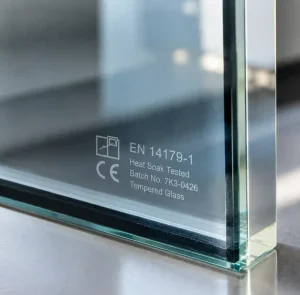
Tempered Glass (Toughened Glass)
Heat-treated to 620-650°C then rapidly air-cooled, creating surface compression. Approximately 4-5 times stronger than annealed glass. Shatters into small granular fragments, qualifying as safety glazing per ANSI Z97.1 and EN 12150. Zhongbo’s tempering lines accommodate panels up to 3660mm × 28000mm.
Heat-Strengthened Glass
Semi-tempered glass approximately twice as strong as annealed glass. Breaks into larger fragments than tempered. Cannot be cut after heat treatment. Used where enhanced strength is needed without full tempering fragmentation.
Laminated Glass
Two or more glass plies bonded with polymer interlayers (PVB, EVA, or SGP). Retains fragments when broken, blocks 99% UV radiation, provides acoustic dampening. The Zhangjiajie Glass Bridge project utilized 15mm+2.67SGP+15mm+2.67SGP+15mm configuration.
Insulated Glass Units (IGU)
Multiple glass panes separated by spacer systems and sealed with air or gas-filled cavities. Dramatically improves thermal and acoustic insulation. Zhongbo produces IGUs up to 3660mm × 28000mm with argon gas fill and Low-E coatings.
| Glass Type | Strength vs Annealed | Breakage Pattern | Safety Rating | Maximum Size at Zhongbo |
|---|---|---|---|---|
| Annealed Glass | 1x (baseline) | Large dangerous shards | Not safety glazing | 4200mm × 28000mm |
| Heat-Strengthened | 2x stronger | Medium fragments | Not safety glazing | 3660mm × 28000mm |
| Tempered Glass | 4-5x stronger | Small granular pieces | Safety glazing | 3660mm × 28000mm |
| Laminated Glass | Varies by construction | Fragments held by interlayer | Safety glazing | 4200mm × 28000mm |
Low-E Glass (Low Emissivity)
Glass with microscopically thin metallic coating reflecting infrared radiation while transmitting visible light. Soft coat Low-E achieves U-values 0.8-1.2 W/m²K. Used extensively in energy-efficient buildings like the Qingpu Huawei R&D Center.

Fire-Resistant Glass
Specialized glazing maintaining integrity and insulation during fire exposure. Tested per ASTM E119 or EN 1364, with ratings from 20 to 120 minutes. Essential for fire exits and compartmentation in commercial buildings.
Curved Glass
Glass bent to specific radii using hot bending or cold bending. Hot bending provides tighter radii and is compatible with tempering. Zhongbo’s curved glass furnaces accommodate panels up to 3660mm × 20000mm for projects like Tianfu Art Museum.

Digital Printed Glass
Ceramic ink patterns applied via digital printing then fired during tempering. Inks fuse permanently with glass surface, providing fade-resistant graphics. Used for decorative facades and privacy screens like the Luoyang Peony Square installation.
Coating Technologies and Interlayers
Pyrolytic Coating (Hard Coat)
Metallic oxide coating applied during float process, chemically bonded to glass. Extremely durable but offers moderate Low-E performance (emissivity 0.15-0.20). Suitable for monolithic glazing.
Sputtered Coating (Soft Coat)
Multiple nano-layers deposited in vacuum chamber. Achieves superior Low-E performance (emissivity 0.02-0.10). Must be protected within IGU. Standard for high-performance curtain wall systems.

PVB (Polyvinyl Butyral)
Standard laminated glass interlayer offering good adhesion and sound dampening. Thickness typically 0.38mm to 2.28mm. Provides 99% UV blocking and fragment retention.
SGP (SentryGlas Plus)
High-performance ionomer interlayer offering 5x tear strength and 100x rigidity compared to PVB. Maintains structural integrity at elevated temperatures. Preferred for structural glass including floors, balustrades, and bridge projects.
| Interlayer Type | Tear Strength | Rigidity | Max Service Temp | Typical Applications |
|---|---|---|---|---|
| PVB | Baseline | Baseline | 50°C | Standard laminated glass, windows |
| SGP | 5x PVB | 100x PVB | 90°C | Structural glazing, bridges, floors |
| EVA | Below PVB | Below PVB | 40°C | Decorative lamination |
Critical Testing Standards
ASTM E1300
Standard practice for determining load resistance of glass in buildings. Provides methodology for calculating glass thickness based on wind loads, dimensions, and support conditions.
ANSI Z97.1
Safety performance specifications for architectural glazing materials. Defines impact testing for safety glazing in hazardous locations including doors, sidelites, and shower enclosures.

EN 12150
European standard for thermally toughened safety glass. Specifies surface compression requirements and fragment size testing. Tempered glass must exhibit minimum 69 MPa surface compression.
EN 12543
European standard for laminated glass covering glass types, interlayer materials, performance requirements, and test methods.
GB 15763
Chinese national standard covering safety glazing materials including tempered glass, heat-strengthened glass, and laminated glass. Specifies performance requirements for Chinese market.
Structural Engineering Terms
Deflection
Maximum lateral displacement of glass under design wind load, typically expressed as fraction of span (L/60). Building codes limit deflection to prevent sealant failure and water infiltration.
Wind Load
Pressure exerted on building facade by wind, measured in Pascals (Pa) or pounds per square foot (psf). Critical design parameter for glass thickness selection in curtain wall applications.

Safety Factor
Ratio of glass design strength to maximum applied stress. Building codes typically require minimum safety factor of 2.5 for annealed glass and 4.0 for tempered glass under wind load.
Point-Supported Glazing
Structural glass system where panels are supported at discrete points using specialized fittings. Allows dramatic all-glass facades with minimal visible support. Requires tempered or heat-strengthened laminated glass.
Frequently Asked Questions
What’s the difference between U-value and R-value?
U-value measures heat transfer rate (lower is better), while R-value measures thermal resistance (higher is better). They are mathematical inverses: R = 1/U. Both describe the same thermal performance from opposite perspectives.
How does Low-E coating improve energy efficiency?
Low-E coating reflects infrared radiation while transmitting visible light. In winter, it reflects indoor heat back into the building. In summer, it reflects outdoor solar heat away. This improves insulation by 30-50% compared to uncoated glass.
What glass type is required for overhead glazing?
Building codes mandate laminated glass for all overhead glazing applications. This ensures glass fragments remain adhered to the interlayer if breakage occurs. Typical configurations use tempered laminated glass with SGP interlayer.
Can tempered glass be cut after tempering?
No. Any cutting, drilling, or edge modification must occur before tempering. The heat treatment creates balanced internal stresses—any alteration after tempering causes immediate shattering.
What determines SHGC in glass specification?
SHGC depends on glass thickness, tint, number of panes, and Low-E coating characteristics. Clear single glazing has SHGC around 0.82. Adding Low-E coating reduces SHGC to 0.25-0.40 depending on coating type.
How large can architectural glass panels be manufactured?
Zhongbo Glass operates world-class processing lines accommodating panels up to 3660mm × 28000mm for tempering and 4200mm × 28000mm for laminating—among the largest capabilities globally for jumbo-size architectural glass.
Conclusion
Mastering architectural glass terminology empowers architects to specify appropriate glazing systems that meet structural, thermal, acoustic, and aesthetic requirements. The critical performance metrics—U-value, SHGC, VLT, and STC—directly influence building energy consumption and occupant comfort.
For projects requiring jumbo-size structural glass, Zhongbo Glass provides world-class manufacturing capabilities with processing lines up to 3660mm × 28000mm. Our facility has successfully supplied architectural glass for landmark projects including the Zhangjiajie Glass Bridge, Shanghai Museum East Hall, and numerous commercial curtain wall systems. We maintain expertise across all glass types including tempered, laminated, insulated, Low-E, curved, and specialty products.
Contact us for technical specifications, project consultation, and competitive factory-direct pricing on architectural glass solutions.