When a bank in downtown Chicago upgraded its teller windows last year, the security consultant specified “bulletproof glass” — only to discover during installation that Level 3 protection couldn’t stop the rifle threats identified in their risk assessment. The $180,000 retrofit had to be redone with Level 7 glass, doubling costs and delaying the branch reopening by six weeks. This scenario repeats across schools, government facilities, and commercial buildings where designers conflate “bulletproof” with adequate protection.
Bullet-resistant glass isn’t a single product but a spectrum of engineered solutions, each calibrated to specific ballistic threats. Selection requires matching UL 752 or EN 1063 protection levels to actual risk profiles, understanding multi-layer laminate construction, and accounting for installation constraints that affect both performance and budget. This guide translates ballistic ratings into actionable specifications for security-critical projects.

What Is Bullet-Resistant Glass?
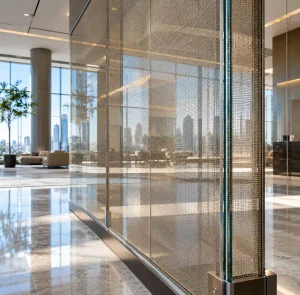
Bullet-resistant glass (also called ballistic glass or security glazing) is a multi-layer composite that absorbs and disperses projectile energy without penetration. Unlike standard tempered glass that shatters on impact, ballistic glazing combines glass plies with polymer interlayers — typically polyvinyl butyral (PVB) or thermoplastic polyurethane — in configurations ranging from 18mm to over 80mm thick depending on threat level.
The term “bulletproof” is a misnomer. No glass is impenetrable against all weapons. Manufacturers and specifiers use “bullet-resistant” to reflect that these products are tested and rated against defined ammunition types and velocities under controlled conditions per UL 752 (North America) or EN 1063 (Europe) standards.
UL 752 vs EN 1063: Protection Level Standards
| Standard | Geographic Use | Level Range | Test Method | Key Difference |
|---|---|---|---|---|
| UL 752 (11th Edition) | North America, Middle East | Level 1 to Level 8 | 3 shots per location, 5 locations | Considers spalling (interior glass fragments) |
| EN 1063 | Europe, Asia-Pacific | BR1 to BR7 (NS/S variants) | 3 shots within 120mm group | NS = no spalling, S = spalling acceptable |
UL 752 is stricter on debris: all levels prohibit complete penetration or spalling that could injure occupants behind the glass. EN 1063’s “S” (spalling) classifications allow glass fragments on the protected side, requiring secondary barriers in occupied spaces.
Both standards test glass panels at 500mm x 500mm minimum. Multiple shots must be placed within close proximity (100-150mm) to simulate sustained attack patterns, not single isolated impacts. This clustering tests the glass’s ability to maintain structural integrity when compromised areas overlap.

UL 752 Protection Levels and Thickness Requirements
| UL Level | Ammunition Type | Velocity (fps) | Typical Thickness | Common Applications |
|---|---|---|---|---|
| Level 1 | 9mm FMJ | 1,175-1,293 | 18-22mm | Retail checkout, reception desks |
| Level 2 | .357 Magnum JSP | 1,250-1,375 | 22-28mm | Bank teller lines, ticket booths |
| Level 3 | .44 Magnum SJHP | 1,350-1,485 | 28-38mm | Cash-handling rooms, courtrooms |
| Level 4 | .30-06 Rifle | 2,540-2,794 | 45-55mm | Border checkpoints, government facilities |
| Level 5 | 7.62mm Rifle | 2,750-3,025 | 50-65mm | Military installations, embassies |
| Level 6 | 9mm submachine gun (5 shots) | 1,400-1,540 | 55-70mm | High-risk government, airport security |
| Level 7 | 5.56mm Rifle (M16) | 3,080-3,388 | 60-75mm | Tactical operations centers, secure facilities |
| Level 8 | 7.62mm Rifle (AK-47) | 2,750-3,025 | 70-85mm | Maximum commercial threat protection |
Weight implications: Level 3 glass weighs approximately 15-18 kg/m², while Level 8 exceeds 40 kg/m². Framing systems, structural supports, and hardware must accommodate these loads. Retrofits often require reinforced headers, upgraded hinges, and recalculated wind load capacity.
Zhongbo Glass manufactures laminated security glass up to 4,200mm x 28,000mm in our world’s largest autoclave, accommodating oversized entrance systems and curtain wall applications that smaller facilities cannot produce. Our laminated glass production uses SGP interlayers for superior post-breakage strength compared to standard PVB.
For security glazing projects requiring both protection and visibility, consult our complete range of tempered glass and safety glazing solutions designed for high-risk facilities.
EN 1063 Ballistic Ratings Explained
| EN Class | Weapon Type | Bullet Mass (g) | Impact Velocity (m/s) | Typical Thickness |
|---|---|---|---|---|
| BR1 | .22 LR | 2.6 | 360 | 12-16mm |
| BR2 | 9mm Luger | 8.0 | 400 | 18-24mm |
| BR3 | .357 Magnum | 10.2 | 430 | 24-32mm |
| BR4 | .44 Magnum | 15.6 | 440 | 32-42mm |
| BR5 | 5.56mm Rifle | 4.0 | 950 | 45-58mm |
| BR6 | 7.62mm Rifle | 9.5 | 830 | 55-70mm |
| BR7 | 7.62mm AP (armor-piercing) | 9.8 | 820 | 65-85mm |
The NS suffix (e.g., BR4-NS) indicates “no spalling” — the protected side must remain free of glass fragments. Specify NS variants for occupied spaces without secondary protection. The S variant costs 15-20% less but mandates polycarbonate shields or safety film on the interior face.

Multi-Layer Construction and Material Selection
Ballistic glass achieves its stopping power through calculated layering of materials with different mechanical properties. Each layer performs a specific function in the energy absorption sequence:
Glass outer plies: face the threat and initiate bullet deformation. Tempered or heat-strengthened glass creates initial resistance. Annealed glass is sometimes used in inner plies for controlled fracture patterns.
Polymer interlayers: bond glass plies and absorb kinetic energy. PVB (polyvinyl butyral) at 0.76mm to 2.28mm per layer provides basic lamination. SGP (SentryGlas Plus) offers five times the stiffness of PVB, maintaining structural integrity longer after bullet impact. For Level 5+ protection, we use SGP exclusively.
Polycarbonate layers: some manufacturers add polycarbonate sheets (6-12mm) to the interior for enhanced spall protection and weight reduction. This creates a glass-clad polycarbonate (GCP) composite. However, polycarbonate yellows under UV exposure and scratches more easily than glass, requiring consideration in high-visibility applications.
A typical Level 3 construction might be: 6mm tempered glass + 1.52mm PVB + 6mm annealed + 1.52mm PVB + 6mm tempered = 22.04mm total. Level 7 might use: 12mm + 2.28mm SGP + 12mm + 2.28mm SGP + 12mm + 2.28mm SGP + 12mm + 6mm polycarbonate = 62.84mm.
The autoclave bonding process is critical. At Zhongbo Glass, our 4.2m x 28m autoclave processes laminates at 140°C and 12-14 bar pressure for 2-4 hours depending on thickness. Insufficient pressure or temperature creates delamination points that compromise ballistic performance.
Testing Standards and Certification Requirements
UL 752 testing protocol:
- Minimum 3 shots per location
- 5 total shooting locations per sample
- Shots spaced to create overlapping damage zones
- Temperature conditioning: -20°C to +50°C prior to testing
- No complete penetration allowed
- Spalling measured using witness panels
EN 1063 testing protocol:
- 3 shots within 120mm triangular pattern
- Shot-to-shot interval minimum 30 seconds
- Ambient temperature 15-25°C
- Separate tests for NS (no spalling) vs S (spalling) classifications
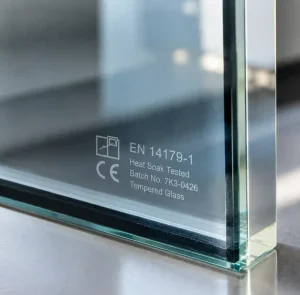
Both standards require independent laboratory certification. Manufacturers cannot self-certify. In the US, listings come from UL, Intertek, or other OSHA-recognized testing labs. Europe requires notified body certification per the Construction Products Regulation (CPR).
Important: certification applies to the tested configuration only. Changing glass thickness, interlayer type, or overall dimensions voids the rating. Field modifications (drilling, notching, edge polishing after lamination) compromise structural integrity. All cutouts for locks, hinges, or vision panels must be specified before manufacturing and included in test samples.

Installation Considerations for Security Glazing
Ballistic glass performance depends equally on proper installation. The glass-to-frame interface is a critical vulnerability. A Level 7 window installed in a standard aluminum frame creates a security failure — attackers bypass the glass by shooting the frame.
Frame requirements:
- Steel frames with minimum 3mm wall thickness for Level 1-3
- Reinforced steel (5-8mm) for Level 4-8
- Continuous structural attachment to building framing
- Ballistic-rated door frames must accommodate hinge loads exceeding 150kg per door
Glazing methods:
- Dry glazing with compression gaskets (preferred for retrofit)
- Structural silicone glazing for seamless appearance
- Mechanical captures with continuous edge support
- Minimum 6mm edge clearance on all sides to prevent glass-to-frame contact under impact
Edge clearance is non-negotiable. When a bullet strikes laminated glass, the panel flexes significantly — up to 25mm deflection in Level 5+ systems. If edges contact the frame during this deflection, the glass can fracture at mounting points, allowing penetration even though the center held.
We specify setting blocks every 300mm on horizontal edges and shims every 450mm on vertical edges. Edge bite (the amount of glass held by the frame) must be minimum 25mm for Levels 1-3 and 35mm for Levels 4-8.

Sizing Limits and Custom Fabrication Capabilities
Standard ballistic glass manufacturers produce panels up to 2,400mm x 3,600mm. Larger dimensions require specialized equipment.
Zhongbo Glass’s maximum ballistic laminate dimensions:
- Laminated glass: 4,200mm x 28,000mm
- Tempered glass components: 3,660mm x 28,000mm
- Autoclave capacity: 4.2m x 28m, accommodating full-height curtain wall sections
This capability eliminates vertical mullions in entrance systems and allows single-piece security glazing for grand lobbies. Our glass bridge projects including the Zhangjiajie Grand Canyon Glass Bridge use 15mm+2.675SGP+15mm+2.675SGP+15mm laminates at 3,050mm x 4,200mm, demonstrating our experience with high-strength, large-format safety glazing.
For airport terminal glass and bulletproof glass applications requiring both ballistic protection and fire ratings, we combine technologies: Level 3 ballistic construction with fire-resistant glass interlayers achieving 60-120 minute fire resistance. Our Riyadh Airport Terminal H expansion project demonstrates this integrated approach to security and life safety glazing.

Cost Analysis by Protection Level
Ballistic glazing costs scale exponentially with protection level due to material thickness, interlayer complexity, and testing requirements.
| Protection Level | Material Cost ($/m²) | Installed Cost ($/m²) | Weight (kg/m²) |
|---|---|---|---|
| Level 1 | $650-950 | $1,100-1,600 | 9-11 |
| Level 2 | $950-1,400 | $1,600-2,200 | 11-14 |
| Level 3 | $1,400-2,200 | $2,200-3,400 | 14-18 |
| Level 4 | $2,600-3,800 | $3,800-5,500 | 22-28 |
| Level 5 | $3,800-5,500 | $5,500-8,000 | 28-35 |
| Level 6-8 | $5,500-12,000+ | $8,000-18,000+ | 35-45+ |
Cost drivers beyond material:
- Custom fabrication for oversized panels: +15-30%
- Fire-rated ballistic glass: +40-60%
- Blast-resistant certification: +50-80%
- Express production (<8 weeks): +20-35%
- Shipping and insurance for international projects: $180-450/m² depending on destination
As a manufacturer, we control costs by eliminating distributor markups. Direct sourcing from Zhongbo Glass typically saves 25-35% compared to Western suppliers for equivalent protection levels.

Design Trade-offs: Security vs Aesthetics vs Budget
Specifying ballistic glazing requires balancing competing priorities:
Visibility: thicker glass has a greenish edge tint. Ultra-clear (low-iron) glass maintains clarity but adds 25-30% to material cost. For museum-quality transparency in security applications, specify low-iron glass throughout the laminate stack.
Weight: Level 8 glass weighs 4-5 times more than standard tempered glass. This affects door hardware (heavy-duty hinges cost $800-1,500 per door vs $150 for standard), floor loading (may require structural reinforcement), and seismic design (higher inertial loads during earthquakes).
Daylighting: ballistic glass reduces visible light transmission (VLT) by 5-15% compared to monolithic glass of similar thickness due to multiple air-interlayer interfaces. For Low-E insulated glass applications requiring both ballistic protection and solar control, we build triple-glazed IGUs with the ballistic laminate as the outboard lite.
Maintenance: unlike standard glass, ballistic laminates cannot be edge-polished or drilled after fabrication. All hardware locations, lock mortises, and hinge reinforcements must be finalized before production. Lead times extend to 10-14 weeks for custom configurations.

Frequently Asked Questions
Can bulletproof glass be retrofitted into existing frames?
Sometimes, but not always. Existing frames must be structurally evaluated for the increased weight and required edge clearance. Aluminum storefront systems typically cannot support Level 3+ glass without reinforcement. Steel frames may work if edge bite and depth accommodate the thicker glass. A structural engineer should assess load paths and anchorage before ordering glass.
How long does bullet-resistant glass last?
The glass itself has indefinite service life if properly maintained. However, edge seals can degrade over 20-25 years in harsh environments, allowing moisture ingress that causes delamination. UV exposure yellows polycarbonate layers in 10-15 years, requiring replacement for visibility. Specify outdoor-rated interlayers and UV-resistant edge sealants for longevity.
Does ballistic glass provide blast protection?
Not necessarily. Ballistic testing uses localized high-velocity impact. Blast loads create uniform pressure across the entire panel surface. Some products carry dual ratings (UL 752 + ASTM F1642 blast), but this requires separate testing and specialized interlayer selection. Specify blast requirements explicitly if your threat assessment includes explosives.
What’s the difference between UL 752 Level 3 and NIJ Level III?
UL 752 rates architectural glazing products. NIJ (National Institute of Justice) rates body armor. NIJ Level III stops rifle rounds that UL 752 Level 3 (handgun only) does not. These are unrelated standards; do not conflate them when specifying building products.
Can you make bulletproof glass curved?
Yes, but with limitations. We hot-bend glass plies before lamination. Minimum radius depends on glass thickness: 1,500mm radius for 6mm glass, 3,000mm for 12mm. Curved ballistic glass costs 40-60% more than flat due to custom molds and lower production efficiency. Our curved glass manufacturing capabilities include bent laminates for secure entrance canopies and reception desks.
Is bulletproof glass available with Low-E coating for energy efficiency?
Yes. We apply Low-E coatings to the inner glass surfaces before lamination. This allows ballistic protection with U-values of 1.2-1.6 W/m²K when fabricated as an insulated glass unit. The coating position must avoid the impact face, as Low-E coatings can delaminate under ballistic shock.
Conclusion
Bulletproof glass specification is a precise engineering discipline, not a commodity purchase. The difference between Level 3 and Level 4 protection isn’t just 10mm of thickness — it’s the difference between stopping handgun threats and rifle threats, between a $2,500/m² investment and a $4,500/m² investment, and between adequate security and a false sense of protection.
Start with a formal threat assessment identifying credible weapon types in your risk profile. Match those threats to UL 752 or EN 1063 levels using the tables in this guide. Then consider the architectural constraints: existing frame capacity, structural loads, sight lines, and budget realities. Oversizing protection wastes money; undersizing protection wastes everything.
Zhongbo Glass provides engineering support for security glazing projects from initial threat assessment through installation. Our technical team helps architects and security consultants translate risk profiles into buildable, certifiable solutions. With manufacturing capacity for panels up to 4.2m x 28m and full UL/EN certification documentation, we deliver both the product and the engineering confidence that security projects demand.
For specifications assistance or project quotations, contact our security glazing specialists at info@hncentralglass.com or review our complete laminated glass capabilities.