When comparing ceramic frit to silkscreen printing on glass, ceramic frit delivers superior long-term durability with a lifespan exceeding 30 years, while UV-bonded silkscreen printing typically lasts 5-10 years outdoors. The critical difference lies in how the color adheres: ceramic frit becomes permanently fused into the glass surface during tempering at 680-720°C, making it virtually indestructible, whereas silkscreen inks bond to the glass surface and remain vulnerable to UV degradation, weather exposure, and chemical attack.

Understanding the Manufacturing Process
Ceramic Frit: Permanent Fusion Technology
Ceramic frit glass begins with inorganic glaze—ground glass particles mixed with metallic oxides—printed onto the glass surface. After drying, the glass undergoes tempering at 680-720°C. At these temperatures, the ceramic particles melt and chemically bond with the glass substrate, creating permanent molecular fusion.
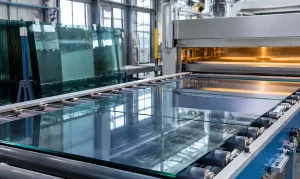
At Zhongbo Glass, our ceramic fritted production line handles panels up to 3660mm × 28000mm, allowing architectural-scale glass with permanent color that will outlast the building structure itself.
Silkscreen Printing: Surface Bonding Methods

Traditional silkscreen printing uses UV-cured or solvent-based inks. UV-cured inks polymerize under ultraviolet light, creating a hardened surface layer. Some manufacturers add low-temperature baking (150-200°C), but this remains far below ceramic fusion temperatures.
The fundamental limitation is that screen-printed inks remain a separate layer on the glass. They achieve mechanical adhesion but never molecular integration. This works well for interior applications or signage with replacement cycles, but cannot match ceramic frit for permanent exterior installations.
Durability Comparison: Performance Metrics
| Durability Factor | Ceramic Frit Glass | UV Silkscreen Printing | Solvent-Based Silkscreen |
|---|---|---|---|
| Expected Lifespan (Exterior) | 30+ years | 5-10 years | 3-7 years |
| UV Resistance | Permanent (no degradation) | Moderate (fading over time) | Low to moderate |
| Weather Resistance | Excellent | Good initially, declines | Fair, requires coatings |
| Chemical Resistance | Excellent (acid/alkaline resistant) | Moderate | Low |
| Scratch Resistance | Excellent (same as glass) | Moderate (surface coating scratches) | Moderate to low |
| Temperature Cycling | Excellent (-40°C to +80°C) | Good | Fair (thermal expansion mismatch) |
| Color Stability | Permanent (no fading) | Fades 10-30% over 5-10 years | Fades 20-40% over 3-7 years |
UV Degradation: Primary Failure Mode
Ultraviolet radiation causes photochemical breakdown of organic polymers in screen-printed inks. Premium UV-resistant formulations show measurable color shift after 2-3 years of direct sunlight. We’ve documented south-facing printed panels showing visible fading while north-facing panels on the same building maintained better color.
Ceramic frit contains no organic polymers. Color comes from metal oxide pigments—iron oxide (red), chromium oxide (green), cobalt oxide (blue)—which are inherently UV-stable, like natural gemstones that maintain color for centuries.
Weather Resistance
Water infiltration accelerates silkscreen ink failure. Moisture at the ink-glass interface weakens adhesion and creates delamination sites. Freeze-thaw cycling compounds this—water expansion during freezing can lift ink layers. In coastal climates, salt spray accelerates degradation.
Ceramic frit has no ink-glass interface to fail. Color is embedded within the glass structure, completely sealed. We’ve tested ceramic fritted panels in salt spray chambers for 3000+ hours (equivalent to 10+ years coastal exposure) with zero degradation.

Chemical Resistance: Cleaning and Environmental Exposure
Modern buildings require regular cleaning. Commercial glass cleaners contain alkaline compounds (pH 10-12), while specialized cleaners may include organic solvents. Over time, these chemicals attack screen-printed inks, causing gradual dulling and surface erosion.
| Chemical Exposure | Ceramic Frit | UV Silkscreen | Solvent-Based Silkscreen |
|---|---|---|---|
| Alkaline Cleaners (pH 11-12) | No effect | Gradual dulling | Surface softening, color loss |
| Acid Rain (pH 4-5) | No effect | Minimal impact | Accelerated degradation |
| Solvent-Based Cleaners | No effect | Color extraction possible | Rapid dissolution |
| Salt Spray (Coastal) | No effect | Adhesion weakening | Delamination risk |
Ceramic frit’s inorganic composition makes it chemically inert to virtually all environmental exposures. Building maintenance teams can use aggressive cleaners without damage—crucial for curtain wall glass systems where cleaning access is difficult.
Mechanical Durability
Screen-printed inks create a 5-15 micron layer with lower hardness than glass (2-4 Mohs versus 5-6 Mohs), making them vulnerable to scratching during handling, installation, and cleaning.
Ceramic frit has identical surface hardness to glass because it IS the glass—metallic oxides are fused into the glass matrix. The printed surface can only be damaged by forces that would scratch or break the glass itself. Critical for glass railing and high-traffic applications.

Application-Specific Requirements
Exterior Architectural Glass
Facade applications demand longest service life. Replacing failed panels on high-rise buildings costs $2,000-$10,000 per panel including access equipment. For tempered glass facades with printed spandrel panels, ceramic frit is the only viable solution for 30+ year performance.
We’ve manufactured ceramic fritted panels for projects with 50-year specified design life. No UV-bonded screen printing can meet this requirement. The cost premium for ceramic frit (typically 15-30% higher) delivers 3-6x longer service life.
Interior Decorative Glass
For decorative glass in interior spaces with no UV exposure, high-quality UV-cured silkscreen can deliver 15-20 years. Interior applications avoid primary failure modes of UV degradation and weather exposure, making screen printing cost-competitive.
However, ceramic frit offers advantages in scratch resistance and cleaning durability. High-traffic commercial interiors benefit from ceramic frit’s superior abrasion resistance.

Manufacturing Capabilities
Ceramic Frit Constraints
Ceramic frit requires tempering, which limits design flexibility. Glass must withstand thermal processing, ruling out pre-assembled laminated glass or insulating glass units. Minimum thickness typically 5mm or greater.
Our ceramic fritted production line at Zhongbo Glass handles panels up to 3660mm × 28000mm with daily capacity of approximately 500㎡, enabling floor-to-ceiling spandrel panels without visible joints.
Screen Printing Advantages

Screen printing can be applied to any glass substrate after fabrication, including laminated and insulating units. This enables printed decorative interlayers and post-processing flexibility ceramic frit cannot match. For digital printed glass with photographic imagery, digital UV printing offers design possibilities ceramic frit cannot achieve.
Production speeds favor screen printing for small batches. Setup time is hours versus days for ceramic frit, making screen printing more economical for runs under 100㎡.
Cost Analysis
| Cost Factor | Ceramic Frit | UV Silkscreen Printing |
|---|---|---|
| Initial Material Cost | High | Moderate |
| Production Cost | High (tempering required) | Lower |
| Installation Cost | Standard | Standard |
| Expected Lifespan | 30-50 years | 5-10 years (exterior) |
| Maintenance | Minimal | Periodic inspection, replacement |
| Replacement Cost | Not required | 3-6x over 30 years |
| Lifecycle Cost (30 years) | Single installation | Multiple replacements |
For permanent architectural installations, ceramic frit delivers lower total cost of ownership despite higher initial investment. For temporary installations or interior applications with expected replacement cycles, screen printing offers appropriate performance at lower upfront cost.
Quality Standards
Specifying printed glass requires verifiable durability standards. For ceramic frit, request:
- ASTM C1048 certification for tempered glass
- Chemical resistance per ASTM C724
- UV stability per ASTM G154 (QUV accelerated weathering)
For screen-printed glass, require UV aging test results showing color stability after 1000+ hours QUV-A exposure. Many suppliers overstate durability claims—demand third-party test data.
At Zhongbo Glass, we provide complete test documentation including 5000+ hour salt spray chamber results and 2000+ hour UV exposure data.

Design Considerations
Color Selection
Darker colors show fading more visibly than lighter colors. For screen-printed applications, specify lighter tones to minimize visible UV degradation. For ceramic frit, all colors perform identically.
High-contrast designs with black and white elements will show differential fading on screen-printed glass. Ceramic frit maintains perfect color consistency across all pigments.
Coverage Patterns
Solid color coverage fails more visibly than gradient or dot patterns. When screen printing must be used for exterior applications, specify halftone patterns that mask gradual fading. Ceramic frit enables solid coverage with zero durability compromise.
For Low-E glass with printed fritting for solar control, ceramic frit maintains solar performance characteristics indefinitely. Screen-printed patterns that degrade lose their solar control function over time.
Hybrid Solutions
Some projects benefit from combining technologies. Insulated glass units might use ceramic fritted exterior lite for weather-facing durability with screen-printed interior decoration between panes where UV exposure is filtered.
Laminated glass assemblies can incorporate both—ceramic fritted exterior ply for durability with digitally printed interlayer for complex graphics. This maximizes both longevity and design flexibility.

Making the Right Choice
Choose Ceramic Frit When:
- Exterior facade with 20+ year design life
- Inaccessible or expensive replacement conditions
- High abrasion exposure (flooring, railings, high-traffic)
- Aggressive cleaning requirements
- Coastal or industrial environments
Choose Screen Printing When:
- Interior applications with minimal UV
- Temporary installations or signage
- Complex photographic imagery required
- Post-fabrication printing needed
- Budget constraints with acceptance of replacement cycles
FAQ
Q: Can screen-printed glass be used for exterior applications?
A: UV-cured screen printing can be used for exterior applications with 5-10 year expected lifespan depending on UV exposure intensity and climate. For buildings with 30+ year design life, ceramic frit is the appropriate specification.
Q: Does ceramic frit glass require special maintenance?
A: No. Ceramic fritted glass can be cleaned with any standard glass cleaning method. The frit surface is as durable as the glass itself and cannot be damaged by normal maintenance procedures.
Q: Can existing screen-printed glass be upgraded to ceramic frit?
A: No. Ceramic frit must be applied before tempering. Existing panels must be completely replaced with new ceramic fritted glass. This is why initial specification decisions are critical.
Q: How do I verify if glass is truly ceramic frit versus screen printed?
A: Ceramic fritted glass is always tempered or heat-strengthened—check for the manufacturer’s tempering mark. The frit surface should be smooth and flush with the glass, not raised. Request mill certifications documenting the tempering process.
Q: What is the cost difference?
A: Ceramic frit typically costs 15-30% more than UV screen printing for initial procurement. However, when lifecycle costs including replacement are factored over 30 years, ceramic frit delivers significantly lower total cost of ownership.
Q: Can ceramic frit colors fade over time?
A: No. Ceramic frit uses inorganic metal oxide pigments permanently fused into the glass. These pigments are UV-stable and chemically inert. Properly manufactured ceramic fritted glass will not fade or degrade over the building lifetime.
Conclusion
The durability comparison between ceramic frit and silkscreen printing on glass comes down to fundamental material science: permanent fusion versus surface bonding. Ceramic frit’s molecular integration with the glass substrate delivers unmatched longevity exceeding 30 years with zero maintenance, making it the definitive choice for architectural facades, exterior applications, and installations where replacement costs are prohibitive.
UV-bonded silkscreen printing serves specific niches—interior decoration, temporary installations, and complex graphics—where its 5-10 year exterior lifespan aligns with project requirements and budget constraints. Understanding these durability differences enables informed specification decisions that balance initial investment against lifecycle performance.
At Zhongbo Glass, we manufacture both ceramic fritted and digitally printed glass products, allowing us to recommend the optimal technology for each application. For projects demanding permanent color and maximum durability, our ceramic fritting process with 3660mm × 28000mm capacity delivers architectural-scale performance that will outlast the building itself.