When sourcing architectural glass for commercial projects, buyers face a critical decision: domestic suppliers or Chinese manufacturers? After supplying glass for landmark projects like the Zhangjiajie Grand Canyon Glass Bridge and Huawei R&D Centers, we’ve seen China’s glass manufacturing infrastructure evolve into a sophisticated production ecosystem delivering quality, speed, and value.
This guide reveals what actually happens when you source from China—the certifications that matter, real lead times, and where cost advantages come from.

Why China Dominates Global Glass Manufacturing
China controls 28.7% of global glass exports and produces over 50% of the world’s architectural glass. At Zhongbo Glass, our facility runs 8 cutting lines, 10 edge grinding lines, and 5 tempering lines processing 3,660mm × 28,000mm panels—dimensions exceeding many Western facilities.
The glass manufacturing market projects to reach $42.3 billion by 2030 with 6.8% CAGR. Major manufacturers now offer CNC machining centers, digital printing lines, and coating production meeting international building codes.
Manufacturing Capabilities That Actually Matter
Here’s what our facility handles daily—and what you should verify with any Chinese supplier:
| Production Line | Maximum Size | Daily Capacity | Quality Control |
|---|---|---|---|
| Cutting Line | 4,200mm × 28,000mm | 4,000㎡ | Automated dimensional scanning |
| Tempering (Flat & Curved) | 3,660mm × 28,000mm | 2,500㎡ | Heat-soak testing available |
| Laminated Glass | 4,200mm × 28,000mm | 1,500㎡ | Autoclave bonding |
| Low-E Coating | 3,300mm × 28,000mm | 8,000㎡ | Spectrophotometer verification |
| Insulated Glass (IGU) | 3,660mm × 28,000mm | 600㎡ | Gas fill concentration testing |
We process panels up to 3,660mm wide for curtain walls daily. When architects specify 3,000mm floor-to-ceiling glass, we don’t need to splice panels.

The real differentiator is vertical integration. Raw float glass arrives at one end. Fully fabricated IGUs, laminated safety glass, or fire-rated panels leave from the other. This eliminates handoff delays and quality inconsistencies.
Quality Standards: Certifications You Can Verify
Export-focused manufacturers now hold multiple international certifications because global construction projects demand them.
Mandatory Chinese Standards:
- CCC (China Compulsory Certification) for all safety glass under GB-9656 standards
- JC/T 2166-2016 for PVB interlayer materials in laminated glass
International Certifications We Maintain:
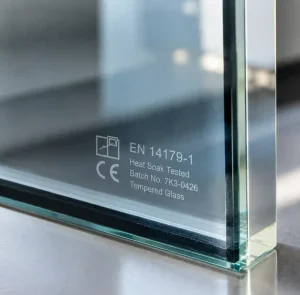
- EN 12150 (European tempered glass)
- AS/NZS 2208 (Australian/New Zealand safety glazing)
- ANSI Z97.1 (American glazing standard)
- CE marking for European market compliance
- ISO 9001:2015 quality management
- ISO 14001 environmental management
These aren’t decorative certificates. Every shipment to Europe requires CE documentation. Middle East projects demand SASO certification. Certification requirements vary by destination market.

Third-party verification matters. We work with SGS, Intertek, and TÜV for pre-shipment inspections. Inspectors measure glass thickness, verify coating performance, and conduct visual quality checks. This costs 0.3-0.5% of order value but catches defects before shipping.
Lead Time Reality: What to Actually Expect
Marketing promises “fast delivery.” Here’s what that means when your project has a fixed installation date:
| Order Phase | Timeline | What’s Happening |
|---|---|---|
| Sample & Approval | 5-7 days | Physical sample production and shipping |
| Production Slot | 3-5 days | Scheduling raw glass procurement |
| Fabrication | 15-25 days | Cutting, processing, quality inspection |
| Packaging & Loading | 2-3 days | Wooden crate construction, container loading |
| Ocean Freight | 20-35 days | Port to port (varies by destination) |
| Customs Clearance | 3-7 days | Import documentation, duties, inspections |
| Total Lead Time | 48-82 days | Typical range for architectural glass |
Standard tempered glass and laminated panels ship in 20-25 days post-approval. Complex specifications—curved glass, custom digital printing, or specialty coatings—add 5-10 days.

Ocean freight is the wildcard. Shanghai to Los Angeles runs 18-22 days normally, but buffer 30 days minimum. Europe-bound shipments take 25-35 days. Middle East destinations like Dubai move faster at 15-20 days.
What slows projects:
- Incomplete specifications: “Clear tempered glass” isn’t enough. We need thickness, edge work, hole locations, and quality grade.
- Sample iteration: Each revision adds 7-10 days.
- Payment delays: Production doesn’t start until deposit clears.
- Peak season: Chinese New Year and Golden Week shut factories 7-15 days.
Cost Comparison: Where China Wins (and Loses)
China’s pricing advantage is real but narrowing. Here’s the breakdown:
| Cost Factor | China | USA | Europe |
|---|---|---|---|
| Raw Float Glass (per ㎡) | Baseline | +15-25% | +30-45% |
| Labor (per ㎡ processed) | Baseline | +120-150% | +180-220% |
| Energy (per ㎡ tempered) | Baseline | +25-35% | +50-70% |
| Total Production Cost | Baseline | +40-55% | +65-85% |
Material costs in China run 10% below U.S. levels and 40% below European pricing. Tempering a 3,000mm × 2,400mm panel costs $45-55 in labor at our facility versus $110-135 in the U.S.

Total landed cost shows 20-35% savings even with freight, insurance, and duties. A 20-foot container holds 850-1,000㎡ of glass. Shipping from Shenzhen to LA costs $1,800-2,200—cheaper than cross-country U.S. truck freight ($2,800-3,500).
Where China loses advantage:
- Small orders under 200㎡: Container shipping favors local suppliers
- Rapid response projects: 25% premium for 2-week domestic beats 60-day China import
- High-touch custom projects requiring multiple jobsite visits
Logistics and Shipping: Getting Glass from Factory to Jobsite
Export packaging evolved significantly. Professional export packaging includes:
- Wooden crate construction using heat-treated ISPM-15 lumber
- Moisture-resistant paper interleaving between glass lites
- Foam edge protection and steel banding
- Silica gel desiccant packets inside sealed crates
At Zhongbo Glass, we engineer crates for specific dimensions and destination climate. Crate construction adds $180-350 per container but reduces breakage from 8-12% to under 1.5%.
Shipping terms:
- FOB (Free on Board): Supplier delivers to port. You handle ocean freight.
- CIF (Cost, Insurance, Freight): Supplier covers shipping to your port. You handle customs.
- DDP (Delivered Duty Paid): Supplier handles everything including customs.
We recommend CIF for first-time imports—the supplier arranges ocean freight, but you control customs clearance with your broker.
Quality Control: Inspection Points That Prevent Problems
Here’s what actual quality control looks like:
In-process inspection at our facility:
- Raw glass incoming inspection: Check for seeds, scratches, dimensional accuracy within ±2mm
- Post-cutting verification: Automated scanning confirms dimensions
- Pre-tempering examination: Visual inspection for edge quality
- Post-tempering certification: Fragmentation test (minimum 40 particles per 50mm × 50mm)
- Lamination quality: Autoclave monitoring, edge seal inspection
- Final QC: 100% visual inspection under bright light

Third-party pre-shipment inspection adds verification. SGS or Bureau Veritas inspectors spend 4-6 hours checking random samples (10-15% of order). They verify dimensions, edge quality, coating uniformity, and packaging. Inspection costs $600-1,200 but catches issues before shipping.
Working with Chinese Glass Manufacturers: Practical Advice
After 18 years supplying glass to international projects, here’s what makes partnerships succeed.
Red flags:
- Can’t provide current certifications or test reports
- No quality control department visible during factory tour
- Prices 20%+ below market averages
- No English-speaking technical staff
- Limited international project experience
Green flags:
- Active certifications for target markets (CE, ANSI, etc.)
- Documented quality management with inspection records
- Technical staff who ask clarifying questions
- Transparent itemized pricing
- References from completed international projects

Request factory video tours before large orders. Look for organized production floor, modern equipment (installed within last 10 years), testing equipment, and clean storage areas. At Zhongbo Glass, we conduct monthly video tours for prospective clients. Our project case studies show completed installations—from shopping malls to hotels.
FAQ
How long does it take to get architectural glass from China?
Standard lead time is 48-82 days total, including 20-25 days production, 20-35 days ocean freight, and 3-7 days customs clearance. Rush orders run 15-18 days production with premium charges, but total delivery still requires 35-55 days minimum.
Is Chinese glass quality comparable to European or American manufacturers?
Top-tier Chinese manufacturers maintain the same international certifications (EN, ANSI, AS/NZS) as Western suppliers. Quality depends more on individual supplier standards than country of origin. Verify certifications, request test reports, and use third-party pre-shipment inspection.
What certifications should Chinese glass suppliers have?
For export markets: CCC (China mandatory), ISO 9001 (quality management), plus destination-specific standards like CE (Europe), ANSI Z97.1 (USA), AS/NZS 2208 (Australia), or SASO (Saudi Arabia). Architectural projects typically require certification documentation before approval.
Can Chinese manufacturers handle custom specifications?
Yes, but complexity affects lead time and cost. Standard products (clear tempered, Low-E IGUs) ship in 20-25 days. Custom curved glass, digital printing, or specialty coatings add 5-10 days and 10-25% cost premium. Provide detailed specifications and shop drawings upfront.
What’s the minimum order quantity for glass from China?
Container economics favor orders of 200㎡ minimum. Smaller orders face proportionally higher shipping costs. A 20-foot container holds 850-1,000㎡ of standard glass; 40-foot high cube holds 1,600-2,000㎡ depending on thickness and packaging.
How much cheaper is Chinese glass than domestic suppliers?
Total landed cost (including freight, duties, and insurance) typically runs 20-35% below U.S. domestic pricing and 30-45% below European suppliers. Cost advantage decreases for small orders under 200㎡ and increases for large-volume projects over 1,000㎡.
Conclusion
China’s position as the global glass manufacturing hub stems from modern production capacity, vertical integration, established export infrastructure, and competitive pricing. Quality concerns from a decade ago have dissipated among export-focused suppliers maintaining international certifications and quality management systems.
Lead times remain longer than domestic sourcing, making China less suitable for rapid-response projects but highly competitive for planned construction with 90+ day horizons. Cost advantages of 20-35% hold true for orders exceeding container minimums.
For architects and contractors specifying glass for curtain walls, hotels, commercial buildings, or infrastructure projects, Chinese manufacturers like Zhongbo Glass offer proven capabilities demonstrated in thousands of completed installations worldwide. Success requires thorough supplier vetting, clear specifications, and professional quality control.
Ready to discuss your project? Contact our technical team for detailed quotations, or explore our completed projects.