Curved window glass replacement is one of architectural glazing’s most demanding challenges. Unlike flat glass cut from stock, each curved panel requires custom fabrication, specialized equipment, and precision engineering. After producing curved glass for major projects, I’ve learned that understanding the manufacturing process is essential for any replacement decision.

Why Curved Glass Costs 50-100% More Than Flat Glass
The cost premium reflects fundamental manufacturing constraints. Standard flat glass replacement runs $300-650 per window, while curved glass costs $400-1,500+ for residential applications and significantly more for commercial installations.
Hot bending requires heating panels to 600-700°C in specialized furnaces with custom steel molds. At Zhongbo Glass, our curved tempering lines handle panels up to 3660mm × 28000mm, but each radius needs a unique mold. For a single window, you’re commissioning a small production run.
| Cost Component | Flat Glass | Curved Glass | Difference |
|---|---|---|---|
| Material (per m²) | $45-80 | $45-80 | Same raw cost |
| Mold fabrication | $0 (stock) | $800-3,000 | Custom tooling |
| Furnace time | 15-20 min | 45-90 min | 3-4× longer |
| Quality control | Visual + dimension | Optical + radius verification | Additional steps |
| Rejection rate | 2-3% | 8-15% | Higher waste |
| Lead time | 3-7 days | 3-6 weeks | Template + fabrication |
Curved glass fails for reasons flat panels don’t: optical distortion at curve centers, uneven heating causing wave patterns, or radius deviation beyond ±2mm tolerance. We’ve seen 12% rejection rates in production runs despite intermediate quality checks.
Hot Bending vs. Cold Bending Process Selection
Most architectural curved glass uses hot bending, but cold bending works for gentle curves. The choice affects cost and durability.

Hot Bending: Glass heats above 550°C until it slumps over a mold, then tempers in the same cycle. Minimum radius varies by thickness—6mm glass bends to approximately 900mm radius, while 12mm requires 1,800mm minimum. These limits come from stress concentration at the apex.
Cold Bending: For radii over 3,000mm, glass manufactures flat then bends during installation using frame pressure. This eliminates mold costs (40% savings) but introduces sustained stress. We’ve seen cold-bent installations fail after 3-5 years from micro-cracks at fixing points. Hot-bent glass typically lasts 20+ years.
Critical Manufacturing Tolerances
Curved glass replacement often fails from measurement errors, not fabrication problems. Key tolerances include radius ±2mm, thickness ±0.5mm, edge straightness ≤0.3mm/m, and diagonal differential <3mm.
We use laser scanning rather than physical templates. Physical templates flex during transport, introducing 5-10mm errors on large panels. Laser point clouds capture the actual 3D opening including building settlement and frame distortion.
For insulated curved units, the curved spacer must match primary seal perfectly. Our robotic application still sees 5-8% failure rates on first attempts for tight-radius IGUs.
Laminated vs. Tempered Curved Glass Construction
The choice affects replacement cost, safety rating, and acoustic performance. Many failures occur because original specifications didn’t match application requirements.
| Property | Tempered Curved | Laminated Curved | SGP Laminated Curved |
|---|---|---|---|
| Breakage pattern | Small fragments | Remains in frame | Remains in frame |
| Post-breakage strength | Zero | Moderate | High |
| Acoustic rating (STC) | 28-32 | 35-38 | 38-42 |
| UV blocking | 0% | 99% (with PVB) | 99% |
| Cost multiplier | 1.0× | 1.4-1.6× | 2.0-2.4× |
| Maximum span unsupported | Limited | 2.5m | 4.5m |
For curved skylights or overhead glazing, codes mandate laminated construction. We produced 12mm+2.28SGP+12mm curved laminated panels for the Shanghai Qiantan Shangri-La—each spans 7,330mm with only perimeter support.

SGP interlayers cost more than PVB but provide 5× the shear strength, enabling structural curved glass. For replacements, upgrading from PVB to SGP often makes sense despite 60-80% cost increase, especially in coastal environments where salt spray degrades PVB edge seals.
When to Replace Glass Only vs. Entire Frame Assembly
Frame condition matters more for curved glass because it exerts continuous outward pressure.
Replace glass only when: Frame shows no distortion (diagonals match within 3mm), weatherstripping grooves remain intact, structural silicone bond area is clean, and glazing stops are functional.
Replace entire assembly when: Frame dimensions shifted >5mm, thermal breaks are compromised, original installation used incorrect edge clearance (<6mm for curved IGUs), repeated glass failures suggest frame-induced stress, or condensation appears between frame cavities.
I’ve investigated failures where the actual cause was frame settlement. A luxury residential tower experienced recurring curved glass cracks in identical locations. Laser scanning revealed aluminum curtain wall frames deflected 12mm over three years from building movement. Replacing glass treated symptoms—structural engineering addressed the cause.
Size Limitations in Curved Glass Manufacturing
Curved glass production faces hard physical limits. Our curved tempering furnace processes panels up to 3660mm × 28000mm, but maximum size and achievable radius interact. A 3660mm wide panel can’t bend to 1,500mm radius—stress concentration would shatter it.

Practical Size-Radius Relationships:
- 6mm glass at 1,000mm radius: maximum width 1,200mm
- 10mm glass at 1,500mm radius: maximum width 2,400mm
- 12mm glass at 2,000mm radius: maximum width 3,200mm
- 15mm glass at 2,500mm radius: maximum width 3,600mm
When replacements exceed single-panel limits, we use structural silicone joints with 15-20mm width. The Baiyun International Conference Center required curved glass fins at 8,200mm length—we segmented into three panels with precision-cut joints invisible at normal viewing distance.
Insulated Curved Glass: Seal Failure and Condensation
Curved IGU replacement often occurs from seal failure causing inter-pane condensation, not glass breakage. The curved shape stresses seals uniquely.
Curved IGUs require flexible spacer systems conforming to radius without kinking. Even with optimal materials, curved IGU seal failure runs 12-18% within 10 years versus 5-8% for flat units.
Seal Failure Indicators: Condensation cycling with temperature (early stage), permanent fogging at bottom edge (desiccant saturated), mineral deposits on internal surfaces, or audible air leakage.
Argon retention is worse—78% after 5 years in curved units versus 91% in flat units under accelerated aging. For replacements, structural silicone secondary seal outperforms polysulfide despite 30% higher cost, maintaining adhesion through thermal cycling.
Templating Process for Accurate Replacement
Templating requires 3D capture. Template error is the most common rejection cause.

We position laser scanners at three locations, capturing point clouds with 0.1mm resolution. Software stitches these into a complete 3D model showing actual radius, frame distortion, and edge profiles, feeding directly into CNC processing.
For manual templating, we use radius gauge with diagonal measurements at 15-point grid. This adds ±2mm uncertainty requiring oversized panels and field trimming. Always apply thermal correction factors: +0.012mm per degree C per meter for aluminum frames, +0.006mm for steel.
Lead Time and Production Timeline
Standard flat glass takes 3-7 days. Curved glass requires 3-6 weeks minimum, and that timeline compresses poorly.
Timeline: Template review (2-3 days) + mold fabrication if new radius (7-14 days) + glass cutting/processing (1-2 days) + bending/tempering (1 day, often 2-3 attempts) + quality inspection (2-3 days) + laminating/IGU assembly (3-5 days) + final inspection/crating (1-2 days) + shipping (5-15 days).
Rush service can compress to 2 weeks for simple single-lite panels at 40-60% cost premium. The bottleneck is mold fabrication. Some manufacturers keep molds for common radii (1,500mm, 2,000mm, 3,000mm), eliminating that delay.
For emergency replacement, we sometimes provide temporary flat glass retrofit frames while manufacturing proper curved replacement. This adds $200-400 but protects the building immediately.
Quality Control Inspection
Curved glass requires specialized inspection beyond standard glass checks. We inspect at six stages with curved-specific criteria.

Optical Distortion: We project calibrated grid patterns through curved glass at viewing distance (3-5m) and measure deviation. Acceptable: <5mm apparent displacement of 100mm grid lines. Distortion increases exponentially as radius decreases. For applications requiring visual clarity, we use annealed-then-bent rather than tempered glass.
Radius Verification: Every panel undergoes CMM or laser profiler measurement. Tolerance ±2mm across entire arc length at three points: both ends and center.
Edge Quality: Curved glass edges see higher stress. We reject shell-shaped chips >1.5mm, grinding marks >0.5mm deep, and inconsistent arrised edge radius.
Cost Reduction Without Compromising Safety
Optimize Glass Type: Not every curved window needs tempered glass. Codes require safety glazing within 18 inches of walking surfaces and in hazard locations. For second-story windows away from traffic, annealed curved glass costs 30-40% less and provides better optical quality.

Laminated Instead of Thick Monolithic: Single 12mm tempered curved and 6mm+1.52PVB+6mm tempered curved laminated cost similarly but laminated provides better acoustics (STC 35 vs. 30), UV protection, and post-breakage retention.
Standardize Radius: Using the same radius for multiple windows amortizes mold cost across panels, cutting per-panel cost by 25%.
Flexible Scheduling: Our curved furnaces run campaigns—two weeks of 1,500mm radius, then switch to 2,000mm. Flexible-schedule orders get 15-20% discount by avoiding changeover charges.
Common Failure Modes and Prevention
Curved glass fails through mechanisms that don’t affect flat glass.
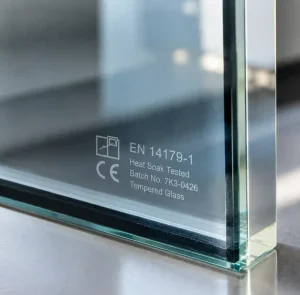
Nickel Sulfide Inclusions: Tempered glass can contain microscopic nickel sulfide particles that expand over time, causing spontaneous breakage. Curved tempered glass is more susceptible because bending stresses add to tempering stresses. We recommend heat-soak testing (EN 14179-1) for all curved tempered panels over 2m², eliminating 95% of NiS risk. Cost: approximately $15-25/m² additional.
Thermal Stress Breakage: Curved glass with partial shading—window film, blinds, facade overhangs—develops thermal gradients exceeding 40°C between shaded and exposed areas. This causes edge cracks at fixing points. Prevention requires heat-strengthened rather than tempered glass, which tolerates 2× the thermal differential.
Installation Edge Damage: Curved glass edges are more vulnerable because frame pressure concentrates at discrete points. Installers unfamiliar with curved glass often overtighten setting blocks, causing immediate or delayed edge cracks. Proper installation uses continuous neoprene setting blocks with 3mm glass clearance minimum, Shore A hardness 60-70.
Curved Glass in Energy-Efficient Windows
Curved IGU replacement offers opportunities to upgrade thermal performance, though geometry limits some technologies.

Standard flat Low-E coated glass achieves U-values of 1.1-1.4 W/m²K. Curved Low-E typically measures 1.3-1.6 W/m²K for equivalent construction due to coating uniformity challenges during bending and increased thermal bridging.
Our Low-E coating lines process curved glass up to 3,300mm × 28000mm, applying soft-coat Low-E before bending. We achieve SHGC of 0.28-0.35 and VLT of 60-70% on curved Low-E glass.
Triple Glazing: Triple-glazed curved IGUs push manufacturing limits. The Yabuli Forum project used 5mm+12A+15mm+12A+15mm curved triple-glazed units achieving U-value of 0.82 W/m²K at -40°C ambient. These weighed 85 kg/m² and required structural frame calculations.
For most replacements, double-glazed curved Low-E is recommended over triple-glazed, accepting slightly higher U-value for 40% weight reduction and 30% cost savings.
FAQ
How long does curved window glass replacement take from order to installation?
Expect 3-6 weeks for standard curved glass replacement. This includes template approval (2-3 days), mold fabrication if needed (7-14 days), glass fabrication (3-5 days), quality inspection (2-3 days), and shipping (5-15 days). Rush service can reduce this to 2 weeks for simple panels at 40-60% cost premium. Complex curved IGUs or laminated units require the full timeline.
Can curved glass be cut or modified after tempering?
No. Once curved glass is tempered, any cutting, drilling, or edge modification will cause immediate shattering. All holes, cutouts, and edge work must be completed before the bending and tempering process. This is why accurate templating is critical—field modifications are impossible.
What causes fog between panes in curved insulated glass units?
Fog indicates seal failure allowing moisture into the airspace between glass layers. Curved IGU seals experience higher stress than flat units due to the radius, leading to 12-18% failure rate within 10 years versus 5-8% for flat units. Primary seal failure typically occurs first, followed by desiccant saturation. Replacement of the entire IGU is required—seals cannot be repaired.
Is cold bending a viable alternative to hot bending for replacement windows?
Cold bending works only for gentle curves (radius >3,000mm) and introduces continuous stress into the glass. While it eliminates mold costs, reducing expenses by 40%+, the sustained stress can cause failure after 3-5 years. For permanent installations, hot-bent curved glass provides better long-term performance despite higher initial cost.
Why does curved glass cost so much more than flat glass?
The cost difference reflects custom mold fabrication ($800-3,000), 3-4× longer furnace time, higher rejection rates (8-15% vs. 2-3%), specialized quality control, and extended lead times. You’re essentially commissioning a small production run rather than cutting from stock. For single residential windows, expect 50-100% premium over flat glass; for large commercial panels, the premium can reach 150-200%.
Can I replace curved laminated glass with just tempered glass to save money?
Building codes determine this, not cost preference. Overhead glazing, glass within 18 inches of walking surfaces, and other hazardous locations require laminated construction regardless of temper. For non-code-required locations, switching from laminated to tempered saves 40-60% but eliminates post-breakage strength, acoustic benefits, and UV protection. Verify code requirements before specifying.
Conclusion
Curved window glass replacement demands expertise that goes well beyond standard flat glass installation. The manufacturing process—whether hot bending or cold bending—introduces variables that affect cost, lead time, and long-term performance. Understanding these technical realities helps property owners and architects make informed decisions rather than simply accepting quotes.
The cost premium for curved glass reflects genuine manufacturing constraints: custom tooling, specialized furnaces, extended production time, and higher rejection rates. These aren’t negotiable inefficiencies but inherent aspects of producing curved glass that meets architectural standards and building codes.
For successful replacement projects, invest time in accurate templating, specify appropriate glass construction for the application, and work with manufacturers experienced in curved glass production. The difference between a curved glass replacement that lasts 20+ years and one that fails within 5 years often comes down to these details. At Zhongbo Glass, our curved tempering lines and 4.2m × 28m autoclave allow us to produce curved glass at scales few manufacturers can match, but even with advanced equipment, the fundamental physics of curved glass manufacturing still dictate realistic timelines and costs.