Architects and designers constantly need distinctive facades that stand out while meeting performance requirements. Traditional methods like ceramic fritting limit design flexibility and carry high setup costs for custom patterns. Digital ceramic printing delivers unlimited design freedom, photographic-quality imagery, and fast turnaround – exactly what conventional methods can’t offer. This guide covers digital printing from a manufacturer’s perspective: ceramic ink technology, resolution, durability, design workflow, cost factors, and real-world facade applications.

What Is Digital Printing on Architectural Glass?
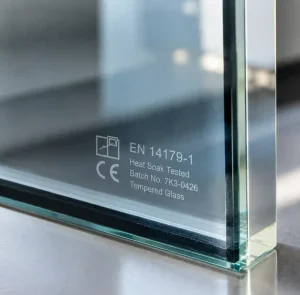
Digital printing uses specialized inkjet technology to apply ceramic inks directly onto glass before tempering. The ceramic particles fuse permanently during tempering at over 650°C, becoming integral to the glass rather than a surface coating. Unlike vinyl films that degrade over time, digitally printed ceramic inks cannot peel, fade, or wear under UV exposure or cleaning. You can use digital printed glass for both exteriors and interiors where durability is critical. The technology works with clear, low-iron, tinted, and coated glass. After printing, the glass is tempered to meet safety standards (ASTM C1048 or EN 12150), and you can also laminate it with PVB or SGP interlayers for enhanced safety.

Ceramic Ink Technology and Durability
Ceramic inks consist of finely ground glass frits (1-5 microns) mixed with metallic oxides for color, plus organic binders that burn off during tempering. When heated to 650-680°C, the frit melts and fuses with the glass, permanently embedding the pigments.
We’ve tested all our ceramic ink formulations with 1000 hours of QUV exposure (equivalent to 5-7 years outdoors) – zero color shift. Abrasion testing per ASTM D4060 shows no wear after 1000 cycles. The key advantage is permanence: ceramic pigments are inorganic and remain stable indefinitely. We have 15-year-old printed facades in harsh Middle East climates still showing original color. The inks also survive autoclave lamination at 140°C and 12 bar, making them suitable for laminated glass assemblies.

Design Possibilities and Resolution Capabilities
Digital printing eliminates the constraints of screen printing. You can reproduce photographic images, gradient fades, complex patterns, and custom artwork at up to 720 DPI – more than enough for architectural viewing distances. Our printing lines handle panels up to 3300mm × 28000mm, enabling floor-to-ceiling printed facades without interruption. Print heads apply up to 8 gray levels per pixel, creating smooth gradients impossible with screen printing.
Design flexibility includes photographic reproduction, custom geometric or organic patterns, gradient effects, sharp text, and expanded color mixing (CMYK-equivalent). You can also vary dot density for solar control: patterns with 10-60% coverage reduce solar heat gain while maintaining outward visibility – the human eye sees uniform tinting beyond 3 meters. Registration accuracy is ±0.5mm across panel width, enabling continuous images spanning multiple panels. Color matching follows RAL or Pantone, though substrate affects appearance – we always provide physical samples for color-critical projects.

Digital Printing vs Traditional Screen Printing
Screen printing has been the workhorse, but digital changes the economics. Here’s the real comparison:
| Factor | Digital Printing | Screen Printing |
|---|---|---|
| Setup Cost | None – direct from digital file | $3,000–$8,000 per screen |
| Minimum Quantity | 1 panel economical | 200+ sqm for cost efficiency |
| Lead Time | 7–10 days | 4–6 weeks (includes screen making) |
| Design Changes | Instant – just update file | New screens required |
| Pattern Complexity | Unlimited detail and colors | Limited to screen count |
| Color Accuracy | ±ΔE 2.0 | ±ΔE 3.0–5.0 |
| Gradient Capability | Smooth photographic quality | Step patterns only |
| Registration Tolerance | ±0.5mm | ±2.0mm |
| Max Panel Size | 3300mm × 28000mm | Equipment-dependent |
| Cost per sqm (100 sqm) | $45–$85 | $35–$65 |
| Cost per sqm (500+ sqm) | $40–$75 | $28–$45 |
Screen printing wins on cost for large volumes of simple, repeat patterns (1000+ sqm). But for custom designs, small quantities, or fast-track projects, digital printing is unbeatable – you can approve a design and start production within days. The crossover is around 200-300 sqm for simple patterns; for complex designs needing 8+ colors, digital is often cheaper even at higher volumes.

Manufacturing Process and Technical Specifications
Our production workflow: file preparation → glass cleaning → digital printing → drying (80-120°C) → automated optical inspection → tempering (680°C) → final inspection. Tempering is critical because printed areas absorb more heat, requiring precise control to avoid optical distortion.
Key technical specs at Zhongbo Glass:
| Parameter | Specification |
|---|---|
| Max panel size | 3300mm × 28000mm |
| Min panel size | 300mm × 600mm |
| Glass thickness | 5mm – 19mm |
| Print resolution | 360–720 DPI |
| Color options | CMYK + White + Custom |
| Ink coverage | 5% – 100% |
| Production capacity | 500 sqm per day |
| Lead time | 7–10 working days |
| Glass types | Clear, low-iron, tinted, coated |
Color limitations exist – bright oranges, purples, and neons are hard to achieve with ceramic inks. Blues, blacks, whites, earth tones, and grays give the most consistent results. We always recommend physical sample approval for color-critical projects. For facades, print on surface 2 (interior face of exterior lite) to protect the pattern, though properly fused ceramics are weather-resistant. For insulated glass units, printing on surface 2 or 3 maintains thermal performance.

Facade and Interior Applications
For curtain wall glass, digital printing combines aesthetics with solar control. By varying dot density, you create graduated shading that cuts cooling loads while preserving views. A 40% coverage on clear glass drops SHGC from 0.82 to about 0.50; combined with Low-E coatings, you can achieve SHGC below 0.30 with VLT above 50%. Performance considerations: wind load capacity same as unprinted tempered glass; thermal stress risk increases with dark coverage – specify heat-soak testing for large panels. For bird strike mitigation, digital printing allows custom patterns with elements spaced 50mm × 100mm to reduce collisions by 90%+. Privacy screening uses gradient density – higher at eye level, lower above and below.
Interior applications include partitions with custom branding, wayfinding graphics directly on glass, artistic installations, shower enclosures, and backsplashes. Ceramic prints are permanent, hygienic, and easy to clean – perfect for high-traffic areas.

Design Workflow and File Requirements
For success, prepare files properly: vector files (AI, EPS, PDF) are preferred for patterns and text; raster images (TIFF or high-res PNG) at 300 DPI minimum for photos. Use CMYK or spot colors; provide 10mm bleeds. For multi-panel installations, include registration marks or a numbering system. Mock-ups are critical – we recommend physical approval for projects over 200 sqm or where color accuracy matters. Pattern scale can surprise – check with human figures in renderings. View-through depends on density and lighting; daytime views through 40% coverage appear clear, but nighttime reverses the effect.
Cost Factors and Project Economics
Cost drivers: panel size, glass thickness, pattern coverage, color count, substrate, special processing (heat-soak, lamination), and quantity. Typical pricing for digital printed facade glass is $65–$120 per sqm, including glass, printing, tempering, and QC – a 40-80% premium over standard tempered glass. Small quantities have higher per-unit cost, but digital avoids screen setup fees. For a 300 sqm project, a simple 2-color pattern might cost $70/sqm digitally vs $45/sqm screen-printed; a complex photographic design costs $95/sqm digitally and is infeasible with screen printing. Lead time is 7-10 days vs 4-6 weeks – a big advantage for fast-track jobs. Solar control printing can save $8–$15 per sqm annually in cooling costs, giving a 3-5 year payback on the material premium.

Engineering Case Study: Luoyang Peony Square
Our Luoyang Peony Square project featured a massive photographic peony pattern on 380 sqm of curtain wall glass, with panels up to 2800mm × 3200mm. Variable density (25-85%) created a three-dimensional effect with custom red, pink, and green colors. The challenge was photographic realism at architectural scale – smooth gradients and fine detail. We processed ultra-high-res files and created a detailed panel map for seamless pattern alignment across 42 panels. The result showcases digital printing’s ability to bring cultural expression to glass, with permanent ceramic inks ensuring long-term durability.
FAQ
How long does digitally printed ceramic glass last before fading?
Ceramic inks fused during tempering are permanent – they will not fade. We have 15-year-old installations with zero color change. Unlike organic inks, ceramic pigments are inorganic and stable indefinitely under UV. The glass itself will outlast the building.
Can digital printing achieve the same opacity as solid ceramic frit?
Yes, 100% coverage creates complete opacity identical to screen-printed frit. However, achieving uniform solid coverage requires more passes and higher ink loading, increasing cost. For full opacity, compare economics with solid frit or paint.
What is the maximum panel size for digital printing?
Our equipment handles up to 3300mm × 28000mm. Practical limits depend on tempering – our largest tempering line is 3660mm × 28000mm. For most facades, practical max is 3200mm × 6000mm considering wind load and handling.
Does printing affect glass strength or safety performance?
No. After tempering, printed glass meets the same safety requirements as unprinted tempered glass (ASTM C1048 or EN 12150). The ceramic layer is microns thick and does not affect structural properties.
Can you print on Low-E coated glass?
Yes, but print on the opposite surface from the coating (typically surface 2 for single-pane or surface 3 for insulated units). Printing directly on Low-E can damage the coating. Consult us for compatibility with specific coatings.
Conclusion
Digital printing turns architectural glass into a medium for custom design, brand expression, and solar control. It delivers photographic quality, unlimited flexibility, and fast turnaround without the setup costs of screen printing. Ceramic inks fused during tempering create permanent patterns that resist fading and wear. For architects, this enables custom facades and interior features that were previously impossible or too costly. Understand density, color limitations, and panel size – and always get physical samples. If you need custom digital printed glass for your project, contact us for capabilities, mock-ups, and technical support.