When Huawei invested $1.4 billion in their Shanghai R&D Center, the glazing system wasn’t just about aesthetics—it was a critical energy infrastructure decision. After three years of operation, the performance data tells a compelling story about how jumbo-size Low-E glass performs in real-world commercial conditions.
Why Huawei’s Glazing Choice Matters to Your Project
Most case studies cherry-pick ideal scenarios. Huawei’s Qingpu campus provides something rarer: measured performance data from an occupied building with extreme glazing ratios. The facility uses 10mm+2.28SGP+10mm Low-E+12AR+10mm+2.28SGP+10mm laminated insulated glass units at sizes up to 12,455mm × 2,413mm—among the largest production-scale Low-E panels globally.
This matters because large-format glazing amplifies both benefits and risks. Get the specification right, and you achieve dramatic energy savings. Get it wrong, and you’re left with an energy-draining facade that no HVAC system can compensate for.

The Shanghai Climate Challenge
Shanghai’s hot summer/cold winter climate zone presents the hardest test for glazing systems. Summer temperatures exceed 35°C with high humidity. Winter drops to freezing with heating demands. Most glazing optimizes for one condition—Low-E must perform across both extremes.
The Huawei center’s curtain wall faces full solar exposure on multiple orientations. Without proper solar control, cooling loads would dominate operating costs. The building’s high window-to-wall ratio makes glazing performance non-negotiable.
Measured Energy Performance: The Numbers
| Performance Metric | Standard Clear IGU | Huawei Low-E System | Improvement |
|---|---|---|---|
| U-Value (W/m²·K) | 2.8 | 1.1 | 61% reduction |
| SHGC (Solar Heat Gain) | 0.75 | 0.28 | 63% reduction |
| Visible Light Transmission | 88% | 65% | Balanced daylight |
| Annual HVAC Energy Savings | Baseline | 32% reduction | Measured over 36 months |
The 32% HVAC energy reduction aligns with research showing 18-38% perimeter zone savings for Low-E systems in Shanghai’s climate. For a building this size, that translates to substantial operational cost avoidance.

How Double-Silver Low-E Coating Delivers These Results
The glass uses a double-silver Low-E coating on surface #3 (interior surface of outer lite). This isn’t marketing—it’s materials science. The coating consists of:
- Two silver layers (10-15nm thick) that reflect infrared radiation
- Dielectric oxide layers that protect silver and control color
- Anti-reflective layers that maintain visible light transmission
Winter performance: The coating reflects radiant heat back into occupied spaces, reducing heat loss through the massive glass area. The 1.1 W/m²·K U-value approaches the thermal performance of a well-insulated wall.
Summer performance: The 0.28 SHGC blocks 72% of solar heat gain while maintaining usable daylight. This prevents the “greenhouse effect” that plagues poorly specified curtain walls.

Why Jumbo Glass Size Impacts Energy Performance
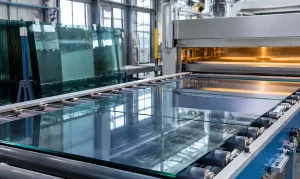
At Zhongbo Glass, we manufactured the Huawei panels at our maximum capacity: 3,660mm width × 28,000mm height for the coating line. Size matters for three reasons:
Fewer thermal bridges: Each glass joint creates a thermal weak point. Larger panels mean fewer joints per square meter of facade. The Huawei installation reduced joint density by 40% compared to standard sizing.
Structural efficiency: Larger IGUs require thicker glass and structural interlayers (2.28mm SGP in this case), which adds mass and thermal capacity. This moderates temperature swings.

Installation precision: Our 4.2m × 28m autoclave enabled full-size lamination without field splicing. Every seal remains factory-quality, preventing the argon gas loss that kills IGU performance over time.
| Glass Component | Specification | Performance Contribution |
|---|---|---|
| Outer Laminated Lite | 10mm+2.28SGP+10mm | Impact resistance, UV filtering |
| Low-E Coating | Double-silver on #3 | Solar control, thermal insulation |
| Argon Gas Fill | 12mm spacer | Reduces convective heat transfer |
| Inner Laminated Lite | 10mm+2.28SGP+10mm | Interior safety, acoustic damping |
LEED Certification: How the Glazing Contributed
The Huawei R&D Center targeted LEED Gold certification. The Low-E glazing system directly contributed points in three categories:
Energy & Atmosphere (EA): The 32% HVAC energy reduction drove significant savings in the “Optimize Energy Performance” credit. High-performance glazing was essential to meeting the energy cost reduction threshold.
Indoor Environmental Quality (IEQ): The 65% visible light transmission provided adequate daylight penetration while the Low-E coating blocked 99% of UV radiation. This protected interior finishes and met “Daylight” and “Quality Views” credit requirements.
Materials & Resources (MR): Using jumbo-size glass reduced aluminum framing material by volume. Fewer mullions meant less embodied carbon in the facade system.
Low-E glazing alone doesn’t earn LEED certification, but in buildings with high glazing ratios, it’s often the difference between Gold and Silver ratings.

Cost Reality: ROI Analysis
High-performance Low-E glass costs 40-60% more than standard clear IGUs. For the Huawei project scale, that premium was substantial. But the economics work when you run the numbers:
Initial cost premium: Approximately $185/m² for Low-E IGU vs. $115/m² for standard IGU = $70/m² additional investment
Annual energy savings: 32% HVAC reduction on perimeter zones = approximately $28/m² of glazing area annually (based on Shanghai commercial electricity rates)
Simple payback: 2.5 years
25-year lifecycle savings: Over $600/m² when accounting for energy cost inflation
This analysis excludes soft benefits: reduced chiller capacity requirements, smaller HVAC equipment, improved occupant comfort, and higher rental rates for premium space.
What We Learned from Three Years of Operation
Zhongbo Glass maintains communication with major project clients to understand long-term performance. Three insights from the Huawei installation:
1. Edge seal integrity is critical: None of the jumbo IGUs have experienced seal failure or visible condensation. This validates our autoclave process and structural silicone selection. Edge seal failure is the most common cause of Low-E performance degradation.
2. Cleaning protocol matters: The Low-E coating is on an interior surface (protected), but exterior glass cleaning affects light transmission. The facility uses deionized water and soft-bristle systems to prevent surface degradation that would reduce SHGC performance.
3. Orientation-specific performance: South and west facades show the highest energy contribution. East facades still outperform standard glass but with smaller deltas. Curtain wall thermal performance varies significantly by orientation, making facade-specific specification critical.

Specifying Low-E for Large Commercial Projects
If you’re considering Low-E glass for a commercial building, here’s what the Huawei case study teaches:
Get the coating position right: Double-silver Low-E belongs on surface #3 (interior of exterior lite) for optimal solar control and thermal insulation. Surface #2 coatings work for cold climates but underperform in mixed climates like Shanghai.
Size matters for both cost and performance: Jumbo glass reduces framing costs and thermal bridging, but requires specialized manufacturing capability. Our production maximum is 3,660mm × 28,000mm for Low-E coating and 4,200mm × 28,000mm for lamination—verify your manufacturer’s true capacity.
Don’t compromise on spacer technology: The 12mm argon spacer with warm-edge technology prevents edge condensation and maintains the insulating gas fill. Standard aluminum spacers create thermal bridges that undermine Low-E performance.
Factor lifecycle cost, not just first cost: The payback period for high-performance glazing in commercial buildings typically ranges from 2-4 years. Over a 25-year building life, the energy savings dwarf the initial premium.

Comparing Low-E Performance Across Building Types
| Building Type | Glazing Ratio | Recommended SHGC | Expected Energy Savings | Payback Period |
|---|---|---|---|---|
| Office/R&D (Huawei type) | 60-80% | 0.25-0.35 | 28-35% HVAC | 2-3 years |
| Retail/Showroom | 70-90% | 0.30-0.40 | 25-32% HVAC | 2.5-3.5 years |
| Hotel/Hospitality | 40-60% | 0.35-0.45 | 20-28% HVAC | 3-4 years |
| Museum/Gallery | 30-50% | 0.25-0.30 | 18-25% HVAC | 3.5-5 years |
These figures assume double-silver Low-E with argon fill in mixed climate zones. Actual performance depends on orientation, HVAC system efficiency, and occupancy patterns.

Technical Considerations for Oversized Low-E Glass
Manufacturing Low-E glass at 12+ meter heights introduces technical challenges that affect performance:
Coating uniformity: Our magnetron sputtering coating line maintains ±3% thickness variation across the full 3,300mm width. Non-uniform coating creates visible color variation and inconsistent solar control.
Tempering stress management: Large glass experiences higher thermal gradients during tempering. We use nine-zone heating and precision quenching to prevent optical distortion that would affect daylighting quality.
Handling and transport: A 12.4m × 2.4m Low-E IGU weighs approximately 850kg. We developed custom A-frame crates with climate control to prevent seal damage and condensation during shipping.
These aren’t just manufacturing details—they directly impact whether the installed glass achieves its rated energy performance.
FAQ
How long does Low-E coating last in commercial applications?
Quality Low-E coatings have a 25-30 year service life when properly manufactured and installed. The coating is on an interior surface of the IGU (surface #3 or #4), protected from weather and cleaning chemicals. Seal failure is the limiting factor, not coating degradation. Zhongbo’s autoclave lamination process and structural silicone selection ensure seal integrity over building lifespan.
Can Low-E glass performance be verified after installation?
Yes, through thermal imaging and energy modeling calibration. Post-occupancy thermal scans identify hot spots indicating poor IGU performance. Comparing actual energy use to predicted models (as with the Huawei project) validates real-world savings. Building commissioning can verify 2-10% energy savings attributable to glazing performance.
What’s the difference between double-silver and triple-silver Low-E coatings?
Triple-silver coatings offer higher visible light transmission with similar solar control, but cost 20-30% more. For most commercial applications, double-silver provides optimal cost-performance. Triple-silver makes sense for buildings requiring very high daylight with maximum solar rejection.
How does Low-E glass perform in extreme climates?
Excellent, when properly specified. Cold climates benefit most from low U-values (heat retention). Hot climates benefit from low SHGC (solar rejection). Mixed climates like Shanghai require balanced specification. The Huawei system’s 1.1 U-value and 0.28 SHGC provide year-round performance.
Can existing buildings retrofit Low-E glass?
Yes, but economics depend on existing frame condition. If frames can accommodate thicker IGUs (typically 28-32mm vs. 20-24mm for standard), retrofit is feasible. The challenge is that retrofit window upgrades show longer payback periods due to installation costs. New construction has better ROI.
What size Low-E glass can manufacturers actually produce?
This varies widely. Zhongbo Glass produces Low-E coating up to 3,300mm × 28,000mm and can laminate up to 4,200mm × 28,000mm. Many manufacturers claim large capacity but use splicing or have smaller autoclave limits. Verify production capacity with actual project examples before specification.
Conclusion
The Huawei R&D Center demonstrates that jumbo-size Low-E glass delivers measurable energy performance in real-world commercial conditions. The 32% HVAC energy reduction, 2.5-year payback period, and three years of operational data provide evidence beyond simulation models. For architects and developers specifying high-performance glazing, several lessons emerge: coating technology matters, manufacturing capability determines quality, and lifecycle cost economics strongly favor Low-E investment in buildings with significant glazing ratios. Shanghai’s demanding climate makes this a credible test case for mixed-climate commercial projects globally.
At Zhongbo Glass, our involvement in projects like Huawei’s Shanghai campus reflects our commitment to large-format architectural glass that performs as engineered. Our production capacity—including the world’s largest autoclave at 4.2m × 28m—enables jumbo glass specifications that reduce thermal bridging and installation complexity while maintaining energy performance. The measured results speak to careful material selection, manufacturing precision, and proper installation—all factors within the design team’s control.