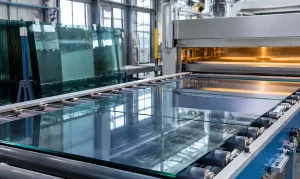
Planning a commercial glass project with Chinese suppliers requires accurate timeline forecasting. After managing over 500 international shipments for projects like the Zhangjiajie Grand Canyon Glass Bridge and Shanghai Museum East Hall, we’ve identified the critical factors that determine delivery speed: production complexity, order size, shipping method, and seasonal logistics patterns. This guide provides insider timelines based on real manufacturing data from our 8 cutting lines and 5 tempering production lines.

Production Lead Times by Glass Type
Production duration varies dramatically by glass complexity and size. Standard tempered glass orders under 1,000 square meters complete in 12-15 working days from deposit confirmation. Laminated glass requires 15-20 days due to autoclave curing cycles. Insulated glass units with Low-E coating extend to 18-25 days because coating application and IGU assembly cannot be rushed without quality compromise.
Jumbo glass panels exceeding 3 meters in any dimension add 5-10 days to standard timelines. At Zhongbo Glass, our cutting lines accommodate panels up to 4200mm × 28000mm, while our tempering furnaces handle sizes to 3660mm × 18000mm. For the Tencent Cloud Tower project, we produced 8-meter curtain wall panels on a 22-day production cycle compared to 14 days for standard 3-meter panels.
| Glass Type | Standard Size (<3m) | Large Size (3-6m) | Jumbo Size (>6m) | Key Time Factor |
|---|---|---|---|---|
| Tempered Glass | 12-15 days | 15-18 days | 20-25 days | Annealing time increases with thickness |
| Laminated Glass | 15-20 days | 18-23 days | 25-30 days | Autoclave cycle scheduling |
| Insulated Glass (IGU) | 18-25 days | 22-28 days | 28-35 days | Coating + edge sealing curing |
| Low-E Coated Glass | 16-22 days | 20-25 days | 25-32 days | Coating line availability |
| Curved Glass | 25-35 days | 30-40 days | 40-50 days | Mold fabrication + bending trials |
| Fire-Rated Glass | 20-28 days | 25-32 days | 35-45 days | Intumescent layer curing time |
Complex glass combinations multiply lead times. A project requiring curved laminated Low-E glass with digital printing takes 45-55 days because each process must occur sequentially: raw glass cutting → Low-E coating → curving → lamination → printing. You cannot parallel-process these steps.

Shipping Duration by Method and Route
Ocean freight dominates architectural glass shipping due to weight and fragility. A 40-foot high cube container from our Henan facility to Los Angeles takes 16-20 days port-to-port. East Coast destinations like New York or Miami require 30-36 days via Suez Canal or 28-32 days via Panama Canal depending on carrier routing.
European shipments to Rotterdam or Hamburg average 28-34 days. Middle East destinations (Dubai, Riyadh) clock 18-24 days. Australia receives containers in 16-22 days to Sydney or Melbourne. These are vessel transit times only—add port handling at both ends.

Express shipping options exist but carry severe cost penalties. Air freight reduces transit to 3-5 days but costs $8-15 per kilogram versus $0.08-0.15 per kg for ocean freight. For a 15-ton curtain wall glass shipment, air freight runs $120,000-225,000 compared to $3,500-5,000 ocean. We recommend air freight only for emergency replacements under 500kg or project delay penalties exceeding transport premiums.
Rail freight via China-Europe Railway Express offers a middle option at 18-22 days to European destinations, costing 30-50% more than ocean but 70-85% less than air. However, glass packaging for rail requires reinforced crating due to more frequent handling and vibration, adding $800-1,500 per container to packing costs.
| Shipping Method | Transit Time | Cost Range (per container) | Best Use Case |
|---|---|---|---|
| Ocean Freight (Asia-US West Coast) | 16-20 days | $3,500-$5,000 | Standard orders, budget-conscious projects |
| Ocean Freight (Asia-US East Coast) | 28-36 days | $4,500-$6,500 | Large volume, flexible timeline |
| Ocean Freight (Asia-Europe) | 28-34 days | $4,000-$6,000 | Standard commercial projects |
| China-Europe Rail | 18-22 days | $6,000-$9,000 | Time-sensitive European deliveries |
| Air Freight | 3-5 days | $8-$15/kg | Emergency replacements, delay penalties |
Customs Clearance and Port Handling Times
Customs clearance duration depends on documentation accuracy and destination country procedures. U.S. customs processes glass shipments in 2-5 business days when paperwork is complete and HTS codes are correct. Tempered glass enters under HTS 7007.19 at 0.9-1.8% duty, while laminated safety glass uses HTS 7007.29 at 2.5-3.9%.

European Union clearance through Rotterdam or Hamburg takes 3-7 days including CE marking verification. Middle East customs (Dubai, Jeddah) typically clear in 2-4 days but can extend to 10+ days if shipping documents lack Arabic translations or commercial invoice details mismatch packing lists.
The most common clearance delay we observe: incorrect declared glass specifications. If your commercial invoice lists “tempered glass” but customs inspection reveals laminated construction, expect 5-10 additional days for classification correction and potential penalty assessment. Work with experienced freight forwarders who understand glass product classifications.

Port handling and container release adds 1-3 days at major ports (Los Angeles, Rotterdam, Singapore) but can extend to 5-8 days at smaller regional ports with limited container handling equipment. Demurrage charges accrue after free time expires—typically 5 days in U.S. ports, 7-10 days in European ports. Budget inland transport coordination to avoid $150-300 daily demurrage fees.
Seasonal Factors Affecting Delivery Speed
Chinese New Year creates the industry’s longest disruption. Factories close 15-25 days (late January through mid-February), but the real impact spans 8-10 weeks. Production stops 2 weeks before the holiday as workers return home. Post-holiday ramp-up takes 2-3 weeks as staff returns gradually and machinery undergoes maintenance. Place orders by early December for pre-holiday delivery or expect March delivery for orders placed in January.
Peak shipping season from August through October increases ocean transit times by 3-7 days due to port congestion and vessel space constraints. Freight rates spike 40-80% during this window. The Shenzhen Conrad project experienced a 12-day delivery delay when their September container sat at Shanghai port for 8 days awaiting vessel space.

European summer vacation period (July-August) slows customs clearance and inland transport as personnel take extended leave. What normally clears in 3 days can stretch to 7-10 days. North American logistics slow during Thanksgiving through New Year (late November-early January) as warehouses prioritize consumer goods over construction materials.
Weather disruptions matter more than most buyers anticipate. Typhoon season (July-September) along China’s coast delays shipments 3-10 days when ports close for storm safety. Winter storms in Northern Europe and North America create inland transport delays even after port clearance. For the Grand Hyatt Dalian project, a January snowstorm delayed final delivery by 6 days despite the container clearing customs on schedule.
Express Production and Shipping Options
When project delays threaten penalties, express options exist but require early coordination. Rush production cutting lead times by 30-40% carries a 15-25% price premium and requires deposit payment to secure production line priority. At Zhongbo Glass, our 4,000 square meters daily cutting capacity and 2,500 square meters daily tempering capacity allow express scheduling when production lines have available gaps.
Express production works only for standard glass types. A tempered glass order can compress from 15 days to 10 days. Laminated glass might reduce from 20 days to 14 days. But curved glass cannot meaningfully accelerate because mold fabrication and bending trials require specific curing times regardless of payment.

Air freight express shipping from our facility to Los Angeles achieves 5-7 day door-to-door delivery including customs clearance, but the economics only work for orders under 2,000kg. We successfully air-shipped replacement panels for the Huawei Experience Store in Wuhan project—480kg at $6,200 total cost versus a 3-week delay that would have triggered $45,000 in contractor standby penalties.
Consolidated LCL (less than container load) shipping offers a compromise for smaller orders. Instead of waiting to fill a full container, your glass shares space with other cargo. LCL transit times run 3-6 days longer than FCL but departure frequency increases from weekly to 2-3 times weekly, potentially saving 5-10 days in departure wait time.
Project Planning: Realistic Timeline Expectations
A complete glass delivery timeline from order confirmation to job site delivery averages 45-65 days for standard commercial projects. Break this into components: production (15-25 days) + ocean freight (18-35 days) + customs clearance (3-7 days) + inland transport (2-5 days) + contingency buffer (7-10 days).
The contingency buffer is not optional. In 500+ international shipments, 68% arrived within the standard timeline, 24% faced 3-7 day delays, and 8% encountered 10+ day delays from factors like customs inspection, port congestion, or documentation issues. Projects without buffer time force expensive air freight corrections or schedule disruptions.

Large-scale projects requiring multiple container loads benefit from staggered production scheduling. The China Resources Group Headquarters Building ordered curtain wall glass in 8 shipments over 5 months rather than one massive order. This approach accommodated installation progress, managed cash flow, and reduced storage requirements at the construction site.
Submit final specifications and approved shop drawings 7-10 days before production start. Last-minute changes after production begins trigger restarts and 10-15 day delays. For Low-E glass or insulated glass units, specification changes after coating application waste completed work and restart the entire production cycle.
FAQ
How long does standard tempered glass production take?
Standard tempered glass under 3 meters in size requires 12-15 working days from deposit confirmation. Larger panels or complex specifications extend this to 18-25 days.
What’s the fastest possible delivery from China to the United States?
Express air freight achieves 5-7 days door-to-door including customs clearance, but costs $8-15 per kilogram versus $0.08-0.15/kg for ocean freight. Practical only for emergency replacements under 500kg.
When should I avoid ordering to prevent Chinese New Year delays?
Order by early December for delivery before Chinese New Year, or plan for March delivery on orders placed in January. Factory closures span late January through mid-February with 2-week pre-holiday slowdown and 3-week post-holiday ramp-up.
Can production time be shortened with rush fees?
Yes, express production reduces lead times 30-40% with a 15-25% premium, but only for standard glass types. Curved glass and specialty products have fixed curing times that cannot accelerate regardless of payment.
What causes most customs clearance delays?
Incorrect glass classification and specification mismatches between commercial invoices and actual products cause 70% of clearance delays. Work with freight forwarders experienced in architectural glass to ensure accurate HTS codes and documentation.
How much contingency time should I include in project schedules?
Include minimum 7-10 days contingency buffer beyond standard transit times. Historical data shows 32% of shipments face 3+ day delays from customs inspections, port congestion, or documentation issues.

Conclusion
Glass delivery lead times from China total 45-65 days for standard commercial projects when you account for production (15-25 days), shipping (18-35 days), customs (3-7 days), and necessary buffers. Success requires early specification finalization, seasonal awareness around Chinese New Year and peak shipping periods, and realistic contingency planning. Express options exist for emergencies but carry 3-5x cost premiums that only make economic sense when delay penalties exceed transport surcharges. Work with manufacturers like Zhongbo Glass who maintain production capacity data transparency and can provide accurate lead time forecasts based on current line loading and your specific glass requirements.