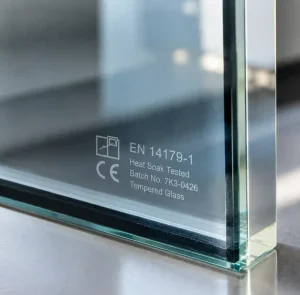
Polished edges increase glass edge strength by 40-60% compared to seamed edges and provide transparent optical clarity, essential for exposed applications like railings and shower enclosures. Seamed edges offer cost-effective processing for framed installations where edges remain concealed. Beveled edges combine decorative profile with improved stress distribution under point loading.
After processing over 4,000 square meters of glass daily through our 10 edge grinding lines, we’ve learned that edge quality directly impacts structural performance and long-term durability. Glass fractures originate at edge defects—proper edge finishing removes micro-cracks from cutting, preventing crack propagation under load.

Seamed Edges: Cost-Efficient Processing
A seamed edge (safety edge) undergoes single-pass grinding with medium-grit abrasives, removing the sharp cutting edge and creating a 1-2mm beveled profile at 45 degrees. Processing time: 30-45 seconds per linear meter.
Ideal applications:
- Tempered glass installations with edges concealed in frames
- Interior partitions with silicone-captured edges
- Spandrel panels with structural gasket glazing
- Budget projects where edges have no visual exposure

The limitation is strength predictability. Seamed edges exhibit higher strength variation because grinding depth inconsistency leaves residual stress concentrations.
Polished Edges: Optical Clarity and Maximum Strength
Polished edge processing involves progressive grinding through increasingly fine abrasives (120 → 220 → 400 grit) followed by cerium oxide polishing. The result is transparent edge with optical clarity approaching the glass face. Processing time: 3-5 minutes per linear meter.
Beyond aesthetics, polishing removes the subsurface damage zone entirely. Our microscopy analysis shows seamed edges retain micro-cracks extending 50-150 microns below the surface. Polished edges reduce this to less than 10 microns.

Critical for:
- Laminated glass balustrades with visible edges
- Shower enclosures where water contact accelerates stress corrosion
- Glass shelving and furniture with edges under constant viewing
- Facades where edge reflections affect appearance
One specification error: designers specify polished edges on glass that will be framed with concealing gaskets, adding 40-60% to edge processing costs with zero functional benefit.
Edge Finish Comparison
| Edge Type | Relative Edge Strength | Processing Time | Cost Multiplier | Optical Clarity |
|---|---|---|---|---|
| Seamed (Safety) | 1.0x baseline | 30-45 seconds | 1.0x | Translucent (frosted) |
| Polished | 1.4-1.6x | 3-5 minutes | 2.5-3.0x | Transparent |
| Flat Polished | 1.5-1.7x | 4-6 minutes | 3.0-3.5x | Transparent with 90° profile |
Beveled Edges: Functional Geometry
Beveled edges combine an angled face (typically 6-19mm wide) with polished finishing. Standard angles range from 1/2″ to 1″ width (12.7-25.4mm).
The structural advantage lies in stress distribution. A sharp 90-degree corner concentrates stress; a beveled profile distributes load across a broader area, improving performance under point loading or thermal stress.

Beveled edge applications:
- Decorative mirrors and glass tabletops
- Laminated assemblies where visual edge thickness reduction is desired
- Historical restoration matching original beveled detailing
Flat Polished Edges: The Laminated Glass Standard
Flat polished edges maintain a true 90-degree profile with full polish, differing from standard polished edges which exhibit slight rounding (0.5-1mm radius).

Why flat polished matters for laminated glass:
When laminating glass lites with interlayer material, any edge radius creates an interlayer exposure line. Flat polished edges minimize interlayer exposure, creating cleaner edge appearance and improving lamination adhesion at the perimeter where delamination is most likely.
Edge Processing Specifications
Maximum dimensions: 3660mm width × 28000mm height
Minimum thickness: 3mm (thinner glass risks breakage during handling)
Maximum thickness: 25mm for standard edges, 19mm for beveled profiles
Production capacity: 4,000 square meters per 24-hour period

Edge Profile Selection
| Application | Recommended Edge Finish | Justification |
|---|---|---|
| Framed curtain wall | Seamed | Edge strength requirements met by frame support |
| Frameless glass doors | Polished or Flat Polished | Exposed edges require optical clarity; hardware creates stress concentrations |
| Glass railings | Polished (vertical), Flat Polished (top edge) | Safety-critical requiring maximum edge strength |
| Interior partitions | Seamed (top/bottom), Polished (vertical) | Top/bottom concealed; vertical edges visible |
| Shower enclosures | Polished | Water contact accelerates stress corrosion at edge defects |
| Glass shelving | Polished or Beveled | Fully exposed edges; contact with objects creates localized stress |
The Strength-Finishing Relationship
Laboratory testing reveals edge strength increases exponentially with subsurface damage removal. A seamed edge typically fractures at 30-40 MPa edge stress. Polished edges fail at 45-65 MPa.

The critical insight: seamed edges show crack initiation from subsurface grinding damage, while polished edges fail from surface flaws (handling damage, debris impacts) occurring after processing. Polished edges shift failure mechanism from process-induced defects to post-process handling damage.
Processing Sequence
Edge finishing must occur before tempering. Once glass is tempered, edge grinding becomes impossible. The correct sequence:
- Cut to size (introduces edge micro-cracks)
- Edge grinding/polishing (removes micro-cracks)
- Washing (removes grinding residue)
- Tempering (locks in surface compression)

This creates a timing constraint: any edge damage discovered after tempering requires complete panel replacement. Our processing includes optical edge inspection after grinding and before tempering.
Cost-Benefit Analysis
Edge finishing costs range from $3-5 per linear meter (seamed) to $12-18 per linear meter (polished). For a typical 1500mm × 3000mm panel with 9 linear meters of edge perimeter, this represents $45-162 in processing costs.
Compare this to replacement costs after installation failure: a failed balustrade panel involves glass replacement ($800-1200), installation labor ($400-600), and engineering review ($1500-3000). The calculus favors appropriate edge specification for safety-critical applications.

FAQ
Can edge finishing be performed after tempering?
No. Tempering creates surface compression that prevents subsequent cutting or grinding. Edge finishing must occur before tempering.
How does edge quality affect tempered glass strength?
Tempering increases surface strength but cannot eliminate pre-existing edge defects. Micro-cracks from inadequate edge finishing become stress concentration points where fracture initiates.
What’s the minimum glass thickness for polished edges?
3mm minimum. Thinner glass risks fracture during grinding due to pressure from grinding wheels.
Do beveled edges provide structural benefits?
Yes. Beveled edges distribute stress more evenly than sharp corners, improving performance under point loading.
Conclusion
Edge finishing represents the intersection of structural performance, cost management, and aesthetic requirements. Specify seamed edges where concealment and budget drive decisions, polished edges where visibility or safety demand maximum performance, and beveled edges where architectural detailing justifies the premium.
The projects that perform best long-term match edge finishing to actual stress conditions and exposure. When edge calculations show stresses below 15 MPa with continuous frame support, seamed edges deliver adequate performance. When calculations approach 25-30 MPa or edges face environmental exposure, polishing becomes structural necessity.