Coastal construction demands glass systems that withstand corrosion rates 5-10 times higher than inland locations. At Zhongbo Glass, we’ve supplied marine-grade glazing for seaside hotels and offshore facilities, where the difference between 20-year performance and premature failure comes down to understanding how saltwater degrades glass and supporting systems.
Chloride ions in salt-laden air accelerate electrochemical degradation at rates standard specifications don’t account for. This guide explains the material science behind coastal glass durability and the configurations proven effective in aggressive marine environments.
How Saltwater Accelerates Glass System Degradation
Chloride ions penetrate protective coatings, initiate pitting corrosion in metal components, and attack laminated glass bond lines. Salt spray creates a hygroscopic film that maintains constant moisture even during dry periods, preventing the natural corrosion slowdown that occurs inland.

For Low-E glass, saltwater poses specific risks to the thin metallic layers. Silver-based Low-E coatings are vulnerable to chloride attack along exposed edges. Within 3-5 years, unprotected Low-E glass shows visible edge corrosion where the coating delaminates and salt penetrates the interface.
Modern laminated glass faces different challenges. PVB and SGP interlayers experience accelerated aging under combined UV and salt exposure. Research shows SGP interlayers, despite superior mechanical strength in dry conditions, experience significant bond strength reduction under sustained water immersion—critical for coastal facades where moisture infiltration is inevitable.
Material Degradation Rates in Marine Environments
| Component | Inland Service Life | Coastal Service Life | Primary Degradation Mechanism | Protection Strategy |
|---|---|---|---|---|
| Aluminum Frame | 30+ years | 8-15 years | Pitting corrosion, galvanic attack | Marine-grade powder coat 80μm, pre-anodized |
| Low-E Coating | 20+ years | 5-8 years | Chloride penetration, delamination | Edge protection, insulated configuration |
| PVB Interlayer | 25+ years | 15-20 years | UV + moisture degradation | Laminated + IGU, edge sealing |
| SGP Interlayer | 30+ years | 12-18 years | Bond strength loss in moisture | Enhanced edge seal, avoid direct exposure |
| Stainless Steel 304 | 20+ years | 5-10 years | Crevice corrosion, chloride pitting | Upgrade to 316 or 2205 duplex |
At Zhongbo Glass, we manufacture laminated glass up to 4200mm × 28000mm using high-pressure autoclave bonding that eliminates edge delamination pathways. Our process ensures complete PVB adhesion across the entire panel, including critical edge zones where most coastal failures originate.

Salt Spray Testing and Marine Standards
ISO 9227:2022 defines the international standard for salt spray corrosion testing, with Amendment 1 (2024) providing updated guidance. However, salt spray testing has recognized limitations—it should serve as one evaluation component, not the sole criterion.
The neutral salt spray (NSS) test exposes materials to 5% sodium chloride solution at 35°C for 240-1000 hours. While this accelerates corrosion, it doesn’t replicate wet-dry cycling, UV exposure, and temperature fluctuations in actual coastal installations. Materials can pass 1000-hour tests yet fail within five years of real exposure.
Environmental classification systems like DSS-E assess how moisture cycling, wind-driven abrasion, and runoff characteristics affect glass performance. These systems consider building orientation, local climate, and maintenance access—factors determining whether salt deposits wash away or continuously accumulate.
For coastal projects, we specify materials with demonstrated field performance. Our hardware selections favor 2205 duplex stainless steel (22% chromium, 5% nickel), providing corrosion resistance superior to 304 or 316 stainless. Testing shows 2205 maintains integrity through 3000+ hours salt spray exposure without pitting—equivalent to 15-20 years severe coastal exposure.
Glass Type Selection for Marine Applications
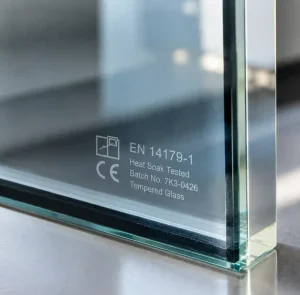
Tempered glass forms the foundation of coastal glazing systems because tempering creates compressive surface stress that resists impact damage and surface etching from saltwater. At Zhongbo Glass, we produce tempered glass up to 3660mm × 28000mm using five flat and curved tempering lines. Thermal strengthening improves thermal shock resistance from 40°C (annealed) to 200°C (tempered)—important where glass experiences rapid temperature swings between sun exposure and sudden rain cooling.
Laminated tempered glass provides fragment retention critical in hurricane-prone coastal regions. When windborne debris impacts single-pane tempered glass, it shatters completely. Laminated construction bonds two tempered plies with PVB or SGP interlayer, so fragments remain attached after fracture. For coastal applications, we recommend modern PVB formulations over SGP—recent research shows PVB maintains superior bond strength under sustained moisture exposure.
Low-E insulated glass units require special consideration because the coating must be protected from direct salt exposure. Surface #2 (exterior pane, interior surface) or #3 (interior pane, exterior surface) placements position the coating within the sealed airspace, preventing chloride contact. Surface #1 placements expose the coating to direct salt spray and should be avoided in severe marine environments.
Recommended Glass Configurations by Coastal Exposure
| Exposure Zone | Distance from Shore | Glass Configuration | Maximum Size (Zhongbo) | Key Features |
|---|---|---|---|---|
| Mild Coastal | 1-3 km inland | 8mm tempered + 16mm air + 6mm Low-E | 3660mm × 18000mm | Surface #2 Low-E, marine sealant |
| Moderate | 100m – 1km | 10mm+1.52PVB+8mm + 16mm + 6mm | 3660mm × 18000mm | Laminated exterior, enhanced edge seal |
| Severe Coastal | <100m, direct exposure | 10mm+1.52PVB+10mm (both panes) | 4200mm × 18000mm | Fully laminated IGU, 2205 hardware |
| Marine Structures | Piers, offshore | 12mm+2.28PVB+12mm+2.28PVB+12mm | 3660mm × 18000mm | Triple-laminated monolithic |
The smooth surface of properly manufactured glass provides inherent salt resistance—salt crystals have difficulty adhering to molecularly smooth surfaces. This makes cleaning easier and prevents salt accumulation that concentrates corrosive attack. However, glass edges must be properly sealed; exposed laminated edges act as wicks drawing moisture into the interlayer bond line.

Hardware and Frame System Requirements
The most meticulously specified glass will fail prematurely if mounted in inadequate hardware. Coastal installations demand marine-grade components throughout, and cost-cutting on frame elements guarantees expensive replacements within a decade.
Aluminum framing must receive marine-grade powder coating between 60-80 microns thickness—substantially thicker than 40-60 micron coatings for inland projects. Pre-anodize the aluminum substrate before powder coating to create a ceramic-like aluminum oxide layer providing secondary corrosion protection. This two-layer system extends frame life from 8-10 years (standard coat) to 25+ years in direct coastal exposure.
Stainless steel hardware selection matters more than specifiers realize. Type 304 stainless contains insufficient chromium (18%) and nickel (8%) to resist sustained chloride attack. Within 3-5 years, 304 stainless fasteners develop crevice corrosion and pitting. Type 316 stainless adds molybdenum for improved resistance, suitable for moderate coastal exposure up to 500m from shore. For severe exposure, 2205 duplex stainless provides corrosion resistance an order of magnitude better than 304, with yield strength 50% higher than 316.
Structural silicone requires marine-grade formulations with enhanced UV stabilizers designed for salt exposure. Standard architectural silicones lose 30-40% adhesion strength after 5-7 years of coastal exposure. Marine-grade formulations maintain >80% initial strength after 15+ years, though they cost 40-50% more—a premium that eliminates costly reglazing operations.
Maintenance and Protection Strategies
Even properly specified coastal glass systems require proactive maintenance. Salt deposits should be removed monthly in severe exposure zones, quarterly in moderate zones. Use deionized water for final rinse—tap water contains minerals that create nucleation sites for salt crystal formation.

Protective coatings like EnduroShield fill microscopic surface irregularities, creating a molecularly smooth surface that repels water and prevents salt adhesion. These coatings are transparent, don’t affect light transmission, and have 10+ year field performance records. Application costs $15-25 per square meter but reduces cleaning frequency by 50-70% and prevents surface etching.
Inspect frame systems and structural silicone joints annually for corrosion or seal degradation. Early detection allows spot repairs before minor defects propagate. Pay attention to horizontal surfaces where water ponds, and lower frame members where salt-laden runoff concentrates. Repaint abraded powder coat areas immediately—aluminum corrosion spreads beneath intact coating through undercutting.
Real Project Performance
Our supply of laminated tempered glass to Shenzhen Bay No. 1 demonstrates coastal glass performance in severe marine exposure. Located 150 meters from the South China Sea coastline, this 320-meter residential tower specified 10mm+1.52mm PVB+10mm laminated exterior panes in an insulated assembly with 316 stainless steel hardware. After eight years, annual inspections show no edge seal failures, no coating degradation, and no hardware corrosion requiring replacement.

Shenzhen Conrad, another coastal project using our glazing systems, specified marine-grade protective coatings on all exterior glass. Maintenance staff report cleaning requirements decreased 60% compared to adjacent buildings with untreated glass, and the glass maintains original clarity with no visible salt etching after six years.
These results confirm that properly specified coastal glass systems cost 30-40% more than standard inland configurations but eliminate replacement and maintenance expenses. Total cost of ownership over 25 years favors marine-grade specifications by a factor of 2-3× when replacement costs and lost building use are accounted for.
Frequently Asked Questions
How long does architectural glass last in coastal environments?
With proper specification and maintenance, architectural glass lasts 25-30 years in coastal environments. The glass itself doesn’t degrade from salt exposure—glass chemistry is unaffected by chlorides. Limiting factors are edge seals (15-20 years), coatings (10-15 years if protected, 5-8 if exposed), and frame systems (8-15 years standard, 25+ years marine-grade).
Can I use Low-E glass in direct coastal exposure?
Yes, but the Low-E coating must be protected within an insulated glass unit cavity (surface #2 or #3 placement) rather than exposed on the exterior. Direct salt spray causes edge corrosion and delamination within 5-8 years. For projects within 100m of coastlines, consider laminated exterior panes to protect IGU edge seals.
What’s the difference between PVB and SGP interlayers for coastal applications?
Modern PVB interlayers outperform SGP in high-moisture coastal environments despite SGP’s higher mechanical strength. Research shows SGP experiences significant bond strength reduction under sustained water exposure, while current PVB formulations maintain stable adhesion.
How often should coastal glass be cleaned?
Severe exposure (<100m): monthly cleaning with deionized water rinse. Moderate exposure (100m-1km): quarterly cleaning. Mild coastal (1-3km): semi-annual cleaning. Regular rainfall helps if glass surfaces are vertical enough to allow runoff.
What’s the best hardware material for coastal installations?
2205 duplex stainless steel provides optimal corrosion resistance and structural strength for severe coastal exposure. For moderate exposure, 316 stainless is acceptable. Avoid 304 stainless within 1km of saltwater—it corrodes within 5 years. Aluminum frames require 80-micron powder coating over pre-anodized substrate.
Conclusion
Coastal glass systems fail when specifiers apply inland standards to marine environments without accounting for 5-10× higher corrosion rates from saltwater exposure. Chloride ions accelerate degradation of coatings, frame systems, and laminate bond lines at rates that overwhelm standard protective measures.
Success requires marine-grade specifications throughout—protected Low-E coatings, modern PVB interlayers in laminated configurations, 80-micron powder coatings over pre-anodized aluminum substrates, and 2205 duplex stainless hardware for severe exposure zones. These specifications increase initial costs 30-40% but eliminate premature failures and replacement expenses.
At Zhongbo Glass, our production capabilities—including 4200mm × 28000mm laminated glass and 3660mm × 28000mm tempered glass—allow jumbo-size coastal panels without mullion proliferation that creates seal joints vulnerable to salt infiltration. Combined with high-pressure autoclave bonding ensuring complete edge seal integrity, our manufacturing is designed for demanding coastal performance requirements.