When a project manager calls asking why their glass order was rejected during inspection, it’s usually the same issue: they assumed compliance without verifying the actual certifications. After two decades manufacturing architectural glass for commercial projects, I’ve seen this scenario play out more times than I can count. The difference between a smooth installation and a costly rework often comes down to understanding which standards actually apply to your specific project.
Why Glass Standards Matter Beyond Code Compliance

Most specifications focus on meeting minimum code requirements. That’s the baseline, not the target. In commercial projects, the right certifications protect you from liability exposure when safety glass fails, performance issues that lead to callbacks, and project delays from failed inspections.
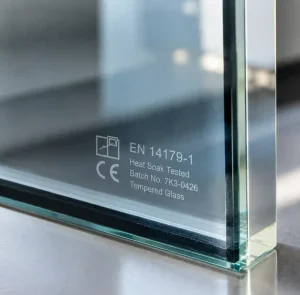
I’ve worked on projects where architects specified “tempered glass” without referencing ASTM C1048 or calling out heat-soak treatment. Spontaneous breakage from nickel sulfide inclusions appeared six months after installation. Heat-soaked tempered glass virtually eliminates this risk, but only if specified and certified properly.
Essential ASTM Standards Every Specifier Must Know
ASTM C1036: The Foundation Standard
This specification covers flat glass characteristics—thickness tolerances, optical quality, and dimensional requirements. The 2019 revision added clearer guidance on surface quality classifications: Pattern 1 for vision glass where optical clarity matters, Pattern 2 for spandrel applications.
ASTM E1300: Calculating Load Resistance
This practice determines minimum glass thickness needed to resist wind loads, snow loads, and other lateral forces. Every commercial project should have load calculations following E1300 methodology—not rules of thumb. For high-rise applications, we design to a lower probability of breakage (8 lites per 1000) rather than the standard level.
ASTM C1048: Heat-Treated Glass Requirements
This standard distinguishes between heat-strengthened and fully tempered glass. Heat-strengthened glass (surface compression 3,500-7,500 psi) is twice as strong as annealed glass and breaks into large pieces. Fully tempered glass (surface compression minimum 10,000 psi) is four times stronger and fragments into small pieces.
For safety-security glass, only fully tempered meets safety glazing requirements. For overhead glazing with a catch system, heat-strengthened laminated glass often performs better because the large fracture pattern maintains structural integrity longer.
Critical Safety Certifications and Testing Standards

ANSI Z97.1 and CPSC 16 CFR 1201
ANSI Z97.1 covers architectural safety glazing applications, while CPSC 16 CFR 1201 is the federal safety standard. For commercial projects, ANSI Z97.1 is your primary reference. Hazardous locations requiring safety glazing include doors and adjacent panels within 24 inches, glass within 18 inches of the floor, and glass in railings and guards.
Testing involves a 100-pound impact drop test—Class A from 48 inches, Class B from 18 inches.
SGCC Certification
The Safety Glazing Certification Council provides third-party verification that products meet ANSI Z97.1 and CPSC requirements. Every piece of certified safety glass receives a permanent label identifying manufacturer, product type, and applicable standard. Building inspectors require this label to be visible and legible after installation.
We maintain SGCC certification across our entire tempered glass and laminated glass production.
Building Code Requirements: IBC and Beyond
| Code Requirement | Application | Key Specification |
|---|---|---|
| IBC Section 2403 | General glazing requirements | References ASTM standards |
| IBC Section 2406 | Safety glazing in hazardous locations | ANSI Z97.1 or CPSC compliance |
| IBC Section 2409 | Glass in handrails and guards | Tempered or laminated |
| IBC Section 705 | Fire-rated assemblies | Tested and listed products |
| IBC Section 2404.2 | Wind load design | ASTM E1300 calculations |
| IBC Section 1613 | Seismic requirements | Glass-to-frame clearance |
Regional Code Variations
Florida’s High-Velocity Hurricane Zone requires impact-resistant glazing meeting ASTM E1996 and E1886 standards. California’s Title 24 often requires lower U-factors and SHGC than other regions. Seismic zones require adequate glass-to-frame clearance to accommodate building movement during earthquakes.
Fire-Rated Glass
Fire-protective glass blocks flames and smoke but transmits radiant heat. Fire-resistive glass blocks flames, smoke, and radiant heat, meeting full wall-rating requirements. Every fire-rated glass product must be tested and listed in its actual frame assembly. We work exclusively with tested and listed fire-rated glass systems.

Energy Performance Standards and NFRC Labeling
U-Factor measures heat transfer—lower is better. Standard IGUs achieve 0.30-0.50; high-performance assemblies can reach below 0.25.
Solar Heat Gain Coefficient (SHGC) indicates solar radiation passing through. Commercial buildings typically range from 0.25 to 0.40.
Visible Transmittance (VT) measures visible light passing through.
Our insulated glass units carry NFRC certification across multiple configurations.
Testing Protocols and Quality Assurance

Factory Testing
For tempered glass, ASTM C1048 requires surface compression testing using a strain viewer. Heat-soaked tempered glass undergoes an eight-hour cycle at 290°C, accelerating potential nickel sulfide expansion. Our heat-soaked glass capacity runs up to 120″ × 90″.
For laminated glass, the critical test is edge seal integrity—we perform accelerated weathering tests on production samples.
Field Testing
Basic field tests include visual inspection for certification labels, measurement verification against shop drawings, and polariscope testing for tempered glass.
Practical Specification Strategies
Reference actual standards with revision years. “Tempered glass” is incomplete. “Fully tempered glass conforming to ASTM C1048 with SGCC certification per ANSI Z97.1 Class A” leaves no ambiguity.
Call out testing documentation. Require SGCC certificates, NFRC labels, test reports for fire-rated assemblies, and dimensional certifications.
Specify load calculations. Provide design loads and require ASTM E1300 calculations stamped by a professional engineer.
Address edge work and hardware preparations. Our minimum edge distance is 2 inches for holes and cutouts, with minimum hole diameter of 1/2 inch.
Working With Certified Manufacturers
| Capability | Why It Matters | Verification Method |
|---|---|---|
| SGCC certification | Legal compliance for safety glazing | Verify at SGCC.org |
| NFRC certification | Energy code compliance | Check at NFRC.org |
| ISO 9001 quality system | Consistent production quality | Request certificate copy |
| In-house testing lab | Immediate quality verification | Facility tour |
| Load calculation capability | Proper glass selection | Request sample calculations |
| Production size limits | Ensures glass fits | Verify against project sizes |
At Zhongbo Glass, we produce tempered and laminated glass up to 130″ × 96″, insulated units to 120″ × 96″, and fire-rated assemblies to 96″ × 72″.

Common Specification Mistakes
Mistake 1: Confusing heat-strengthened and tempered glass. Tempered is required for safety glazing; heat-strengthened is not an acceptable substitute.
Mistake 2: Omitting heat-soak treatment. Heat-soak treatment reduces spontaneous breakage risk by 90% or more—the cost premium is insignificant compared to replacement costs.
Mistake 3: Inadequate edge clearance specifications. Minimum clearances typically require 1/8″ to 1/4″ on each edge.
Mistake 4: Specifying custom tints without verifying availability. Early manufacturer engagement prevents schedule impacts.
Mistake 5: Ignoring laminated glass interlayer specifications. For acoustic glass, PVB thickness and type must be specified. For structural applications, SGP interlayer provides significantly higher strength.
Emerging Standards
Bird-friendly glazing has moved to code requirements in several jurisdictions. Products achieving a threat factor of 30 or less per ABC testing qualify.
Embodied carbon tracking is becoming standard for large projects. We provide Environmental Product Declarations (EPDs) for projects requiring embodied carbon data.
Blast resistance certifications require specialized laminated glass constructions tested in actual frame systems.
Smart glass technologies are now available at commercial scale, though size limitations remain.

Regional Requirements
Hurricane Zones
Impact-resistant glazing must be tested per ASTM E1886 and E1996. Miami-Dade County requires a Notice of Acceptance (NOA) number for permit approval. Projects need complete assembly certification—not just glass certification.
Seismic Design
IBC Section 1613 and ASCE 7 define drift requirements. For tall buildings, glazing systems must provide adequate edge clearance, flexible sealant joints, and proper glass-to-frame bite.

Documentation and Compliance Verification
Complete glazing documentation should include shop drawings, SGCC certificates, NFRC labels, load calculations stamped by a professional engineer, test reports for fire-rated assemblies, material certifications, and warranties.
We provide complete documentation packages with every shipment.

FAQ
Can heat-strengthened glass be used for safety glazing applications?
No. Only fully tempered or laminated glass meets ANSI Z97.1 requirements. Heat-strengthened glass doesn’t fragment into small pieces like tempered glass.
How do I verify that installed glass is actually tempered?
Check for the permanent SGCC certification label. Additionally, use a polariscope to view the characteristic stress pattern.
What’s the difference between fire-protective and fire-resistive glass?
Fire-protective blocks flames and smoke but allows radiant heat. Fire-resistive blocks flames, smoke, and radiant heat, meeting full wall-rating requirements.
Do I need NFRC certification for commercial projects?
Most commercial projects require NFRC certification for energy code compliance. Check your specific jurisdiction’s adopted energy code.
How long is the lead time for certified commercial glass?
Standard products require 3-4 weeks from approved shop drawings. Specialty products may require 6-8 weeks.
Conclusion
Glass standards and certifications prevent failures that risk occupant safety and create liability exposure. Projects that prioritize proper specifications, certified products, and complete documentation succeed. Reference specific standards with revision years, require third-party certifications from SGCC and NFRC, verify manufacturer capabilities, and maintain complete documentation through project closeout. For more information about our certified glass products, explore our technical specifications and manufacturing capabilities.