When glass shatters into large, jagged shards, severe injury risk is significant. This drove tempered glass development—transforming ordinary glass into safety material through precise thermal treatment. After producing glass for projects like the Zhangjiajie Glass Bridge, I’ve witnessed how tempering creates strength that protects lives while enabling bold architectural visions.
What Is Glass Tempering?
Glass tempering induces compressive stress on the surface while maintaining tensile stress in the core. The process heats glass to 620-650°C, then rapidly cools it using calibrated air jets. This rapid cooling locks surface molecules in compression before the interior cools, creating stress differential that gives tempered glass its properties.

The result is glass that’s 4-5 times stronger than annealed glass and maintains safe fracture patterns—small, cube-like fragments rather than dangerous shards.
The Science Behind Thermal Strengthening
Upon quenching, the glass surface solidifies while the core remains hot. As the core cools and contracts, it pulls the rigid surface inward, creating surface compression of 69-172 MPa and core tension of 24-69 MPa. This permanent stress state must be overcome before tensile stress can develop, giving tempered glass superior resistance to wind loads, thermal shock, and impact.

At Zhongbo Glass, our 3660mm × 28000mm tempering lines maintain temperature uniformity within ±3°C. This precision prevents stress inconsistencies that cause optical distortion or breakage.
The Complete Tempering Process
Stage 1: Cutting and Edge Treatment
Tempering permanently locks in stress, making post-tempering fabrication impossible. All cutting, edging, and hole drilling must occur beforehand. Edge quality directly impacts strength—microchips create stress concentrators causing premature failure.
Waterjet edging achieves 85% edge strength versus 60-70% with standard grinding. For large-format glass up to 3660mm × 28000mm, edge preparation takes 40% of processing time but determines 60% of reliability.
Stage 2: Washing and Inspection

Surface contamination creates localized heating variations causing optical defects or breakage. Automated washing with deionized water ensures ISO 4 cleanliness. Inspection identifies inclusions or scratches that could propagate under thermal stress, preventing costly post-tempering failures.
Stage 3: Heating
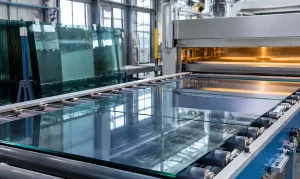
Glass enters the furnace on ceramic rollers, heating at 8-12°C per second to 620-680°C depending on thickness. Low-iron glass requires 15-20°C higher temperature due to reduced iron oxide absorption.
| Glass Thickness | Heating Time | Target Temperature | Quench Pressure |
|---|---|---|---|
| 4-6mm | 180-240 sec | 640-660°C | 180-220 Pa |
| 8-10mm | 280-350 sec | 650-670°C | 200-240 Pa |
| 12-15mm | 380-480 sec | 660-680°C | 220-260 Pa |
| 19mm+ | 550-700 sec | 670-690°C | 240-280 Pa |
Nitrogen blanketing maintains oxygen below 5%, eliminating surface haze that degrades optical clarity.
Stage 4: Quenching
Glass exits the furnace and passes between air nozzle arrays blasting high-pressure air onto both surfaces. Quench must initiate within 1-2 seconds—delay reduces final strength.
Nozzles positioned 40-50mm from glass with 50mm spacing create overlapping air streams preventing localized cooling variations. Air pressure adjusts automatically based on thickness and ambient temperature.

Tempering curved glass requires specialized quenching arrays matching glass curvature. Our 9-meter arc bending furnace maintains curvature tolerance within 2mm while achieving strength equivalent to flat tempered glass.
Tempering vs Other Strengthening Methods
| Method | Strength Increase | Surface Stress | Process Time | Cost Factor | Reworkable |
|---|---|---|---|---|---|
| Tempering | 4-5x | 69-172 MPa | 8-15 min | 1.0x | No |
| Heat Soaking | Same as tempered | 69-172 MPa | +4-8 hours | 1.4x | No |
| Chemical Strengthening | 5-7x | 400-700 MPa | 8-24 hours | 3.5x | No |
| Laminating | 2-3x | Varies | 2-4 hours | 2.0x | No |
| Annealed | 1x | 0 MPa | N/A | Baseline | Yes |
Heat-soaking is applied after tempering to reduce spontaneous breakage from nickel sulfide inclusions. Glass held at 290°C for 4-8 hours causes defective panels to break in-factory. For overhead glazing, we heat-soak 100% of tempered glass, reducing field failure from 1 in 400 to less than 1 in 8,000 panels.

Chemical strengthening exchanges sodium ions with larger potassium ions, creating higher surface compression. Limited to thin glass (≤6mm) and costs 3-4x more. Specified only for extreme edge strength requirements or when post-strengthening machining is necessary.
Quality Control and Testing
Surface Stress Measurement
Polariscope inspection reveals stress patterns after quenching. We measure surface compression at five locations per panel using scattered light polariscope (SCALP) technology, ensuring values exceed 69 MPa per ASTM C1048.
Fragment Testing
Tempered glass must produce minimum 40 fragments in a 50mm × 50mm area with no dimension exceeding 100mm. We test one panel per production batch, documenting fragment count and verifying no long splinters indicate inadequate tempering.

Optical Quality
Roller wave, edge kink, and anisotropy are optical distortions specific to tempered glass. We measure roller wave with laser profilometry, maintaining amplitude below 0.15mm per 300mm span. For facades where anisotropy is visible in polarized light, we orient glass to minimize effect.
Common Tempering Defects and Prevention
Nickel Sulfide Inclusions: Microscopic crystals causing spontaneous breakage. Heat-soaking is the only prevention. We source low-nickel raw materials and heat-soak all overhead glazing.
Edge Failure: 80% of breakage originates at edges. Prevention requires proper edge grinding (120-grit minimum), removing sharp arrises, and inspecting for chips. Waterjet edging eliminates microcracks from grinding.
Quench Marks: Visible patterns from non-uniform cooling. Caused by nozzle misalignment or inadequate air pressure. We calibrate quench systems weekly and monitor pressure real-time.
Optical Distortion: Results from temperature variation during heating. Maintaining ±3°C uniformity and using 38mm ceramic rollers prevents this.
Real-World Performance Data
Based on load testing 2,400 panels for the Zhangjiajie Glass Bridge project:
- Wind Load: 12mm tempered glass withstands 7.5 kPa with safety factor 2.5, equivalent to 200 km/h wind
- Impact Resistance: Passes large missile impact (9 kg lumber at 24 m/s) at 8mm thickness
- Thermal Shock: Withstands 200°C temperature differential without failure

These values represent guaranteed performance. Design engineers should reference ASTM E1300 for specific load calculations based on dimensions, support conditions, and load duration.
Large-Format Tempering Challenges
Tempering glass beyond 3000mm × 6000mm presents challenges most fabricators cannot address. Temperature uniformity becomes difficult—edge cooling outpaces center cooling, creating stress gradients causing spontaneous breakage or bowing.
Our solution involves zone-controlled heating with 12 independent temperature circuits and edge-biased quenching increasing air pressure at glass perimeters by 15-20%. This maintains stress uniformity within 8% across panels up to 3660mm × 28000mm.

Zhongbo Glass operates five tempering lines producing 2,500m² per 24 hours, with maximum capability of 3660mm × 28000mm—enabling single-piece installations that eliminate visual interruptions and reduce installation time by 60% versus mullion-divided systems. Learn more about our tempered glass capabilities.
Industry Innovations
Localized Tempering: Selective quenching creates zones of different strength within one panel, enabling structural optimization for glass beams.
Online Stress Control: Real-time stress measurement during quenching allows adaptive control, adjusting quench pressure within 0.1 seconds based on stress development, reducing optical distortion by 40%.
High-Performance Coatings: New ceramic coatings maintain 85% energy performance after tempering, enabling single-pane tempered glass with U-values below 1.4 W/m²·K. See our Low-E glass products for energy-efficient options.

FAQ
Can tempered glass be cut or drilled after tempering?
No. Any attempt to cut, drill, grind, or modify tempered glass causes immediate catastrophic failure. All fabrication must occur before tempering.
Why does tempered glass sometimes break spontaneously?
Nickel sulfide inclusions are the primary cause, affecting approximately 1 in 400 panels. Heat-soaking reduces this to less than 1 in 8,000. Poor edge preparation and installation stress are secondary causes.
What’s the difference between tempered and heat-strengthened glass?
Tempering creates higher surface compression (69+ MPa) and fractures into small fragments. Heat-strengthened glass has lower compression (24-52 MPa), is twice as strong as annealed glass, and breaks into large pieces similar to annealed glass.
How long does tempered glass last?
Indefinitely if properly installed. The tempering stress does not degrade over time. Service life is limited by edge damage, seal failure in insulated glass units, or coating degradation—not the tempering itself.
Is all safety glass tempered?
No. Laminated glass achieves safety through plastic interlayers that retain fragments. Many applications use laminated annealed glass instead of tempered. Overhead glazing typically requires laminated tempered glass for redundant safety.
Conclusion
Glass tempering transforms architectural possibilities by creating material that combines transparency with structural strength. The process—heat and cool—appears simple, but achieving consistent quality requires precision engineering and deep material understanding.
From producing glass for landmark projects, the fundamental truth remains: tempering quality depends on hundreds of details executed correctly. Temperature uniformity within 3°C, quench initiation within 1.5 seconds, edge quality achieving 85% of center strength—these margins determine whether glass performs for decades or fails during installation.
As architectural ambitions push toward larger panels and complex geometries, tempering technology evolves. Our 28-meter production capability represents current state-of-art, enabling single-piece installations that eliminate mullions while reducing installation time by 60%. Yet the core challenge persists: applying thermal science to create strength while maintaining optical clarity that makes glass irreplaceable.
For professionals specifying tempered glass, understanding this process enables better decisions. Knowing why 12mm glass tempers more reliably than 19mm, or why heat-soaking adds 40% cost, supports informed specification balancing performance, aesthetics, and budget. Explore our curved glass and digital printed glass options, or review our project portfolio to see tempered glass applications in landmark buildings worldwide.