When a pharmacy chain manager asks us about bulletproof glass pricing, they expect more than “$100 per square foot.” They need to know why one quote comes in at $15,000 and another at $45,000 for the same storefront. After manufacturing laminated security glass for projects ranging from bank teller windows to embassy installations, I can tell you the cost breakdown most suppliers won’t explain upfront.
Bulletproof glass typically costs $90 to $250 per square foot installed for commercial applications, but that range becomes meaningless without understanding the protection level, glass composition, and installation complexity driving your specific project cost.
What Determines Bulletproof Glass Cost?
The price gap between a $3,000 reception window and a $50,000 storefront installation comes down to four engineering factors that directly affect manufacturing complexity and material volume.
Protection Level Requirements
UL 752 and EN 1063 standards define ballistic resistance through increasingly demanding test protocols. A Level 1 rated panel stops three 9mm rounds—adequate for most retail environments. Level 3 withstands multiple .44 Magnum shots. Level 4 jumps to rifle protection, requiring fundamentally different glass construction.
Each protection level increase adds laminated layers, changes interlayer material from PVB to SGP, and increases total thickness from 19mm at Level 1 to over 75mm at Level 7. Manufacturing a 75mm multi-layer laminate requires larger autoclave capacity (we use a 4200mm × 28000mm autoclave for oversized security panels), longer processing cycles, and more stringent quality control.

Glass Size and Thickness
Security glass pricing scales non-linearly with size. Standard architectural panels (up to 2400mm × 3000mm) process efficiently through most manufacturing lines. Jumbo panels present challenges: specialized equipment, higher breakage risk during tempering, custom crating for transport, and crane requirements for installation.
At Zhongbo Glass, our 4200mm × 28000mm laminating capacity allows single-piece panels that competitors must divide into mullion systems, but this capability comes at a manufacturing premium of 30-50% over standard sizes. A 3000mm × 6000mm bank partition costs approximately $18,000-$24,000 at Level 3, while segmenting it into four standard panels might reduce material cost to $14,000 but add $3,000-$5,000 in framing and mullion hardware.
Thickness directly correlates with protection level, but the relationship isn’t linear in cost. A 19mm Level 1 panel uses 2-3 laminated layers. A 76mm Level 7 panel requires 8-10 layers with multiple SGP interlayers, each requiring separate autoclave cycles if exceeding single-cycle thickness limits.
Interlayer Material Selection
PVB (polyvinyl butyral) interlayers work for lower protection levels but degrade structurally under sustained high temperatures and edge moisture exposure. SGP (SentryGlas Plus) costs 3-4× more than PVB but provides 5× the tensile strength and 100× the stiffness, essential for rifle-rated protection where panel deflection under impact must stay within survivable limits.
For a 10-square-meter installation, upgrading from PVB to SGP adds $2,000-$4,000 in material cost alone. We specify SGP exclusively for any application above Level 2, architectural glass floors, and coastal installations where edge seal integrity is critical.
2026 Bulletproof Glass Cost by Protection Level
| Protection Level | Standards | Threat Protection | Typical Thickness | Cost per m² (Material) | Cost per m² (Installed) |
|---|---|---|---|---|---|
| Level 1 | UL 752 L1 / EN 1063 BR2 | 9mm handgun (3 shots) | 19-25mm | $320-$540 | $970-$1,400 |
| Level 2 | UL 752 L2 / EN 1063 BR3 | .357 Magnum (3 shots) | 25-32mm | $430-$650 | $1,180-$1,720 |
| Level 3 | UL 752 L3 / EN 1063 BR4 | .44 Magnum (3 shots) | 32-40mm | $540-$860 | $1,400-$2,150 |
| Level 4 | UL 752 L4 / EN 1063 BR5 | .30-06 rifle (1 shot) | 44-57mm | $860-$1,400 | $2,150-$3,230 |
| Level 5 | UL 752 L5 / EN 1063 BR6 | 7.62mm rifle (3 shots) | 51-64mm | $1,180-$1,720 | $2,690-$3,760 |
| Level 7 | UL 752 L7 / EN 1063 BR7 | 5.56mm NATO (5 shots) | 64-76mm | $1,610-$2,370 | $3,440-$5,380 |
Note: Costs shown in USD converted from $/sq ft estimates. Installed costs include standard aluminum framing, basic installation labor, and transportation within 500km. Custom framing, remote locations, and structural modifications add 20-40%.
Real-World Application Costs
Bank Teller Windows
A typical drive-through teller window measures 600mm × 900mm with Level 3 protection. Material cost runs $700-$1,100, but the complete system including transaction drawer and mounting frame totals $3,200-$5,800 installed.
The transaction drawer represents 30-40% of total cost. Basic mechanical drawers start at $800; electronic drawers run $2,500-$4,000.

Retail Storefronts
A 3000mm × 2400mm storefront door with sidelites (approximately 8 square meters total glass area) at Level 2 protection:
- Glass panels: $9,400-$13,800
- Ballistic-rated door hardware: $1,800-$3,200
- Structural framing: $2,400-$4,800
- Installation labor: $3,200-$5,400
- Total: $16,800-$27,200
Retailers often question whether Level 1 suffices. For smash-and-grab deterrence, yes. For active shooter scenarios, Level 3 provides meaningful additional protection for $6,000-$9,000 more—a 30% premium that facility managers justify by comparing it to 2-3 years of additional security guard costs.
[IMG_3]
Government and Institutional Buildings
Embassy consultation rooms and courthouse entrances typically specify Level 4-5 protection. A 4000mm × 2800mm window wall at Level 4:
- Laminated glass panels: $19,200-$31,400
- Blast-resistant framing: $8,900-$14,300
- Structural anchorage: $5,400-$8,900
- Installation: $7,200-$10,800
- Total: $40,700-$65,400
These installations often pair with forced-entry resistance testing, adding engineering costs of $3,000-$8,000.

Hidden Costs That Inflate Final Budgets
Bulletproof glass weighs 40-100 kg per square meter depending on protection level. A Level 3 panel weighs approximately 80 kg/m², compared to 20 kg/m² for standard architectural glass. Existing window frames rarely support this load.
Structural upgrades add $1,200-$3,600 per opening for steel header installation and frame reinforcement. Older buildings with masonry openings require engineering analysis ($1,800-$5,400) to verify wall capacity.

Curved reception desks and radius corners require hot-bent laminated glass—a process that adds 3-4 weeks lead time and 40-60% cost premium over flat panels.
Cost Comparison: Bulletproof Glass vs. Alternatives
| Security Solution | Protection Level | Cost per m² Installed | Advantages | Limitations |
|---|---|---|---|---|
| Security Window Film | Impact resistance | $86-$161 | Low cost, retrofit-friendly | No ballistic protection |
| Laminated Safety Glass | Forced entry deterrent | $215-$430 | Meets codes, good clarity | Defeats tools but not firearms |
| Level 1 Bulletproof Glass | 9mm handgun | $970-$1,400 | True ballistic protection | Limited to pistol calibers |
| Level 3 Bulletproof Glass | .44 Magnum | $1,400-$2,150 | Broad handgun coverage | Rifle rounds penetrate |
| Level 5 Bulletproof Glass | 7.62mm rifle | $2,690-$3,760 | Rifle protection | Significant weight, complexity |
| Polycarbonate Shields | Level 1-2 equivalent | $540-$970 | Lightweight, easier retrofit | Scratches easily, yellows |
The cost gap between security film and true bulletproof glass appears substantial, but the comparison is invalid. Security film delays forced entry by 30-90 seconds—valuable for alarm response. It doesn’t stop bullets.
Installation Cost Variables
Simple retrofit installations run $32-$54 per square meter for panels under 3 square meters. Complex installations with structural modifications escalate to $108-$215 per square meter.
High-security facilities requiring background checks add $2,400-$7,200 in labor premiums.
Metropolitan areas see competitive pricing. Rural locations face freight premiums, per-diem costs, and potential crane rental. A Level 3 storefront costing $22,000 in a major city might run $31,000-$35,000 in a location 800km from the nearest installer.

How to Reduce Bulletproof Glass Costs Without Compromising Safety
Rather than protecting entire facades at Level 3, design layered security: public-facing transaction points at Level 3, interior offices at Level 1, and non-accessible windows with laminated safety glass. This approach can cut costs 35% while maintaining staff protection.
Standardizing on dimensions like 1200mm × 1800mm reduces costs 15-20% through better material yield.
Ordering glass, framing, and installation from a single manufacturer eliminates coordination markup (typically 12-18%).
Zhongbo Glass Manufacturing Capabilities for Security Glazing
Our facility produces laminated security glass up to 4200mm × 28000mm—among the world’s largest autoclave capacity. This eliminates mullion requirements on oversized installations and allows single-piece bank partitions that competitors must segment.
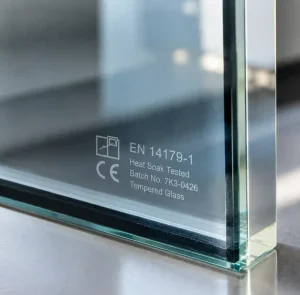
We maintain dedicated production lines for security lamination with SGP interlayers, allowing 8-12 week lead times on Level 1-3 projects and 12-16 weeks for Level 4-5 installations. Our heat-soak testing eliminates nickel sulfide breakage risk, critical for installations where panel replacement costs $8,000-$15,000.
Quality certifications include ISO 9001:2015 standards and compliance testing to UL 752, EN 1063, and GB 17840 standards, with ballistic testing documentation provided for every project.
FAQ
How long does bulletproof glass last?
Properly installed bulletproof glass lasts 20-30 years in most commercial applications. Edge seals may require inspection every 8-10 years in coastal or high-humidity environments.
Can bulletproof glass be repaired if damaged?
No. Ballistic glass must be replaced entirely if impacted by gunfire. The laminated structure maintains integrity after impact but the panel no longer meets ballistic test standards.
Does bulletproof glass block UV rays?
Standard laminated security glass blocks 97-99% of UV radiation due to the PVB or SGP interlayer, similar to automotive windshields.
What is the lead time for bulletproof glass orders?
Standard sizes at Level 1-2 ship in 6-8 weeks. Custom sizes and Level 3+ require 10-16 weeks. Curved panels and oversized installations extend lead times to 14-20 weeks.
Can bulletproof glass be installed in existing frames?
Rarely without modification. Bulletproof glass weighs 4-5× more than standard glass. Existing frames require reinforcement with steel headers and upgraded anchoring. Budget $800-$2,400 per opening for frame modifications.
Does bulletproof glass stop all bullets?
No. Each UL 752 level specifies exact ammunition types tested. Level 3 stops .44 Magnum but won’t stop 5.56mm rifle rounds. Match protection level to your specific threat assessment.

How much does bulletproof glass weigh?
Weight ranges from 40 kg/m² (Level 1, 19mm thick) to 180 kg/m² (Level 7, 76mm thick). A typical 1200mm × 1800mm Level 3 window weighs approximately 170 kg.
Is bulletproof glass soundproof?
Bulletproof glass provides excellent sound insulation due to mass and laminated construction. Level 3 panels typically achieve STC 38-42 ratings. However, speak-through systems compromise acoustic performance.
Conclusion
Bulletproof glass costs $90-$250 per square meter installed for commercial projects, but this range means little without understanding the specific protection level, size requirements, and installation complexity your facility requires. A Level 1 system protecting retail staff costs $12,000-$18,000 per transaction point, while Level 4 government installations reach $40,000-$65,000 per secured opening.
Focus on matching protection level to documented threat assessment rather than over-specifying. A pharmacy doesn’t need Level 5 rifle protection—Level 2 stops the handgun threats that comprise 94% of retail violent crime while saving $18,000-$32,000 per storefront.
The investment pays off through reduced insurance premiums (8-12% annual reductions), eliminated security guard costs, and staff confidence that drives retention in high-risk locations. Request ballistic test documentation, verify UL 752 or EN 1063 certification, and prioritize manufacturers with autoclave capacities matching your panel sizes.