Most buyers lose 15-25% of their budget to avoidable logistics mistakes, customs miscalculations, and quality issues when importing architectural glass from China. After supplying glass for projects like the Zhangjiajie Glass Bridge and Shanghai Museum East Hall, we’ve identified three critical success factors: accurate total cost calculation, proper logistics planning, and rigorous quality verification. This guide provides insider knowledge to help you import tempered glass, laminated glass, and curtain wall systems successfully.

Understanding FOB vs CIF Pricing Models
Chinese glass manufacturers quote using FOB (Free On Board) or CIF (Cost, Insurance, Freight). The difference determines whether you save money or overpay by 20-30%.
FOB pricing means the manufacturer’s responsibility ends at the Chinese port. You arrange ocean freight, insurance, customs, and inland delivery. FOB gives you control but requires logistics management.
CIF pricing includes glass cost, ocean freight, and marine insurance to your destination port. CIF appears simpler but typically costs 15-20% more than FOB because manufacturers markup freight costs.
| Pricing Term | Seller Responsibility | Buyer Responsibility | Best For |
|---|---|---|---|
| FOB (Free On Board) | Production, export customs, loading at origin port | Ocean freight, insurance, import customs, inland delivery | Large buyers with freight forwarders, multiple shipments |
| CIF (Cost, Insurance, Freight) | Production, export customs, ocean freight, marine insurance to destination port | Import customs clearance, unloading fees, inland delivery | First-time importers, small orders, simple logistics |
| EXW (Ex Works) | Production only | All transportation, export/import customs, insurance | Buyers with complete logistics infrastructure in China |
| DDP (Delivered Duty Paid) | All costs including import duties and delivery to site | Only unloading and installation | Small buyers wanting zero logistics hassle (premium pricing) |
For projects requiring insulated glass or Low-E glass over 10 square meters, FOB typically saves $8-15 per square meter compared to CIF when you work with an experienced freight forwarder.

Shipping Methods and Real Cost Breakdown
Ocean freight dominates architectural glass imports due to size and weight. A 40-foot high cube container accommodates 26-28 tons with better space efficiency for panels up to 11.8m long, critical for large curtain wall glass projects.
| Cost Component | Typical Range | Notes | Who Pays |
|---|---|---|---|
| Ocean Freight (China to US West Coast) | $2,500 – $4,500 per 40’HC | Seasonal variation; higher Oct-Dec | Buyer (FOB) / Seller (CIF) |
| Ocean Freight (China to Europe) | $3,500 – $6,000 per 40’HC | Route and port dependent | Buyer (FOB) / Seller (CIF) |
| Marine Insurance | 0.3% – 0.5% of cargo value | Higher for first-time buyers | Buyer (FOB) / Seller (CIF) |
| Customs Clearance | $200 – $500 | Broker fees, documentation | Buyer (always) |
| Port Handling Fees | $300 – $800 per container | THC, terminal fees, container deposit | Buyer (always) |
| Inland Transportation | $500 – $2,500 | Distance and accessibility dependent | Buyer (always) |
| Customs Duties (US) | 0% – 3.9% of declared value | HTS code dependent (see below) | Buyer (always) |
| Customs Duties (EU) | 0% – 3.7% of CIF value | Combined nomenclature code | Buyer (always) |
For a $50,000 order of tempered laminated glass shipped FOB from China to Los Angeles, your total landed cost including all fees typically ranges from $56,500 to $59,000 depending on broker efficiency and customs classification.

Customs Duties by Country
United States: Tempered glass under HTS 7007.19 at 0.9-1.8% duty. Laminated safety glass uses HTS 7007.29 at 2.5-3.9%. Insulated glass units enter at 2.2%. Anti-dumping duties (ADD) may add 21-164% on certain flat glass from China depending on manufacturer.
European Union: Tempered glass under CN 7007 at 2.3-3.7%. Laminated glass at 2.8%. IGUs at 2.5%. CE marking required under CPR.
Australia: Typically 0-5% (often duty-free under ChAFTA). Middle East (UAE, Saudi): 5% duty. Southeast Asia: Singapore 0%, Malaysia 0-20%, Thailand 20-30%, Vietnam 10-15%.
Always verify current duty rates with licensed customs brokers before ordering.

Quality Inspection: What to Check Before Shipping
Quality inspection is the most critical step buyers skip, leading to 30-40% of import disputes. Implement third-party inspection before shipping – once containers are sealed, disputes become expensive.
Pre-production inspection: Verify raw materials and specs. Check glass thickness (±0.2mm tolerance), Low-E coating specs (U-value, SHGC, VLT), and interlayer materials (PVB vs SGP).
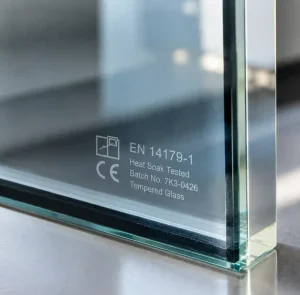
During production inspection (30-50% complete): Verify tempering quality via fragmentation tests per ASTM C1048 (40+ fragments in 50mm square), edge quality, and optical distortion.
Pre-shipment inspection (100% complete): Verify dimensions (measure every panel over 3m), inspect for scratches and defects, confirm packaging quality, validate shipping marks. Inspection companies like SGS or Bureau Veritas charge $300-600 per day but save thousands in claims.
Critical tolerances: Thickness ±0.2mm (under 12mm), length/width ±2mm (under 3m), ±3mm for jumbo-size, diagonal difference max 3mm, optical distortion max 0.5mm roller wave.
Zhongbo Glass manufactures panels up to 3660mm × 18000mm on the world’s largest autoclave (4.2m × 28m), maintaining ±3mm tolerance on 18-meter panels for projects like Shanghai Museum East Hall which required 12.4-meter glass ribs.

Lead Times and Production Planning
Production lead time: Standard tempered glass and laminated glass – 2-3 weeks after deposit. Insulated glass units with Low-E – 3-4 weeks. Jumbo-size (over 8m) – 4-6 weeks.
Ocean shipping: China to US West Coast 14-18 days, US East Coast 28-35 days, Europe 25-35 days, Middle East 18-25 days, Australia 15-20 days. Customs adds 3-7 days.
Total timeline: Standard under 6m – 6-8 weeks; jumbo over 10m – 10-12 weeks; complex configurations – 12-15 weeks. Add 2-week buffer for Chinese New Year (late January/February) which shuts factories for 2-3 weeks.

Payment Terms That Protect Both Parties
Standard structure: 30-50% deposit upon order, 50-70% balance before shipping. Protects manufacturers but exposes buyers to quality risk.
Letter of Credit (L/C): Bank-guaranteed security. Payment only when seller presents shipping documents and inspection certificates. Costs 0.3-0.5% of order value. For first-time orders over $30,000, L/C significantly reduces risk.
Better terms for larger orders: 30% deposit, 60% against inspection report (before shipping), 10% balance within 30 days after installation. Few manufacturers accept except for established relationships or orders exceeding $100,000.
Payment methods: Wire transfer (T/T) dominates B2B glass transactions. PayPal and credit cards add 3-4% processing fees.
For curtain wall glass systems, structure payments around inspection milestones: 30% deposit, 40% at pre-shipment inspection approval, 20% upon customs clearance, 10% after installation acceptance.

Packaging and Transportation
Glass packaging quality determines whether panels arrive intact or shattered. Chinese manufacturers use wooden crates with protective corners, moisture-proof paper, and PE foam padding. For ocean shipping, specify moisture barriers and desiccant packets – container condensation damages glass edges and coatings.
Jumbo-size packaging: Custom crates with internal bracing every 2 meters. Transportation companies charge $2,000-$5,000 premium per container for specialized handling.
Container loading: Heavier glass at bottom, lighter on top. Never exceed 27 tons gross weight. Improper loading causes breakage. Arrange crane or forklift access before arrival – a 40-foot container requires 3-4 hours for safe unloading.
Insurance claims: Marine cargo insurance covers transit damage but excludes improper packaging. Photograph all packaging before shipping and upon arrival. Claims require evidence within 7 days.

Real Project Insights
Success case: Dubai developer ordered 2,400 sqm Low-E insulated glass using FOB Shanghai, hired experienced freight forwarder, conducted pre-shipment inspection, structured payment as 30% deposit, 50% against inspection, 20% after customs. Glass arrived in 9 weeks with 99.8% acceptance at $142/sqm landed.
Failure case: US contractor ordered 800 sqm laminated glass on CIF without inspection. Minor coating defects failed on-site specs. Dispute lasted 4 months, replacement missed schedule by 6 weeks, costing $35,000 in delays. Insurance denied claim due to no pre-shipment inspection.
Critical success factors: Always conduct third-party inspection ($400-600 prevents $10,000-$100,000 disputes), verify manufacturer has produced similar configurations, specify exact tolerances, build 2-week schedule buffers, work with freight forwarders experienced in glass handling.

FAQ
What are minimum order quantities for importing glass from China?
Most manufacturers require 100-200 sqm for standard glass or one full container (200-300 sqm). Custom configurations like digital printed glass may require 300-500 sqm due to setup costs. You can consolidate multiple glass types in one container to meet minimums.
How do I verify a manufacturer’s quality credentials?
Request ISO 9001 certification, product certifications for your market (SGCC for North America, CE for Europe), and check project portfolio for similar scale. For critical projects, request mill test certificates and third-party testing per ASTM, EN, or GB standards.
What happens if glass arrives damaged?
File insurance claims within 7 days with photos documenting damage and packaging. Marine cargo insurance covers transit damage if packaging was adequate. This highlights why payment terms should retain 10-20% until installation acceptance. Inspect containers before signing delivery receipts.
What are anti-dumping duties and how do they affect costs?
The US imposes anti-dumping duties on certain glass products from China ranging from 21-164% depending on manufacturer and product type. Tempered and laminated safety glass often qualify for exemptions. Verify with customs brokers before ordering.
How long do manufacturers warrant imported glass?
Standard warranties cover manufacturing defects for 5-10 years, including delamination, coating failure, and seal failure on insulated glass units. Warranties exclude improper installation or maintenance. Clarify warranty terms and claim procedures before ordering.
Conclusion
Importing architectural glass from China successfully requires understanding the complete cost structure beyond factory price, choosing appropriate shipping terms (FOB typically saves 15-20% versus CIF for experienced buyers), conducting mandatory third-party inspections before shipping, and structuring payment terms that protect both parties through milestone-based releases. The difference between success and costly mistakes comes down to calculating total landed costs before committing, implementing rigorous quality inspection, and building realistic lead times with buffers.
If you need high-quality architectural glass for your international project, Zhongbo Glass offers manufacturing capabilities up to 18 meters with the world’s largest tempering lines (3.66m × 28m) and autoclave (4.2m × 28m). We’ve supplied glass for iconic projects including the Zhangjiajie Glass Bridge and Shanghai Museum. Contact us for technical specifications, export documentation, and factory-direct pricing.