Jumbo glass panels are transforming modern architecture, enabling architects to design curtain walls, skylights, and structural glazing systems that were impossible just a decade ago. If you want to specify oversized glass panels for your next high-rise building, museum, or airport terminal project, then you will need to understand manufacturing capabilities, size limitations, transportation challenges, and the technical requirements that make jumbo-size glass production possible.
This comprehensive guide explains how manufacturers produce architectural glass panels up to 28 meters in length, the equipment limitations that define maximum sizes, transportation logistics for oversized panels, and real-world engineering considerations for specifying jumbo glass in your projects.
What Are Jumbo Glass Panels?
Jumbo glass panels are architectural glass products that exceed standard manufacturing dimensions, typically measuring over 3 meters in any dimension. While conventional equipment handles panels up to 3 meters, jumbo glass production requires specialized equipment capable of processing panels up to 3.66 meters wide and 28 meters long.
These ultra-large panels are used in commercial curtain wall systems, airport terminals, museum facades, and structural glazing where minimizing mullions is critical. Jumbo-size manufacturing enables seamless glass facades and reduces building envelope joints.

Manufacturing Equipment Determines Maximum Glass Size
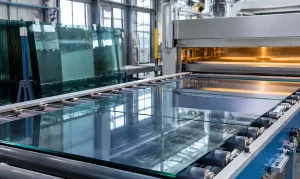
The maximum size of architectural glass panels is directly constrained by the dimensions of manufacturing equipment. Glass fabrication requires multiple processing stages, and each piece of equipment in the production line creates a size bottleneck.
Tempering Line Limitations
Tempered glass requires heating to 620°C and rapid air-jet cooling. Tempering furnace dimensions determine maximum panel size. Standard lines handle glass up to 2.4m × 4.5m, while jumbo lines process panels up to 3.66m × 28m.
Zhongbo Glass operates the world’s largest tempering lines at 3.66m × 28m for flat glass and 3.66m × 28m for curved sections, enabling jumbo panel production up to 28 meters.

Autoclave Size for Laminated Glass
Laminated glass requires bonding glass layers with PVB or SGP interlayers under high temperature and pressure. Standard autoclaves measure 2.5m × 5m, limiting laminated panel dimensions.
The world’s largest autoclave at 4.2m × 28m enables production up to 4.2 meters wide and 28 meters long. This capability was essential for the Zhangjiajie Grand Canyon Glass Bridge, which required triple-laminated panels exceeding 3m × 4m.
Cutting and Edging Equipment
Raw glass cutting and edge grinding impose additional size constraints. Jumbo manufacturers require cutting lines handling 4.2m × 28m panels and CNC machining centers for drilling, cutouts, and edge finishing.
Maximum Glass Panel Sizes by Processing Type
Different glass processing methods have varying size limitations based on equipment capabilities and physical constraints.
| Glass Type | Maximum Width | Maximum Length | Key Limitation | Typical Applications |
|---|---|---|---|---|
| Tempered Glass | 3.66 m | 28 m | Tempering furnace dimensions | Curtain walls, facades, structural glazing |
| Laminated Glass | 4.2 m | 28 m | Autoclave chamber size | Glass bridges, skylights, overhead glazing |
| Insulated Glass (IGU) | 3.66 m | 28 m | Sealing equipment and handling | Energy-efficient curtain wall systems |
| Curved Glass | 3.66 m | 28 m | Bending furnace radius and length | Cylindrical facades, custom architecture |
| Low-E Coated Glass | 3.66 m | 28 m | Coating chamber dimensions | High-performance building envelopes |

Transportation Challenges for Oversized Glass Panels
Manufacturing capability is only half the equation. Transportation logistics often impose practical size limitations that are more restrictive than manufacturing equipment constraints.
Road Transport Restrictions
Most countries regulate oversized loads. In the US, loads exceeding 8.5 feet wide or 13.5 feet high require special permits and pilot vehicles. Europe restricts transport width to 2.55 meters without permits.
Glass panels at 3.66 meters wide require wide-load permits globally. Panels exceeding 15-18 meters need custom trailers, route surveys for bridge clearances, and coordination with authorities.
Shipping Container Limitations
Standard 40-foot containers measure 12.03m × 2.35m × 2.69m internally. Oversized panels require break-bulk shipping or custom crating, significantly increasing costs and transit time.

Handling and Installation Equipment
Jumbo panels measuring 3.66m × 18m can weigh over 2,500 kg. Installation requires specialized cranes, vacuum lifting systems, and experienced crews. Equipment availability can limit projects in some markets.
Engineering Considerations for Jumbo Glass Specification
Specifying jumbo glass panels requires careful engineering analysis beyond standard glass selection criteria.
Structural Load Calculations
Larger panels experience higher absolute wind loads. A 3.5m × 15m panel has significantly higher total force than smaller panels at identical wind pressure.
Verify that structural supports and framing accommodate increased loads through engineering analysis per ASTM E1300 and ASCE 7 wind load calculations.

Thermal Stress Management
Large panels face greater thermal stress risk from temperature differentials. Edge conditions, shading, and HVAC create localized stress.
Heat-soak testing is critical for jumbo tempered glass to eliminate spontaneous breakage from nickel sulfide inclusions. Larger dimensions increase defect probability, making quality control essential.
Deflection Limits
Deflection increases with panel span. Codes limit deflection to L/60 or L/175 depending on glass type. For 15-meter panels, allowable deflection may be only 100mm.
Specify sufficient thickness and laminated configurations to meet deflection limits. Account for long-term PVB interlayer creep in analysis.
Manufacturing Process for Jumbo Glass Panels
Understanding the production process helps architects and engineers appreciate the complexity and lead time requirements for jumbo glass fabrication.
Step 1: Raw Glass Cutting
Float glass arrives in lites up to 4.2m × 28m. CNC cutting tables with 4.2m × 28m capabilities cut panels to project dimensions.
Step 2: Edge Processing
CNC edging machines grind and polish edges before tempering or laminating. CNC machining centers drill holes and create cutouts. Jumbo equipment handles panels up to 28 meters.

Step 3: Tempering (If Specified)
Panels are heated to 620°C and rapidly cooled. Maintaining uniform temperature across jumbo panels is challenging for consistent tempering quality.
Step 4: Laminating (If Specified)
Glass panels are assembled with PVB or SGP interlayers and bonded in autoclaves at 140°C and 12-14 bar pressure. Jumbo panels require 3-6 hour cycles.
Step 5: Insulating Glass Assembly (If Specified)
IGUs use spacers and sealants between panels. Jumbo IGU lines require specialized equipment and vertical storage for 28-meter panels.

Cost Implications of Jumbo Glass Panels
Jumbo glass panels command significant price premiums compared to standard-size glass due to equipment requirements, handling complexity, and transportation logistics.
| Factor | Standard Glass Impact | Jumbo Glass Impact | Cost Multiplier |
|---|---|---|---|
| Equipment Availability | Widely available | Limited global capacity | 1.3–1.5× |
| Manufacturing Complexity | Standard process | Specialized handling required | 1.2–1.4× |
| Transportation | Standard freight | Oversized load permits, custom transport | 1.5–3.0× |
| Installation | Standard crews | Specialized equipment and crews | 1.3–2.0× |
| Lead Time | 4–6 weeks | 8–14 weeks | N/A |
| Overall Cost | Baseline | Combined factors | 2.0–4.0× per m² |
Despite the cost premium, jumbo glass panels can provide cost savings at the building system level by reducing mullion quantities, simplifying curtain wall framing, and accelerating installation schedules for large facades.
Real-World Applications and Case Studies
Jumbo glass panels have enabled some of the world’s most iconic architectural projects.
Chongqing Joy City
The Chongqing Joy City commercial complex features ultra-long laminated insulated glass panels measuring 2.476m × 16.74m. The glass configuration uses 12mm+2.28SGP+12mm Low-E+19A+12mm+2.28SGP+12mm ultra-clear tempered laminated IGU, demonstrating Zhongbo Glass’s capability to produce panels exceeding 16 meters in length for large-scale retail and mixed-use developments.

Qingpu Huawei R&D Center
The Huawei R&D Center in Shanghai’s Qingpu district showcases jumbo glass technology in corporate architecture. Panels measuring up to 12.455m × 2.413m use a complex laminated insulated configuration (10mm+2.28SGP+10mm Low-E+12A+10mm+2.28SGP+10mm ultra-clear tempered laminated IGU), combining energy efficiency with the transparency required for modern research facilities.
Banyan Tree Nanjing Garden Expo Park
The luxury Banyan Tree resort at Nanjing Garden Expo features architectural glass panels reaching 12 meters in length (1.6m × 12m). The five-layer laminated configuration (12mm+2.28SGP+12mm+2.28SGP+12mm+2.28SGP+12mm+2.28SGP+12mm ultra-clear tempered laminated glass) provides both structural integrity and optical clarity for this high-end hospitality project, demonstrating jumbo glass applications in luxury resort architecture.
Frequently Asked Questions
What is the absolute maximum size for architectural glass panels?
The practical maximum is approximately 4.2m × 28m for tempered glass and 4.2m × 28m for laminated glass, limited by tempering furnace and autoclave dimensions. However, transportation constraints often restrict real-world installations to panels under 3.66m × 15m for most markets.
Why can’t glass be manufactured in unlimited sizes?
Glass production equipment creates physical constraints. Tempering furnaces, autoclaves, cutting tables, and coating chambers all have fixed dimensions. Building larger equipment is technically possible but economically impractical given the limited demand for ultra-large panels and the exponential cost increase with size.
How do you transport glass panels longer than shipping containers?
Panels exceeding container dimensions require break-bulk shipping, flat rack containers, or custom crating. For road transport, oversized panels need special permits, pilot vehicles, and route planning to verify clearances. Some projects fabricate and install jumbo panels domestically to avoid international shipping constraints.
Does jumbo glass cost more per square meter?
Yes, jumbo glass typically costs 2-4 times more per square meter than standard-size glass due to limited manufacturing capacity, specialized handling, increased transportation complexity, and higher installation costs. However, system-level savings from reduced framing may offset panel premiums.
What is the minimum order quantity for jumbo glass panels?
Most jumbo glass manufacturers require minimum orders of 500-1,000 square meters or project-based minimums due to the specialized setup required for oversized production. This makes jumbo glass practical primarily for commercial projects rather than residential applications.
Can curved glass be produced in jumbo sizes?
Yes, but with more restrictive size limitations. Curved tempered glass production typically maxes out at 3.66m × 9-12m depending on the radius and bending method. Hot-bending furnaces for jumbo curved glass are extremely rare, with only a handful of facilities globally offering this capability.
How long is the lead time for jumbo glass fabrication?
Typical lead times range from 6-10 weeks for jumbo glass versus 4-6 weeks for standard glass. This includes scheduling production time on limited jumbo equipment, extended processing cycles, and coordination of specialized transportation. Rush orders may be accommodated with premium pricing.

Conclusion
Jumbo glass panel manufacturing represents the cutting edge of architectural glass production, enabling designers to push the boundaries of transparency and structural expression in modern buildings. Understanding manufacturing capabilities, equipment limitations, transportation challenges, and engineering requirements is essential for successfully specifying oversized glass in your projects.
If you need jumbo-size architectural glass for your high-rise curtain wall, museum, airport terminal, or landmark building project, Zhongbo Glass offers world-class manufacturing capabilities up to 18 meters. Our facility features the world’s largest tempering lines (3.66m × 28m) and autoclave (4.2m × 28m), ensuring superior quality and precision for ultra-large structural glass. We have successfully supplied jumbo glass panels for iconic projects including Zhangjiajie Glass Bridge, Shanghai Museum East Hall, and numerous commercial curtain wall systems globally.
Contact us today for custom jumbo glass solutions, technical specifications, and competitive factory-direct pricing for your architectural glazing project.