Glass bridge projects demand the highest safety standards in architectural glazing. According to structural engineering data, glass bridges can experience live loads exceeding 5 kPa while maintaining transparency for visitor experience. This creates unique engineering challenges that standard building glazing never encounters.
If you want to specify laminated glass for glass bridge projects, then you will need to understand multi-layer configurations, interlayer selection, load-bearing calculations, anti-slip treatments, and rigorous testing protocols. This guide provides technical specifications and safety standards based on real-world glass bridge engineering experience.

What Makes Glass Bridge Laminated Glass Different?
Glass bridge laminated glass is not standard architectural glazing. You’re specifying a structural flooring system that must support concentrated loads, resist impact, provide post-breakage redundancy, and maintain optical clarity under extreme conditions.
Standard curtain wall laminated glass typically uses 2-layer configurations with single PVB interlayers. Glass bridges require 3-layer minimum configurations with multiple SGP interlayers. The Zhangjiajie Grand Canyon Glass Bridge, for example, uses 15mm+2.675GP+15mm+2.675GP+15mm triple-layer construction with two SGP interlayers.
This multi-layer approach provides structural redundancy. If one glass layer cracks, the remaining layers continue supporting loads while interlayers hold fragments in place. You cannot achieve this safety level with standard 2-layer laminated glass.

Multi-Layer Configuration Requirements
Triple-Layer vs. Double-Layer Performance
Glass bridge specifications universally require triple-layer minimum configurations. Engineering calculations show why double-layer construction fails to meet safety factors for pedestrian bridges.
| Configuration Type | Glass Layers | Interlayers | Post-Breakage Capacity | Typical Application |
|---|---|---|---|---|
| Double-Layer | 2 × 10-15mm | 1 × 1.52mm PVB | 0% (single point failure) | Building facades, non-structural |
| Triple-Layer | 3 × 10-19mm | 2 × 2.28mm+ SGP | 66% load retention | Glass bridges, skywalks |
| Quad-Layer | 4 × 10-15mm | 3 × 2.28mm SGP | 75% load retention | High-traffic bridges, extreme spans |
Triple-layer construction with SGP interlayers maintains structural integrity even after glass fracture. Testing per ASTM E1300 shows triple-layer panels retain 60-70% load-bearing capacity with one layer completely fractured. This redundancy is why building codes mandate triple-layer minimum for glass bridge solutions.
Layer Thickness Specifications
Glass layer thickness depends on span length, support conditions, and design loads. For pedestrian bridges with 5 kPa live load plus 1.5 kPa dead load:
- Short spans (< 3m): 3 × 12mm tempered glass minimum
- Medium spans (3-6m): 3 × 15mm tempered glass standard
- Long spans (6-10m): 3 × 19mm tempered glass with increased support points
- Extreme spans (> 10m): 3 × 19mm+ with cable support systems
Zhongbo Glass manufactures laminated glass panels up to 4200mm × 28000mm, enabling single-piece installations for medium-span bridges without mid-panel joints. This eliminates joint-related stress concentrations and water infiltration risks.

PVB vs. SGP Interlayer Selection
Why SGP Dominates Glass Bridge Applications
The interlayer choice fundamentally determines structural performance. PVB (Polyvinyl Butyral) and SGP (SentryGlas Plus) have dramatically different mechanical properties that affect load-bearing capacity.
| Property | PVB Interlayer | SGP Interlayer | Engineering Impact |
|---|---|---|---|
| Tensile Strength | 20-25 MPa | 85-90 MPa | SGP provides 4× strength |
| Shear Modulus (23°C) | 0.3 MPa | 150 MPa | SGP maintains rigidity under load |
| Post-Breakage Load | 10-15% retention | 60-70% retention | Critical safety redundancy |
| Edge Stability | Prone to delamination | Excellent edge seal | Prevents moisture infiltration |
| Temperature Range | -40°C to +50°C | -40°C to +60°C | Better hot climate performance |
| UV Resistance | Good | Excellent | Maintains clarity over decades |
| Cost Factor | 1× baseline | 3-4× higher | Justified by safety performance |
SGP interlayers are mandatory for glass bridges because they maintain structural rigidity after glass fracture. When tempered glass shatters into small fragments, SGP holds those fragments in a structural membrane that continues supporting loads. PVB becomes too flexible after glass breakage, losing structural capacity.
You should specify minimum 2.28mm SGP interlayers for each bonding layer in triple-layer configurations. The Zhangjiajie project uses 2.675mm SGP (custom thickness) to achieve required safety factors for 430-meter span lengths.
Temperature Performance Considerations
Glass bridges experience extreme temperature variations. Surface temperatures can reach 60-70°C in direct summer sun, while nighttime or winter temperatures drop below -20°C in many locations.
SGP maintains consistent shear modulus across this temperature range, while PVB softens significantly above 40°C. This is why summer testing revealed PVB-laminated bridge panels developing excessive deflection under load, failing safety inspections. SGP-laminated panels maintained deflection within specification limits.

Load-Bearing Calculations and Safety Factors
Design Load Requirements
Glass bridge engineering requires comprehensive load analysis beyond standard building codes. You must account for:
Dead Loads:
- Glass panel weight: 60-90 kg/m² (triple 15mm configuration)
- Frame and support structure
- Waterproofing and drainage systems
Live Loads:
- Pedestrian loads: 5.0 kPa standard (ASCE 7 minimum)
- Crowd loading: 7.5 kPa for high-traffic tourist attractions
- Maintenance equipment: 2.5-3.5 kPa concentrated loads
Environmental Loads:
- Wind loads: 1.5-2.5 kPa (location-dependent)
- Snow loads: 0.5-2.0 kPa (climate-dependent)
- Seismic considerations: per local codes
Impact Loads:
- Dropped object impact: 300-500 J minimum
- Vandalism resistance testing
Safety factors for glass bridges typically require 4:1 minimum for glass and 3:1 for support structures, significantly higher than 2.5:1 used in standard building glazing. This accounts for glass material variability and the consequence-of-failure severity.
Structural Engineering Workflow
Glass bridge specifications require iterative engineering analysis: initial sizing based on span and support conditions, finite element analysis (FEA) modeling panel deflection, stress analysis ensuring glass stress remains below 24 MPa, deflection limits verifying L/60 maximum under live load, post-breakage analysis confirming redundancy with one layer failed, and fatigue analysis for thermal cycling. Engineering software like RFEM, SAP2000, or ANSYS is essential for accurate modeling of stress concentrations at support points and panel corners.

Anti-Slip Surface Treatments
Critical Safety Feature
Smooth glass surfaces become dangerously slippery when wet. Glass bridge accidents worldwide predominantly involve slip-and-fall incidents, not structural failures. Anti-slip treatments are mandatory for all glass bridge walking surfaces.
Treatment Options:
Acid Etching (Most Common)
- Chemical treatment creating microscopic surface texture
- Coefficient of friction: 0.60-0.75 wet surface
- Durable, no delamination risk
- Maintains 85-90% transparency
- Applied to top glass layer only
- Cost: +15-20% vs. smooth glass
Ceramic Frit Pattern
- High-temperature fired ceramic dots or patterns
- COF: 0.65-0.80 wet surface
- Extremely durable
- Reduces transparency to 70-80% (pattern dependent)
- Can create aesthetic patterns
- Cost: +20-30% vs. smooth glass
Polymer Coating
- Applied surface coating with grip additives
- COF: 0.70-0.85 wet surface
- Requires reapplication every 2-3 years
- Slight visibility reduction (5-10%)
- Lower initial cost
- Maintenance burden
Acid-etched anti-slip treatment dominates glass bridge applications. You get permanent slip resistance without maintenance requirements or significant transparency loss. Specify etching depth 0.1-0.2mm maximum to maintain structural integrity while achieving COF > 0.60.
Testing per ASTM C1028 (wet static coefficient of friction) is mandatory. All glass bridge solutions must achieve minimum 0.60 COF wet, with 0.70+ recommended for tourist attractions with elderly visitors.

Safety Certifications and Testing Protocols
Mandatory Testing Requirements
Glass bridge laminated glass undergoes more rigorous testing than any other architectural glass application. Building codes typically require:
Pre-Installation Testing:
- Impact Resistance Testing (EN 12600, ANSI Z97.1)
- Drop ball test: 45kg weight from 1200mm height
- Must not penetrate, fragments must remain adhered
- Load Testing (ASTM E1300)
- Uniform load test to 3× design load
- Concentrated load test at panel center
- Deflection measurement under load
- Post-Breakage Load Testing (SGP-specific)
- Intentionally break one glass layer
- Load remaining structure to 1.5× design load
- Verify structural integrity maintenance
- Environmental Cycling (ASTM E2190)
- Temperature cycling -30°C to +70°C
- 100 cycles minimum
- Check for delamination, seal failure
- UV Resistance Testing (ASTM G155)
- 2000 hours accelerated weathering
- Measure interlayer yellowing, clarity loss
On-Site Testing:
After installation, full-scale load testing is mandatory. Typical protocol:
- Load entire bridge deck to 150% design live load using water tanks or sandbags
- Maintain load for 4 hours minimum
- Measure deflection at multiple points
- Inspect for cracking, delamination, seal failure
- Document results for safety certification
The Zhangjiajie Grand Canyon Glass Bridge underwent the most rigorous testing program ever conducted on a glass bridge. Load testing included:
- 200 people walking simultaneously (exceeding design capacity)
- Driving a 20-ton loaded truck across the deck
- Striking panels with sledgehammers to verify post-breakage integrity
This extreme testing validated the triple-layer SGP-laminated specification and established confidence in the structural system.

Manufacturing Quality Control
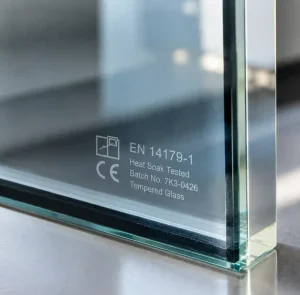
Glass bridge laminated glass demands manufacturing precision beyond standard architectural glazing. Tempered glass must achieve minimum 120 MPa surface compression (EN 12150) with 40-60 fragments per 50×50mm area. Heat soak testing at 290°C for 8 hours eliminates nickel sulfide inclusions that cause spontaneous breakage.
Lamination requires autoclave pressure of 12-14 bar at 135-145°C for SGP bonding. Glass cleanliness is critical as any contamination between layers compromises structural integrity. Zhongbo Glass operates autoclaves up to 4200mm × 28000mm, enabling jumbo-size glass bridge panels without mid-panel joints. Our production capacity reaches 1500m²/24h with rigorous inspection at every stage including dimensional verification (±0.5mm tolerance) and interlayer adhesion testing.

Installation and Support Systems
Glass bridge panels require engineered support systems that distribute loads while accommodating thermal expansion. Continuous edge support using structural steel frames with silicone glazing is most common, providing load distribution across the entire perimeter. Point-supported systems with spider fittings offer visual minimalism but require thicker glass.
For spans exceeding 6 meters, stainless steel cable support systems supplement edge supports, reducing glass thickness requirements. Glass panels expand approximately 9×10⁻⁶/°C, requiring 12-20mm expansion joints with structural silicone every 3-4 meters maximum.

Frequently Asked Questions
What thickness laminated glass is required for glass bridges?
Glass bridge specifications typically require triple-layer configurations ranging from 3×12mm to 3×19mm depending on span length and design loads. For standard pedestrian bridges with 3-6 meter spans, 3×15mm tempered glass with SGP interlayers is most common. Engineering calculations per ASTM E1300 determine exact thickness based on your specific project parameters.
Why is SGP interlayer mandatory instead of PVB?
SGP interlayer provides 4× the tensile strength and 500× the shear modulus of PVB, maintaining structural rigidity after glass fracture. When tempered glass breaks, SGP holds fragments in a structural membrane that retains 60-70% load-bearing capacity. PVB becomes too flexible after glass breakage, losing structural capacity and creating safety hazards. All modern glass bridges use SGP interlayers for this critical post-breakage performance.
How is anti-slip treatment applied to glass bridges?
Anti-slip treatment is typically acid-etched into the top glass layer surface before lamination. This chemical process creates microscopic surface texture achieving 0.60-0.75 coefficient of friction on wet surfaces. The etching depth of 0.1-0.2mm maintains structural integrity while providing permanent slip resistance. Alternative treatments include ceramic frit patterns (fired during tempering) or polymer coatings (applied post-installation but requiring periodic maintenance).
What safety factor is required for glass bridge engineering?
Glass bridges require minimum 4:1 safety factor for glass components and 3:1 for support structures, significantly higher than standard building glazing (2.5:1). This accounts for glass material variability, extreme loading conditions, and consequence-of-failure severity. Additionally, post-breakage analysis must demonstrate 60%+ load capacity with one glass layer completely fractured, providing structural redundancy.
How long does glass bridge laminated glass last?
Properly manufactured and maintained glass bridge panels have 25-30 year service life expectancy. SGP interlayers show minimal degradation over this period when protected from edge moisture infiltration. Regular inspection programs are mandatory, with annual structural assessment and 5-year major evaluation. Anti-slip surface treatments may require renewal every 10-15 years depending on traffic volume and maintenance practices.
What are maximum glass bridge panel sizes?
Panel size limitations depend on manufacturing capabilities and transportation constraints. Zhongbo Glass produces laminated glass panels up to 4200mm × 28000mm using our specialized autoclave systems. However, practical site constraints typically limit installed panels to 3000mm × 6000mm maximum. Larger bridge spans use multiple panels with structural silicone joints or point-support systems spanning between discrete panels.
Conclusion
Glass bridge laminated glass specifications demand engineering rigor beyond standard architectural glazing. Triple-layer configurations with SGP interlayers, comprehensive load analysis with 4:1 safety factors, mandatory anti-slip treatments, and rigorous testing protocols ensure visitor safety while maintaining the transparent experience that makes glass bridges architecturally significant.
The key technical requirements are non-negotiable: minimum 3-layer tempered glass construction, SGP interlayers for post-breakage structural capacity, acid-etched anti-slip surfaces achieving COF > 0.60 wet, and full-scale load testing before public access. These specifications, validated through projects like the Zhangjiajie Grand Canyon Glass Bridge, represent current best practice in glass bridge engineering.
If you need high-quality laminated glass for your glass bridge project, Zhongbo Glass offers world-class manufacturing capabilities up to 4200mm × 28000mm panel sizes. Our specialized autoclave systems and rigorous quality control ensure structural glass that meets the most demanding safety standards for pedestrian bridges, skywalks, and floor glass applications. We have successfully supplied glass for iconic projects worldwide.
Contact us today for technical specifications, engineering support, and competitive pricing for your glass bridge project.