Modern interior design demands materials that balance aesthetics with structural performance. Metal-inlaid decorative glass combines the transparency of glass with the visual warmth and texture of metallic elements. According to recent studies, embedded steel mesh inserts significantly enhance post-breakage capacity while maintaining architectural beauty. If you need decorative glass that delivers both visual impact and structural integrity for commercial or residential projects, understanding metal-inlaid glass design options and manufacturing techniques is essential.
What Is Metal-Inlaid Decorative Glass?
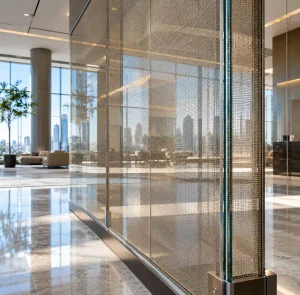
Metal-inlaid decorative glass is a laminated glass product with metallic elements—typically woven mesh, wire patterns, or metal sheets—embedded between glass layers using specialized interlayer materials. The metal component is permanently bonded within the glass structure through high-temperature and high-pressure lamination, creating a composite material that combines glass optical properties with decorative and structural benefits of metal.

This architectural glass includes various configurations: woven metallic mesh laminated between clear or tinted glass, metal wire patterns in custom geometric designs, expanded metal sheets for industrial aesthetics, and perforated metal layers for controlled light diffusion. The manufacturing process uses polyvinyl butyral (PVB) or SentryGlas Plus (SGP) interlayers to bond metal and glass permanently. Zhongbo Glass manufactures metal-inlaid decorative glass up to 4200mm × 28000mm using our world’s largest autoclave, enabling oversized architectural installations.
Design Options for Metal-Inlaid Glass
Mesh Pattern Variations
Metal mesh interlayers offer the widest design flexibility for architectural glass projects. You can specify woven wire mesh with apertures ranging from 0.5mm to 50mm, expanded metal mesh with diamond or hexagonal patterns, perforated metal sheets with custom hole patterns, and welded wire mesh for maximum structural strength. Decorative mesh-laminated glass provides extensive pattern options while maintaining 60% to 85% visible light transmission depending on mesh density.
| Mesh Type | Wire Diameter | Aperture Size | VLT Range | Applications |
|---|---|---|---|---|
| Woven wire mesh | 0.3mm – 2.0mm | 1mm – 20mm | 70% – 85% | Office partitions, decorative panels |
| Expanded metal | 1.0mm – 3.0mm | 5mm – 50mm | 60% – 75% | Exterior facades, balustrades |
| Perforated sheet | 0.5mm – 2.0mm | 2mm – 30mm | 65% – 80% | Privacy screens, feature walls |
| Welded mesh | 2.0mm – 5.0mm | 10mm – 100mm | 55% – 70% | Structural glazing, safety barriers |
Metal Material Selection
Material choice significantly impacts aesthetics and performance. Stainless steel 304 or 316 provides corrosion resistance for exterior applications. Brass mesh creates warm golden tones for luxury interiors. Copper develops natural patina over time. Bronze combines durability with rich brown tones. Aluminum delivers lightweight solutions with silver-gray finishes.

Research on stainless-steel mesh reinforcement shows that wire size and orientation significantly influence structural performance. You should specify marine-grade stainless steel (316) when glass will be exposed to moisture or salt air, as standard 304 stainless may corrode in these environments.
Pattern Customization
Beyond standard mesh configurations, metal-inlaid glass supports custom pattern design. Digital cutting technologies enable precise metal shapes: geometric patterns with repeating motifs, organic designs inspired by nature, gradient effects with varying mesh density, and corporate logos embedded at architectural scale. Custom metal patterns can be fabricated through laser cutting, water jet cutting, or chemical etching before lamination.

Manufacturing Process
The manufacturing process begins with precise material preparation. Glass sheets are cut to specified dimensions using CNC cutting lines. Metal mesh is fabricated to exact sizes with 2mm to 5mm edge clearance from glass perimeter. PVB interlayer sheets are prepared at 0.38mm, 0.76mm, or 1.52mm thickness depending on structural requirements. Laminated glass manufacturing processes require clean room environments with controlled humidity below 30% to prevent PVB moisture absorption.
Components are assembled in sequence: bottom glass sheet, PVB interlayer, metal mesh, second PVB interlayer, top glass sheet. The assembly passes through pre-press rollers at 90°C to 110°C, activating the PVB and creating preliminary adhesion between all layers. The pre-pressed assembly then enters the autoclave for final bonding. Autoclave curing parameters typically include temperature of 135°C to 145°C, pressure of 12 to 14 bar, and cycle time of 90 to 180 minutes.

Zhongbo Glass operates eight laminated glass production lines with autoclaves up to 4.2m × 28m, enabling metal-inlaid glass panels reaching 18 meters in single-piece dimensions. This eliminates joints in large architectural installations. Every panel undergoes rigorous inspection including visual checks, adhesion testing per ASTM D3359, dimensional verification, and structural testing for impact resistance per EN 12600.
Structural and Safety Performance
One of the most significant advantages of metal-inlaid glass is enhanced post-breakage performance. Research confirms that embedded steel mesh provides continued structural support after glass fracture, maintaining occupant safety during evacuation. The metal mesh acts as a secondary load path, bearing weight even when glass has completely fractured. Testing shows mesh-reinforced laminated glass can maintain 40% to 60% of pre-breakage load capacity, compared to less than 10% for conventional laminated glass.

Studies on pull-through resistance demonstrate that locally embedded steel mesh significantly improves connection performance under both monotonic and sustained creep loading. Metal mesh reinforcement enhances impact resistance beyond standard laminated glass capabilities. For public spaces, mesh-laminated glass durability has been proven through installations in airports, shopping malls, and transit stations.
Thermal performance varies with metal type and coverage. Highly conductive metals like copper or aluminum can slightly reduce insulation value, while stainless steel has minimal thermal impact. For energy-efficient applications, you can combine metal-inlaid glass with Low-E coatings applied to non-mesh surfaces, achieving U-values of 1.2 to 1.6 W/m²K in insulated glass unit (IGU) configurations.
Interior Design Applications
Metal-inlaid glass excels in creating semi-transparent partitions that define space without blocking light. Luxury interior design applications include hotel lobbies, upscale retail stores, and residential feature walls.

Feature walls using metal-inlaid glass create dramatic focal points in commercial and residential spaces. Backlit installations amplify the mesh pattern, casting intricate shadows and highlighting the three-dimensional quality of embedded metal. Designers can also explore fabric and metal glass options or combine different mesh densities to create gradient effects or zoned privacy within a single panel.
Structural considerations for mesh glass balustrades include wind load resistance, impact requirements per building codes, and connection details for point-fixed or channel-mounted systems.

Metal-inlaid glass doors create memorable entrances for commercial buildings, hotels, and upscale retail. Metal-inlaid glass doors require minimum 10mm + 1.52PVB + 10mm thickness, tempered glass for safety, and 5mm mesh edge clearance.
Specification Guidelines
For interior partitions requiring 70% to 80% light transmission, specify fine woven mesh with 1mm to 3mm apertures. For exterior facades, choose stainless steel 316. When structural performance is critical, specify expanded metal mesh with minimum 2mm thickness.
| Application | Glass Config | Mesh Type | Interlayer | Total Thickness |
|---|---|---|---|---|
| Interior partition | 6mm + 6mm | Woven SS304 | 0.76mm PVB | 12.76mm |
| Balustrade | 10mm + 10mm | Expanded SS316 | 1.52mm SGP | 21.52mm |
| Overhead glazing | 12mm + 12mm | Welded SS316 | 2.28mm SGP | 26.28mm |
| Facade panel | 8mm + 8mm | Perforated aluminum | 1.52mm PVB | 17.52mm |
Metal-inlaid decorative glass must comply with applicable safety glazing standards. In North America, specify compliance with ANSI Z97.1 and CPSC 16 CFR 1201. For European projects, EN 12543 governs laminated glass, while EN 12600 classifies impact resistance. Building codes may require safety glazing within 900mm of doors, less than 450mm above walking surfaces, and in overhead glazing applications.
Metal-inlaid glass requires no special maintenance beyond standard glass cleaning. Use pH-neutral glass cleaners and soft cloths to avoid scratching. The embedded metal is protected by glass and interlayer, preventing oxidation and degradation. This long-term durability reduces lifecycle costs compared to alternative decorative finishes.

Cost Considerations
Metal-inlaid glass costs $120 to $250 per square meter depending on complexity, metal type, and size. Custom patterns increase costs by 30% to 60% compared to standard configurations.
Metal-inlaid glass delivers value through distinctive aesthetics, enhanced durability, and reduced maintenance costs, justifying higher initial investment for commercial developments.
Frequently Asked Questions
What is the maximum size for metal-inlaid decorative glass panels?
Zhongbo Glass manufactures metal-inlaid glass up to 4200mm × 28000mm using our world’s largest autoclave. This enables single-piece panels reaching 18 meters, eliminating joints in large architectural installations.
Can metal-inlaid glass be used in exterior applications?
Yes, when specified correctly. Use stainless steel 316 mesh for corrosion resistance. Ensure complete edge sealing to prevent moisture ingress. Specify tempered glass for thermal stress resistance. Exterior metal-inlaid glass should comply with wind load requirements per ASTM E1300 and local building codes.
How does metal mesh affect visible light transmission?
VLT depends on mesh density and wire diameter. Fine woven mesh (1mm to 3mm apertures) provides 70% to 85% VLT. Expanded metal or coarser mesh reduces VLT to 55% to 70%. You can calculate approximate VLT by determining the percentage of open area in the mesh pattern.
Is metal-inlaid glass suitable for overhead glazing?
Metal-inlaid glass is an excellent choice for overhead applications due to enhanced post-breakage capacity. Specify minimum 12mm + 12mm configuration with SGP interlayer. Use welded or expanded metal mesh for maximum structural support. Structural calculations must account for dead load, live load, snow load, and seismic requirements.
What maintenance does metal-inlaid glass require?
Maintenance requirements are minimal. Clean with pH-neutral glass cleaner and soft cloths. Inspect stainless steel mesh annually for corrosion signs in high-humidity environments. The embedded metal is protected by glass and interlayer, requiring no polishing or refinishing throughout the building lifecycle.
Can metal patterns be customized for branding or specific designs?
Yes, laser cutting and water jet technologies enable precise custom metal patterns including corporate logos, geometric designs, or organic patterns. Minimum feature size is typically 2mm for reliable fabrication. Lead time for custom mesh fabrication is 4 to 6 weeks beyond standard production.

Conclusion
Metal-inlaid decorative glass represents a sophisticated solution for architectural projects requiring both aesthetic distinction and structural performance. Understanding design options—from mesh pattern variations to metal material selection—enables architects and designers to specify configurations that meet project-specific requirements. Zhongbo Glass’s world-class production facilities, including the industry’s largest autoclave at 4.2m × 28m, deliver jumbo-size metal-inlaid glass panels up to 18 meters for landmark architectural installations.
If you need custom metal-inlaid decorative glass for commercial, residential, or institutional projects, Zhongbo Glass offers comprehensive engineering support, material testing, and factory-direct pricing. Contact us today for technical specifications and project consultation.