Choosing between tempered and heat-strengthened glass isn’t just about picking the stronger option—it’s about matching the glass type to your project’s specific demands. Both undergo heat treatment, but the differences in their manufacturing process create distinct performance characteristics that matter for safety, cost, and long-term durability.
After specifying both glass types across hundreds of commercial projects, I’ve learned that the wrong choice leads to costly replacements or safety incidents. This guide breaks down the real-world differences based on strength testing, building code requirements, and field performance.
What Is Tempered Glass?
Tempered glass (also called toughened glass) is manufactured by heating annealed glass to approximately 620°C (1,148°F), then rapidly cooling it with high-pressure air jets. This process locks the outer surfaces in compression while the core remains in tension, creating a glass product that’s approximately 4-5 times stronger than standard annealed glass.
The defining characteristic? When tempered glass breaks, it shatters into thousands of small, relatively blunt cube-like fragments rather than dangerous shards—a safety feature that’s saved countless people from serious injuries.

Key Properties of Tempered Glass
Surface Compression: Minimum 10,000 psi (69 MPa) on surfaces, 9,700 psi (67 MPa) on edges—this is what gives tempered glass its exceptional strength.
Thermal Resistance: Can withstand temperature differentials up to 200°C (392°F), making it suitable for applications with significant heat exposure like oven doors and fire-rated assemblies.
Post-Breakage Safety: The dice pattern breakage reduces laceration risk by 80% compared to annealed glass, according to construction safety studies.
Limitations: Cannot be cut, drilled, or edge-worked after tempering. Any fabrication must occur before the heat treatment process. Additionally, tempered glass carries a small risk of spontaneous breakage due to nickel sulfide inclusions (typically 1 in 10,000 panels).
What Is Heat-Strengthened Glass?
Heat-strengthened glass follows a similar manufacturing process but with less intense cooling. It’s heated to the same temperature as tempered glass but cooled at roughly half the rate. This creates lower surface compression—between 3,500 and 7,500 psi (24-52 MPa)—resulting in glass that’s approximately twice as strong as annealed glass but not as strong as fully tempered.
The critical difference lies in how it breaks. Heat-strengthened glass fractures into larger pieces similar to annealed glass, but these pieces tend to stay in the frame longer, providing what glaziers call “fallout resistance.”

Key Properties of Heat-Strengthened Glass
Moderate Strength: Approximately 2x stronger than annealed glass, providing enhanced wind load and thermal stress resistance without full tempering.
Controlled Breakage: Breaks into larger fragments that remain in the opening longer—beneficial for overhead glazing where you want broken glass to stay in place temporarily rather than showering down immediately.
Lower Spontaneous Breakage Risk: The gentler cooling process virtually eliminates nickel sulfide-induced spontaneous fracture, making it more predictable for large installations.
Thermal Cycling Tolerance: Better suited for applications with repeated thermal cycling, as the lower residual stress means less fatigue over time.
Strength Comparison: The Numbers That Matter
| Property | Annealed Glass | Heat-Strengthened Glass | Tempered Glass |
|---|---|---|---|
| Surface Compression | 0 psi | 3,500-7,500 psi | 10,000+ psi |
| Strength vs. Annealed | 1x (baseline) | 2x | 4-5x |
| Thermal Shock Resistance | 40°C (72°F) | 100°C (180°F) | 200°C (392°F) |
| Breakage Pattern | Large, sharp shards | Large fragments, stay longer | Small, blunt cubes |
| Safety Glazing Classification | No | No | Yes |
| Spontaneous Breakage Risk | None | Virtually none | 0.01-0.03% |
At Zhongbo Glass, our testing with panels up to 3,660mm × 28,000mm—produced on the world’s largest tempering line—confirms these strength differentials hold even at extreme sizes where thermal gradients become more challenging to control.

Breakage Patterns: Why It Matters for Safety
Tempered Glass Breakage
When tempered glass fails, the entire panel explodes into thousands of small pieces almost instantaneously. This “dicing” occurs because cracks propagate through the tension-stressed core at speeds exceeding 5,000 feet per second.
Safety advantage: The small, blunt fragments significantly reduce laceration injuries. Building codes recognize this, allowing tempered glass in “hazardous locations” like doors, shower enclosures, and guardrails.
Trade-off: Complete fragmentation means immediate loss of the barrier. In overhead applications, this creates a “glass rain” scenario, though the blunt edges minimize injury severity.
Heat-Strengthened Glass Breakage
Heat-strengthened glass cracks into larger pieces—typically hand-sized or larger—that tend to remain in the frame for several minutes after initial fracture. The crack propagation is much slower because there’s less internal tension driving it.
Safety consideration: Larger fragments pose greater laceration risk, which is why heat-strengthened glass doesn’t qualify as safety glazing under most building codes.
Trade-off: The delayed fallout can be advantageous in overhead or sloped glazing where you want time to evacuate an area before glass falls.
Cost Analysis: Initial Investment vs. Long-Term Value
| Cost Factor | Heat-Strengthened Glass | Tempered Glass |
|---|---|---|
| Raw Material Processing | $6-8/m² | $8-12/m² |
| Heat Treatment Premium | 15-25% over annealed | 35-50% over annealed |
| Heat Soak Testing (optional) | Not typically required | Add $2-4/m² if specified |
| Replacement Risk (spontaneous) | <0.001% | 0.01-0.03% |
| Fabrication Constraints | Moderate | Severe (no post-processing) |
Heat-strengthened glass typically costs 20-30% less than tempered glass for equivalent specifications. However, the real cost comparison depends on your specific application.
When heat-strengthened saves money: Large vision panels, curtain walls, and spandrel glass where safety glazing isn’t required. The lower processing cost and virtually zero spontaneous breakage risk can deliver significant savings on projects with thousands of square meters.
When tempered justifies the premium: Any application where human contact is likely, building codes mandate safety glazing, or maximum strength is required. The safety benefits and code compliance make it non-negotiable despite higher initial cost.

Thermal Stress Resistance: Real-World Performance
Both glass types excel at resisting thermal stress, but they behave differently under extreme conditions.
Heat-Strengthened Glass in Thermal Applications
The moderate compression levels allow heat-strengthened glass to accommodate thermal expansion and contraction with less internal stress buildup. This makes it particularly suitable for:
- Tinted or reflective glass facades where solar absorption creates temperature differentials across the panel
- Applications with partial shading where one section heats while another remains cool
- Insulated glass units where thermal cycling occurs daily
Heat-strengthened glass can typically handle center-to-edge temperature differences of 100°C (180°F), according to thermal stress analysis guidelines.
Tempered Glass in High-Heat Environments
Tempered glass doubles that thermal differential tolerance to 200°C (392°F), making it the only choice for applications like:
- Fire-rated assemblies requiring integrity during fire exposure
- Oven and appliance doors with sustained high temperatures
- Exterior glazing in extreme climates where snow loads combined with solar heating create severe thermal stress
At Zhongbo Glass, we’ve supplied tempered glass for desert installations where surface temperatures exceed 80°C while edges remain 40°C cooler—conditions that would fracture heat-strengthened glass within hours.

Building Code Requirements: When the Choice Isn’t Yours
The International Building Code (IBC) and most regional codes mandate safety glazing in specific “hazardous locations.” Only fully tempered glass (or laminated glass) meets these requirements.
Applications Requiring Tempered Glass
Building codes specify tempered glass for:
- Doors and sidelights (within 24 inches of door edges, bottom edge less than 60 inches above walking surface)
- Shower and bathtub enclosures (any glazing within 60 inches of water)
- Stair-adjacent glazing (bottom edge below 60 inches, within 60 inches horizontally)
- Guardrails and barriers (any glazing used as a structural guard)
- Specific sports and recreational facilities
Violating these requirements exposes building owners to serious liability. In one project audit we conducted, a contractor had installed heat-strengthened glass in a commercial entrance—technically strong enough, but not code-compliant. The entire installation required replacement before occupancy.
Where Heat-Strengthened Glass Is Allowed
Heat-strengthened glass is code-compliant for:
- Vision panels in curtain wall systems (not in hazardous locations)
- Spandrel glass (non-vision areas)
- Overhead glazing when laminated (the lamination provides post-breakage containment)
- Interior partitions away from doors and high-traffic areas
Reference: Building code requirements

Application Guidelines: Matching Glass to Use Case
Choose Tempered Glass When:
Maximum strength is required: High-wind zones, areas with impact risk, or any application where the glass faces significant mechanical stress.
Safety glazing is mandated: Building codes leave no choice—hazardous locations require tempered or laminated glass.
Thermal stress is extreme: Fire-rated applications, high-heat environments, or severe climate differentials exceed heat-strengthened capabilities.
Spontaneous breakage can be managed: Projects with accessible panels where occasional replacement is acceptable, or where heat-soak testing can reduce NiS risk.
Choose Heat-Strengthened Glass When:
Curtain wall applications: Large vision panels in commercial facades where wind loads require strength beyond annealed glass but safety glazing isn’t mandated.
Minimizing spontaneous breakage risk: High-rise installations where glass fallout poses significant hazards, and the virtual elimination of NiS-related failures justifies choosing heat-strengthened.
Thermal cycling is significant: Facades with daily temperature swings benefit from heat-strengthened glass’s superior thermal fatigue resistance.
Post-breakage retention matters: Overhead or sloped glazing where you want fractured glass to stay in the frame temporarily (typically combined with lamination for code compliance).
Cost is a major factor: Projects with large glass areas where heat-strengthened provides adequate performance at lower cost.
Production Capabilities: Size Considerations
Maximum production dimensions often determine glass selection for large-scale projects. Standard tempering equipment handles panels up to 2,400mm × 3,600mm, but modern architectural projects frequently demand larger formats.
Zhongbo Glass operates specialized equipment producing both tempered and heat-strengthened glass up to 3,660mm × 28,000mm for flat panels and 3,660mm × 20,000mm for curved sections. These dimensions enable seamless facades and structural glazing without intermediate mullions.

Combining with Other Glass Types
Both tempered and heat-strengthened glass integrate into laminated and insulated glass units, but sequencing matters—heat treatment must occur before lamination.
Tempered + lamination: Combines impact resistance with post-breakage retention. When tempered glass shatters, the interlayer holds fragments in place. Common for overhead glazing, guardrails, and hurricane-resistant assemblies.
Heat-strengthened + lamination: Larger fracture patterns with interlayer retention create excellent post-breakage stability. Often specified for overhead glazing where fallout prevention matters but full tempering isn’t required.
Insulated glass units: Both work in IGU fabrication, but heat-strengthened glass offers lower spontaneous breakage risk in inaccessible cavity positions—valuable since replacing an interior lite requires removing the entire unit.

Industry Innovations and Trends
Recent developments are changing the tempered versus heat-strengthened calculation:
Advanced heat-soak testing: New protocols reduce tempered glass spontaneous breakage risk to near-zero levels, though at added cost and lead time. This makes tempered glass more reliable for high-risk installations.
Chemical strengthening: Ion-exchange processes create strength comparable to heat-strengthening without thermal treatment, enabling curved and complex shapes impossible with traditional methods.
Larger production capabilities: As equipment advances, size-related limitations that once favored heat-strengthened glass for large panels are diminishing, giving architects more design freedom.
FAQ
Q: Can you convert heat-strengthened glass to tempered glass?
No. Once cooled, the glass’s stress profile is permanent. Converting would require re-heating the glass above its annealing point (which erases all heat treatment) and starting over—essentially destroying and remaking the panel.
Q: How can you tell tempered and heat-strengthened glass apart?
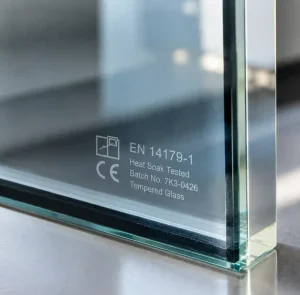
Visually, they’re nearly identical. Code requires tempered glass to carry permanent identification (etched, sandblasted, or ceramic-fired marks). Heat-strengthened glass typically isn’t marked. Using polarized light or strain viewers reveals different stress patterns: tempered shows more intense edge stress bands.
Q: Is heat-strengthened glass worth the extra cost over annealed?
For curtain walls and large facades, absolutely. The 2x strength increase provides necessary wind load resistance and thermal stress tolerance at roughly 20% added cost—far less than tempered glass’s 40-50% premium.
Q: Can I use heat-strengthened glass in a residential shower door?
No. Building codes explicitly require safety glazing (tempered or laminated) in shower enclosures. Heat-strengthened glass doesn’t qualify because its fracture pattern poses laceration risk.
Q: What about mixing tempered and heat-strengthened glass in the same project?
Common and often advisable. Many curtain wall projects use tempered glass at entry levels (within hazardous location zones) and heat-strengthened above, optimizing both code compliance and cost.
Conclusion
The choice between tempered and heat-strengthened glass comes down to three factors: building code requirements, performance demands, and project budget. Tempered glass is mandatory when codes require safety glazing or when maximum strength matters most. Heat-strengthened glass offers the best value for commercial facades where safety glazing isn’t mandated—lower cost, virtually zero spontaneous breakage, and excellent thermal performance make it ideal for curtain walls.
Both glass types serve distinct purposes in modern architecture. Understanding their differences ensures you specify the right one. For projects requiring heat-treated glass fabrication up to 3,660mm × 28,000mm, Zhongbo Glass provides technical consultation on glass selection, wind load analysis, and thermal stress evaluation.
Related Products: Tempered Glass | Laminated Glass | Insulated Glass