Energy costs account for nearly 40% of building operating expenses, with curtain wall systems responsible for up to 30% of heating and cooling energy loss in commercial high-rise buildings. Selecting the right curtain wall glass configuration determines whether a building performs efficiently for decades or becomes a maintenance burden.
If you want to select the right curtain wall glass for your high-rise project, you need to understand glass types, performance specifications, structural requirements, and international standards.
What Is Curtain Wall Glass?
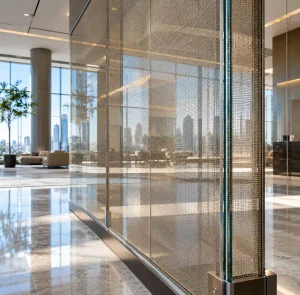
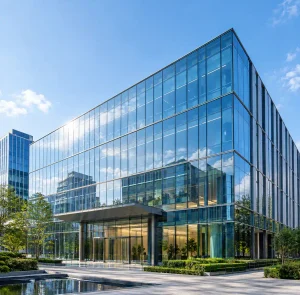
Curtain wall glass refers to glazing systems used in non-structural building facades. The glass doesn’t carry structural loads except its own weight and wind forces. You can specify curtain wall glass in unitized or stick-built systems, ranging from single-pane to complex multi-layer configurations.
Modern curtain wall systems use tempered glass, laminated glass, or insulated glass units (IGU) depending on performance requirements. According to ASTM E2112 standards, curtain wall systems must meet specific performance criteria for air infiltration, water penetration, and structural deflection.

Types of Curtain Wall Glass Systems
Tempered Glass
Tempered glass offers 4-5 times the strength of annealed glass and breaks into small, harmless fragments. It’s manufactured by heating glass to 620°C and rapidly cooling it, creating surface compression. The main limitation is poor thermal performance with U-values of 5.8 to 6.0 W/m²K, making single-pane systems unsuitable for energy-efficient high-rise buildings.
Insulated Glass Units (IGU)
Insulated glass units consist of two or more glass panes separated by spacers and sealed to create an air or gas-filled cavity. You can achieve U-values as low as 0.25 W/m²K with triple-pane Low-E IGU configurations filled with argon gas. The cavity width typically ranges from 12mm to 20mm, with argon gas improving performance by approximately 20% compared to air-filled units.

Low-E Coated Glass
Low-E glass features microscopically thin metallic coatings that reflect infrared radiation while allowing visible light transmission. Surface 2 coating (inner surface of outer pane) optimizes solar control, while surface 3 (outer surface of inner pane) maximizes thermal insulation. You can achieve SHGC values ranging from 0.23 to 0.70 depending on coating type and configuration, with VLT typically ranging from 40% to 70%.
Laminated Safety Glass
Laminated glass consists of glass plies bonded with PVB (Polyvinyl Butyral) or SGP (SentryGlas Plus) interlayers. When broken, fragments adhere to the interlayer, providing post-breakage integrity. You should specify laminated glass for overhead glazing, blast-resistant facades, and hurricane-prone regions. SGP interlayers offer 5 times the stiffness and 100 times the tear strength of PVB, making them ideal for structural applications.

Critical Performance Specifications
Thermal Performance: U-Value and SHGC
U-value measures heat transfer through glazing, with lower values indicating better insulation. For high-rise commercial buildings, target U-values below 1.2 W/m²K in cold climates and below 1.8 W/m²K in mixed climates. SHGC measures solar heat gain (0 to 1 scale)—lower SHGC reduces cooling loads in hot climates, while higher SHGC benefits heating-dominated climates.
| Climate Zone | Recommended U-Value (W/m²K) | Recommended SHGC | Glass Configuration |
|---|---|---|---|
| Hot Climate | 1.2 – 1.8 | 0.25 – 0.35 | Double-pane Low-E, low SHGC coating |
| Mixed Climate | 0.8 – 1.4 | 0.35 – 0.45 | Double or triple-pane Low-E |
| Cold Climate | 0.25 – 1.0 | 0.40 – 0.55 | Triple-pane Low-E with argon |
Visible Light Transmission
VLT measures visible light passing through glazing. For commercial office buildings, VLT between 50% and 70% provides adequate daylighting while controlling glare. Low-E coatings can maintain high VLT (60-70%) while achieving low SHGC (0.25-0.35). The light-to-solar-gain ratio (LSG = VLT/SHGC) helps evaluate this balance, with values above 1.5 considered excellent.

Structural Requirements and Wind Load Calculations
Glass Thickness Selection
Glass thickness depends on panel dimensions, wind loads, and safety factors. According to ASTM E1300, you must use probability-based methodology considering glass type, aspect ratio, and load duration. For typical high-rise curtain wall applications, glass thickness ranges from 6mm to 19mm. Wind pressure increases with building height—for a 50-story building, design wind pressures can exceed 3.5 kPa (73 psf).
Load Resistance
Tempered glass offers approximately 4 times the load resistance of annealed glass of the same thickness. For structural glazing applications, maximum tensile stress should remain below ASTM E1300 allowable values: 24 MPa for annealed glass and 90 MPa for heat-strengthened glass. Deflection should be limited to L/60 for typical curtain wall applications to prevent gasket problems.
| Glass Type | Relative Strength | Maximum Tensile Stress | Breakage Pattern | Applications |
|---|---|---|---|---|
| Annealed | 1x (baseline) | 24 MPa | Large dangerous shards | Not recommended for high-rise |
| Heat-Strengthened | 2x | 45 MPa | Larger fragments | Laminated glass substrate |
| Tempered | 4-5x | 90 MPa | Small harmless cubes | Safety glazing, curtain walls |
| Laminated (SGP) | Enhanced | Higher post-breakage | Superior integrity | Structural glazing, bridges |

Manufacturing Size Capabilities
Standard tempering lines accommodate glass up to 2400mm × 3660mm, but iconic architectural projects often require larger dimensions. Zhongbo Glass operates the world’s largest tempering line at 3660mm × 28000mm, enabling ultra-large panels up to 18 meters in length. Large-format glass reduces mullion count, creating cleaner sightlines and reducing thermal bridging. For projects requiring jumbo glass, verify manufacturing capabilities during the design phase.

Safety Standards and Testing
Curtain wall glass must comply with multiple standards. ASTM E2112 specifies performance requirements for curtain wall systems, while ASTM E1300 governs glass thickness selection. EN 12150 requires fragmentation testing for tempered glass. Testing protocols include wind load testing per ASTM E330, air infiltration per ASTM E283, and water penetration per ASTM E331. For hurricane-prone regions, specify impact-resistant laminated glass tested per ASTM E1996.
Heat Soak Testing
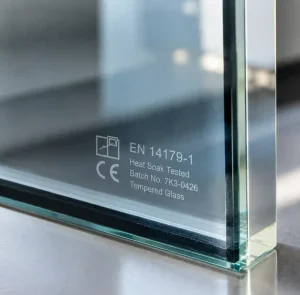
Spontaneous breakage of tempered glass due to nickel sulfide inclusions occurs in approximately 1 in 400 to 1 in 10,000 panels. Heat soak testing per EN 14179 reduces this risk by 95%. You should specify heat-soaked tempered glass for overhead glazing and large panels where replacement is difficult. The additional cost of 15-25% is justified by reduced liability.

Selection Criteria for High-Rise Buildings
Climate-Based Selection
In cooling-dominated climates (ASHRAE zones 1-3), prioritize low SHGC (0.25-0.35) to reduce solar heat gain. Specify Low-E coatings on surface 2 for maximum solar control. In heating-dominated climates (zones 6-8), maximize insulation with low U-values (0.25-0.8 W/m²K) using triple-pane IGU with argon fill. Higher SHGC (0.40-0.55) provides beneficial solar heat gain during winter.

Building Height and Wind Exposure
Building height significantly impacts wind loads. For buildings above 100 meters, design wind pressures often exceed 4.0 kPa, requiring thicker glass. Wind tunnel testing is recommended for buildings exceeding 150 meters. The cost ($30,000-$80,000) is justified by material savings on large projects.
Orientation and Solar Exposure
South and west facades receive maximum solar exposure, requiring lower SHGC values. North facades receive minimal direct sunlight, allowing higher SHGC and VLT for better daylighting. You can optimize performance by varying glass specifications based on orientation. External shading systems can reduce solar heat gain by 70-80%. The combination of high-performance energy-efficient glass and external shading delivers optimal performance.

Frequently Asked Questions
What is the standard glass thickness for high-rise curtain walls?
Standard glass thickness ranges from 6mm to 12mm per lite, depending on panel size and wind loads. For tall buildings above 50 stories, you may need 10mm to 19mm glass. Always verify thickness using ASTM E1300 calculations based on your specific project parameters.
How do I calculate required glass thickness for wind loads?
Use ASTM E1300 standard practice for glass thickness selection. Calculate design wind pressure per ASCE 7 based on building location, height, and exposure. Input glass dimensions, type, and edge support conditions into ASTM E1300 charts or software to determine required thickness with appropriate safety factors.
What is the difference between U-value and SHGC?
U-value measures heat transfer through conduction, with lower values indicating better insulation (0.25 to 6.0 W/m²K range). SHGC measures solar heat gain from radiation, with lower values reducing cooling loads (0 to 1 scale). You need to optimize both—low U-value for insulation and appropriate SHGC based on climate zone.
Should I specify heat-soaked tempered glass?
Heat soak testing reduces spontaneous breakage risk by 95% but adds 15-25% to glass cost. Specify heat-soaked glass for overhead applications, inaccessible locations where replacement is difficult, and projects where spontaneous breakage risk is unacceptable. For standard vertical curtain walls, heat soak testing is optional but recommended for large panels.
What are the lead times for jumbo-size curtain wall glass?
Standard curtain wall glass typically requires 6-8 weeks production time plus 4-6 weeks shipping from China. Jumbo-size panels exceeding 12 meters may need 8-10 weeks production time. For projects requiring ultra-large glass, confirm manufacturing capabilities and lead times during design development to avoid schedule delays.
Can I mix different glass types on the same building?
Yes, you can specify different glass configurations based on orientation and exposure. South and west facades often use lower SHGC glass for solar control, while north facades use higher VLT glass for daylighting. Ensure aesthetic consistency by matching color and reflectance properties.
Conclusion
Selecting curtain wall glass for high-rise buildings requires balancing thermal performance, structural requirements, safety standards, and cost considerations. Understanding U-values, SHGC, glass types, and engineering requirements helps you make informed decisions that deliver energy efficiency, occupant comfort, and long-term building performance.
If you need high-quality curtain wall glass for your high-rise building project, Henan Zhongbo Glass offers world-class manufacturing capabilities up to 28 meters. Our facility features the world’s largest tempering lines (3.66m × 28m) and autoclave (4.2m × 28m), ensuring superior quality and precision for jumbo-size architectural glass. We have successfully supplied glass for iconic projects including Zhangjiajie Glass Bridge, Shanghai Museum East Hall, and numerous commercial curtain wall systems worldwide.
Contact us today for custom curtain wall glass solutions, technical specifications, and competitive factory-direct pricing.