When specifying glass for high-end architectural projects, the terminology can be confusing. You’ll hear “ultra-clear,” “low-iron,” “extra-clear,” and various brand names thrown around. Here’s what you need to know from someone who’s specified both for projects ranging from museum installations to curtain walls: ultra-clear and low-iron glass are the same material—just different marketing terms for glass with reduced iron oxide content.
After working on projects like the East Hall of Shanghai Museum where color accuracy was non-negotiable, I’ve learned exactly when the premium for low-iron glass justifies itself and when standard clear glass works just fine.
What Makes Low-Iron Glass Different
The distinction comes down to chemistry. Standard float glass contains approximately 0.10% iron oxide (Fe₂O₃) from the raw silica sand. That iron gives standard “clear” glass its characteristic greenish tint—subtle in thin sections but unmistakable when you look at the edge or stack multiple panes.
Low-iron glass reduces that iron oxide content to below 0.015%, sometimes as low as 0.01%. The result isn’t just less green—it fundamentally changes how the glass transmits light and renders color.

The Visual Difference: More Than Just “Less Green”
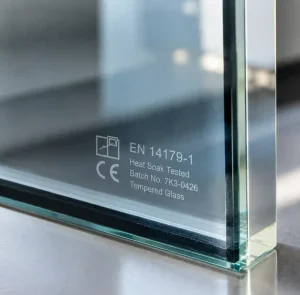
The edge color tells the story immediately. Hold a piece of standard clear glass next to low-iron glass and the difference is striking:
- Standard clear glass: distinct green edge, becomes more saturated as thickness increases
- Low-iron glass: blue-white or neutral edge, maintains clarity even at greater thicknesses
But the real difference shows up in how the glass performs in architectural applications. In our laminated glass assemblies for structural glazing, that color difference compounds with each layer. A triple-laminated unit in standard clear glass can look noticeably green; the same configuration in low-iron glass stays neutral.
Light Transmittance: The Numbers That Matter
Visible light transmittance (VLT) is where low-iron glass delivers measurable performance gains:
| Glass Type | VLT at 6mm | VLT at 12mm | Iron Oxide Content |
|---|---|---|---|
| Standard Clear Glass | 83-85% | 78-80% | ~0.10% Fe₂O₃ |
| Low-Iron Glass | 90-91% | 87-89% | <0.015% Fe₂O₃ |
| Ultra-Clear (Premium) | 91-92% | 88-90% | <0.01% Fe₂O₃ |
That 6-8% improvement in light transmission might not sound dramatic, but in a building envelope it translates to brighter interiors, reduced artificial lighting loads, and more accurate color rendering throughout the space.

Color Rendering: Why Museums Choose Low-Iron
Color accuracy is where low-iron glass becomes essential. The green cast of standard glass shifts how colors appear—whites look slightly green, blues shift toward teal, warm tones lose saturation. For most commercial applications, this shift is barely noticeable. For museums, galleries, high-end retail, or any space where color fidelity matters, it’s unacceptable.
The Shanghai Museum East Hall project required low-iron glass specifically because the exhibited artifacts needed to appear under neutral glazing that wouldn’t distort their colors. When visitors view 2,000-year-old ceramics, they need to see the true glaze colors, not a version filtered through greenish glass.
Thickness and Color Saturation
Here’s a practical consideration that often gets overlooked: the green tint of standard glass intensifies with thickness. At 6mm, it’s subtle. At 19mm, it’s pronounced. At 25mm in a laminated assembly, it’s unmistakable.
Low-iron glass maintains its neutral appearance even in thick configurations. This makes it the only viable option for:
- Structural glass fins (often 19-25mm thick)
- Heavy-duty laminated assemblies
- Aquariums and water features
- Glass staircases and floors where you’re looking through substantial thickness

Manufacturing Considerations at Scale
At Zhongbo Glass, we process both standard clear and low-iron glass through the same production lines—tempering up to 3660mm × 28000mm, laminating in our 4200mm × 28000mm autoclave, and coating with Low-E on our 3660mm line. The raw material cost differs, but the processing doesn’t.
What does change is quality control. Low-iron glass shows defects more readily than standard glass. That same neutrality that makes colors accurate also makes any inclusions, seeds, or surface imperfections more visible. This demands tighter QC at every stage.

Cost Analysis: When the Premium Makes Sense
Low-iron glass typically costs 40-80% more than standard clear glass, depending on availability, thickness, and order volume. That premium compounds when you factor in processing—tempering, laminating, coating.
| Application Type | Recommend Low-Iron? | Why |
|---|---|---|
| Standard curtain wall, tinted | No | Tint dominates, iron content irrelevant |
| Museum glazing, display cases | Yes | Color accuracy required |
| Frameless glass walls, partitions | Yes | Edge visibility, aesthetic clarity |
| Vision glass with standard aluminum framing | No | Frames visually dominate |
| Structural glass fins | Yes | Thick glass amplifies green tint |
| Storefronts, high-end retail | Yes | Product color accuracy, brand image |
| Back-painted glass, spandrel | No | Coating hides glass color |
| Residential windows, standard spec | No | Incremental VLT gain doesn’t justify cost |
Edge Detail and Aesthetics
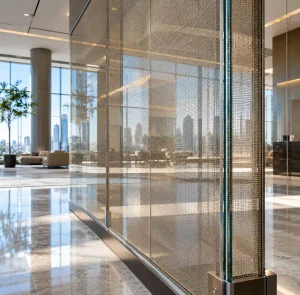
In frameless applications, the edge of the glass becomes a visible design element. This is where the blue-white edge of low-iron glass versus the green edge of standard clear creates a dramatic aesthetic difference.
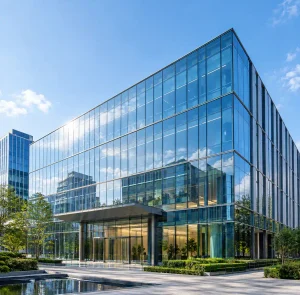
For curtain wall glass systems with minimal framing or structural silicone glazing where edges are exposed, low-iron glass delivers a cleaner, more premium appearance. The glass reads as genuinely transparent rather than as a greenish material.

Low-Iron Glass in Laminated Assemblies
Laminated glass multiplies the effect of iron oxide. A standard clear laminated unit (6mm + 6mm + 6mm with two PVB interlayers) accumulates the green tint through three glass layers. The result can look distinctly green rather than neutral.
For laminated glass applications where clarity matters—safety glazing in museums, structural glass floors, overhead glazing—low-iron glass is often specified for at least the visible surfaces. Some projects use low-iron on the exterior face and standard clear for interior layers to balance cost and performance.
Combining Low-Iron with Low-E Coatings
One question that comes up repeatedly: does it make sense to specify low-iron glass as the substrate for Low-E coated insulated glass units?
The answer depends on the coating position. If the Low-E coating faces the interior airspace (position 2 or 3 in a double-glazed unit), the low-iron substrate on the outer lite improves visible light transmittance and reduces color shift in reflection. If the coating is on an interior lite, low-iron glass on the view side still delivers clearer vision glass.
For high-performance facades balancing daylighting and solar control, low-iron glass with advanced Low-E coatings can achieve 70%+ VLT while maintaining low solar heat gain—impossible with standard clear substrates.

Real-World Application Guidelines
Specify low-iron glass when:
- Color accuracy is critical (museums, galleries, high-end retail)
- Maximum daylight transmission matters (LEED daylighting credits)
- Glass edges will be visible (frameless systems, structural fins)
- Glass thickness exceeds 12mm (green tint becomes pronounced)
Standard clear glass works fine when:
- Glass is tinted or reflective coated (iron content becomes irrelevant)
- Frames visually dominate the system
- Budget constraints outweigh marginal VLT gains

Specifications and Quality Control
Because low-iron glass reveals defects more readily, specifications should reference:
- ASTM C1036 for flat glass quality
- VLT requirements (typically ≥90% for 6mm)
- Maximum iron oxide content (<0.015% Fe₂O₃)
Both glass types process identically through tempering, laminating, and coating. The thermal performance (U-value), acoustic properties, and structural strength are equivalent. The difference is purely optical.

The 6-8% VLT improvement translates to real energy benefits in buildings optimized for daylighting, particularly for projects pursuing LEED credits or high daylight autonomy targets.
FAQ
Q: Is ultra-clear glass the same as low-iron glass?
Yes. “Ultra-clear,” “extra-clear,” and “low-iron” all refer to the same material—float glass with reduced iron oxide content (typically <0.015% Fe₂O₃). Specific brand names include Starphire, UltraClear, Optiwhite, and others, but the underlying product is equivalent.
Q: Can you see the difference between clear and low-iron glass when installed?
In thin sections with framing, the difference is subtle. The edge color reveals it clearly—green for standard, blue-white for low-iron. In frameless installations, thick glass, or laminated assemblies, the difference becomes obvious. Standard clear glass looks distinctly green; low-iron appears neutral.
Q: Does low-iron glass cost significantly more?
Typically 40-80% more than standard clear glass at the raw material level. For a complete curtain wall system, this translates to roughly 15-25% cost premium since glass is one component among framing, labor, and installation.
Q: What’s the maximum size for low-iron glass?
At Zhongbo Glass, we process low-iron glass up to 3660mm × 28000mm on our tempering lines and 4200mm × 28000mm for laminating, matching our standard clear glass capabilities. Size limitations depend on the manufacturer’s equipment rather than the glass composition.
Q: Will low-iron glass reduce energy costs?
The 6-8% improvement in VLT can reduce artificial lighting energy in daylit zones. The thermal insulation (U-value) depends on the overall system (single, double, triple glazing, Low-E coatings, gas fills), not whether the glass substrate is low-iron or standard clear.
Q: Does low-iron glass need special handling or installation?
No. It processes, handles, and installs identically to standard clear glass. The only difference is optical—how it looks and how it transmits light—not structural or procedural.
Conclusion
The choice between standard clear and low-iron glass comes down to where optical performance justifies the cost premium. For most commercial curtain wall applications with tinted or reflective coatings, standard clear glass performs perfectly well. For museums, high-end retail, frameless systems, and any application where color accuracy or maximum light transmission matters, low-iron glass delivers measurable benefits.
Having specified both across dozens of projects, my guideline is simple: if someone will notice the edge color, if color rendering matters, or if you’re working with thick laminated glass, specify low-iron. If the glass is framed, tinted, or coated such that the substrate color becomes irrelevant, save the budget for standard clear.
The technical performance difference is real and measurable—90-91% VLT versus 83-85%, neutral edge versus green edge, accurate color rendering versus slight green cast. Whether those differences matter depends entirely on the application and the priorities of the project.