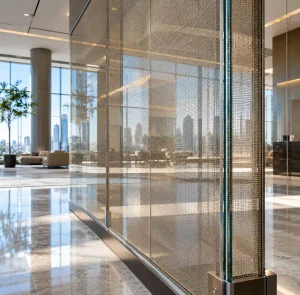
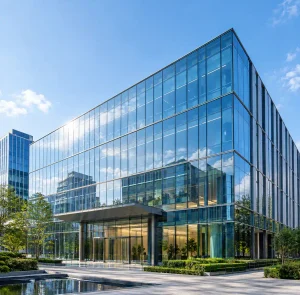
When specifying curtain wall glass for high-rise buildings, the right choice directly impacts energy performance, occupant comfort, structural integrity, and long-term maintenance costs. Modern curtain wall systems typically use tempered insulated glass units (IGUs) with Low-E coatings, ranging from 6mm to 12mm thickness per lite, configured as double or triple glazing to meet thermal and structural performance requirements. The specific glass type depends on climate zone, building height, wind loads, solar exposure, and safety standards.
Understanding Curtain Wall Glass Requirements
Curtain wall glass must satisfy multiple performance criteria simultaneously. Unlike conventional windows, these systems span multiple floors and face extreme environmental stresses.
Primary Performance Criteria
Structural Performance: Glass must withstand wind loads calculated per ASCE/SEI 7-22 standards, which vary by building height, geographic location, and Risk Category. High-rise buildings in coastal zones may require glass capable of resisting loads exceeding 720 Pa (15 psf) while maintaining deflection limits of L/175 for spans under 4.1m or L/240+6.4mm for longer spans.
Thermal Performance: U-factor and Solar Heat Gain Coefficient (SHGC) determine energy consumption. Modern codes like ASHRAE 90.1-2022 and IECC 2021 set prescriptive maximums based on climate zones. Cooling-dominated buildings prioritize low SHGC (0.25-0.35) to reduce solar heat gain, while heating-dominated climates need low U-factors (under 1.4 W/m²·K).
Safety and Code Compliance: Building codes mandate safety glazing in locations subject to human impact. Tempered or laminated glass meeting ANSI Z97.1 or CPSC 16 CFR 1201 provides required impact resistance. Fire-rated assemblies may require fire-resistant glass tested per ASTM E119 or E2307.

Glass Types for Curtain Wall Systems
Tempered Glass: The Foundation
Tempered glass undergoes controlled thermal treatment, creating surface compression that makes it 4-5 times stronger than annealed glass. Upon breakage, it fractures into small, relatively harmless pieces, meeting safety glazing requirements.
Manufacturing Specifications: At Zhongbo Glass, our flat and curved tempering lines handle glass up to 3660mm × 28000mm, accommodating jumbo-sized curtain wall units without joints. Thickness ranges from 4mm to 19mm, with 6mm, 8mm, and 10mm most common for mid-rise applications.
Application Considerations: Tempered glass cannot be cut or drilled after heat treatment, requiring precise fabrication planning. Edge quality critically affects strength—clean, polished edges prevent stress concentrations that could cause spontaneous breakage.
Laminated Glass: Enhanced Safety
Laminated glass bonds two or more glass plies with PVB (polyvinyl butyral), EVA, or ionoplast interlayers. When broken, glass fragments adhere to the interlayer, maintaining barrier integrity.
Security and Hurricane Resistance: Buildings in hurricane zones or requiring blast mitigation specify laminated glass tested per ASTM E1886 and E1996. Our lamination capacity reaches 4200mm × 28000mm, enabling seamless security glazing for entire facade sections.
Acoustic Performance: PVB interlayers dampen sound transmission, valuable for urban high-rises. Asymmetric constructions (e.g., 6mm + 8mm with 1.52mm PVB) outperform symmetric laminates by disrupting sound wave resonance.

Insulated Glass Units (IGUs): Thermal Control
IGUs combine multiple glass lites separated by spacer bars and sealed with desiccant-filled air or gas gaps. This construction dramatically reduces heat transfer compared to single glazing.
Configuration Options: Double glazing (two lites) suits most climates, while triple glazing serves extreme cold regions. Our insulating glass lines produce units up to 3660mm × 28000mm with cavity widths from 6mm to 20mm. Argon or krypton gas fill reduces U-factor by 20-30% compared to air-filled units.
Edge Seal Critical Performance: Dual-seal systems using polyisobutylene (PIB) primary seal and silicone or polysulfide secondary seal prevent moisture ingress and gas leakage. Warm-edge spacers with low-conductivity materials minimize heat loss at perimeter zones, reducing condensation risk.
Low-E Coated Glass: Energy Efficiency
Low-emissivity coatings are microscopically thin metallic layers that reflect infrared radiation while transmitting visible light. This selective spectral performance optimizes daylighting and thermal control.
Coating Types and Selection:
- Hard-coat (pyrolytic): Durable, suitable for single glazing or IGU surface #1, moderate performance
- Soft-coat (sputtered): Superior performance, must be used on protected IGU surfaces (#2 or #3)
Position matters significantly. Surface #2 placement (interior side of outer lite) maximizes solar control in cooling-dominated climates, while surface #3 (exterior side of inner lite) emphasizes insulation for heating climates.

Spectrally Selective Coatings: Advanced triple-silver Low-E coatings achieve SHGC values as low as 0.23 while maintaining visible light transmission above 60%, enabling natural daylighting without excessive heat gain. This technology transformed curtain wall design for hot climates, allowing expansive glazing without overwhelming cooling loads.
Glass Selection by Building Type and Climate
| Building Type | Recommended Glass Configuration | Typical Thickness | Key Performance Target |
|---|---|---|---|
| Office Tower (Hot Climate) | Low-E IGU (6mm+6mm) with argon | 12mm total | SHGC < 0.30, U-factor < 1.8 W/m²·K |
| Office Tower (Cold Climate) | Triple Low-E IGU with argon | 32-44mm total | U-factor < 1.0 W/m²·K |
| High-Rise Residential | Laminated Low-E IGU | 26-36mm total | Acoustic STC > 35, U < 1.4 |
| Healthcare/Laboratory | Triple IGU with spandrel zones | 36-50mm total | Condensation resistance CRF > 70 |
| Hurricane Zone | Laminated impact-resistant IGU | 32-42mm total | ASTM E1996 compliance |
| Coastal High-Rise (>50 floors) | Heat-strengthened laminated IGU | 38-48mm total | Wind load > 720 Pa, safety retention |
Structural Considerations for Glass Selection
Wind Load Calculations
Design wind pressure varies dramatically by building height, location, and facade geometry. Corner zones and upper floors experience significantly higher loads than mid-building flat sections. Glass thickness selection begins with structural calculations ensuring maximum stress remains below allowable limits with appropriate safety factors.
For buildings exceeding 100 meters, wind tunnel testing often refines code-prescribed loads, sometimes reducing glass thickness requirements and associated costs. However, designers must balance structural adequacy against deflection limits—excessive glass flex causes seal failure in IGUs and potential framing damage.

Thermal Expansion and Stress
Glass expands approximately 9 × 10⁻⁶ per °C. In curtain walls, temperature differentials between shaded and sunlit zones create internal stress. Dark-tinted or heavily coated glass absorbs more solar radiation, reaching higher temperatures and greater thermal stress.
Heat-Strengthened vs. Fully Tempered: For applications with high thermal stress risk (large panels, dark coatings, partial shading), heat-strengthened glass offers a middle ground—twice the strength of annealed glass with lower surface compression than tempered glass, reducing spontaneous breakage risk while maintaining adequate strength.
Edge clearance in IGUs must accommodate thermal movement. Inadequate edge clearance causes glass-to-spacer contact, creating stress concentration points. Standard practice allows 3-5mm clearance for units under 2m², increasing for larger sizes.
Comparative Performance: Glass Type Analysis
| Glass Type | Light Transmission | U-Factor (W/m²·K) | SHGC | Relative Cost | Best Application |
|---|---|---|---|---|---|
| Single Tempered Clear | 90% | 5.8 | 0.82 | 1.0× | Non-conditioned spaces only |
| Double Clear IGU | 81% | 2.8 | 0.70 | 1.8× | Mild climates, budget projects |
| Double Low-E IGU | 70-75% | 1.6-1.8 | 0.35-0.40 | 2.2× | Standard high-performance |
| Triple Low-E IGU | 60-70% | 0.8-1.0 | 0.28-0.32 | 3.0× | Cold climates, passive buildings |
| Spectrally Selective Low-E | 60-72% | 1.4-1.6 | 0.23-0.28 | 2.5× | Hot climates, maximum daylight |
Advanced Glass Technologies
Ceramic Fritted Glass
Ceramic frit patterns applied to glass surfaces provide solar shading, glare control, and aesthetic variation. Our digital printing lines accommodate custom patterns up to 3300mm × 28000mm, enabling gradient densities and complex graphics.
Frit density determines solar performance—40% coverage typically reduces SHGC by 30-40%. Frit placement on surface #2 or #4 avoids trapped heat in IGU cavities. This technology allows architects to modulate transparency across facades while maintaining uniform glass thickness for simplified framing.

Electrochromic and Smart Glass
Electrochromic glass dynamically adjusts tint in response to electrical current, enabling real-time solar control without mechanical shading devices. While initial costs remain high (4-6× conventional Low-E IGUs), whole-building energy modeling often justifies the investment for premium projects.
Integration challenges include power requirements, control systems, and long-term durability. Current generation products achieve SHGC ranges from 0.09 (fully tinted) to 0.42 (clear state) with switching times of 5-15 minutes.
Installation Method Impact on Glass Specification
Unitized Systems
Factory-glazed unitized panels arrive fully assembled with glass pre-installed in frames. This approach offers superior quality control, reduced field labor, and faster installation. Glass specifications must account for shipping constraints—maximum panel dimensions typically limit to 1.8m × 4.5m, though custom transport enables larger sizes.
Weather sealing between panels becomes critical. Stack joint design must accommodate thermal movement, story drift, and installation tolerances while preventing water infiltration and air leakage.

Stick-Built Systems
Field-glazed stick systems offer greater design flexibility, accommodating complex geometries and on-site adjustments. Glass is typically installed after frame erection, requiring careful scheduling to protect interior finishes from weather.
Glazing quality depends heavily on installer skill. Proper setting block placement, edge clearance, and sealant application directly affect long-term performance. Field conditions—temperature, humidity, wind—influence sealant cure and installation quality.
Quality Control and Testing
Factory Testing
Reputable curtain wall glass undergoes rigorous testing before shipment. Our quality control includes:
- Optical inspection: Surface quality, coating uniformity, defects
- Dimensional verification: Size, thickness, edge condition
- Seal integrity testing: IGU moisture seal, gas concentration
- Performance sampling: Randomly selected units tested for strength, thermal performance, weatherability
Field Performance Verification
AAMA 501.2 and 503 standards enable field testing of installed curtain walls, verifying air leakage and water penetration performance. This diagnostic testing, performed after installation completion, identifies workmanship defects before building acceptance.
Performance criteria match laboratory test standards—typically less than 0.3 L/s·m² at 300 Pa for air infiltration and no water penetration at 480-720 Pa static pressure.

Maintenance and Long-Term Performance
Expected Service Life
Properly specified and installed curtain wall glass typically provides 25-30 years of service before requiring replacement. IGU seal failure constitutes the primary failure mode, resulting in moisture infiltration, condensation between lites, and lost thermal performance.
Factors affecting longevity include:
- Edge seal quality: Dual-seal systems with structural silicone outperform single-seal construction
- UV exposure: South and west facades experience accelerated sealant degradation
- Thermal cycling: Extreme temperature swings stress seals and glass
- Installation quality: Proper clearances and drainage prevent premature failure
Maintenance Requirements
Unlike operable windows, fixed curtain wall glazing requires minimal maintenance beyond periodic cleaning. Inspection programs should monitor:
- Perimeter sealant condition (5-year intervals)
- Gasket and setting block integrity
- Surface coating condition (especially on exposed single-glazed applications)
- Hardware and anchor points
Specialized access equipment—swing stages, gondolas, or BMU systems—enables façade inspection and maintenance on high-rises.

Cost Considerations and Value Engineering
Initial glass selection significantly impacts total project cost. However, life-cycle cost analysis often justifies premium glazing through reduced energy consumption and maintenance costs.
Cost-Benefit Analysis Framework:
- Energy savings: Model annual HVAC load reductions from improved U-factor and SHGC
- Downsizing opportunity: Better thermal performance may permit smaller mechanical systems
- Maintenance costs: High-performance coatings and robust seals reduce replacement frequency
- Occupant productivity: Daylighting and thermal comfort affect tenant satisfaction and rental rates
For speculative office buildings, energy performance directly impacts marketability. LEED and ENERGY STAR certification requirements increasingly mandate high-performance glazing, making it a baseline expectation rather than premium option.
Emerging Trends and Future Directions
The curtain wall glass industry continues evolving toward improved performance and sustainability:
Triple glazing adoption: Once limited to cold climates, triple IGUs are gaining traction in moderate climates as energy codes tighten and ultra-low U-factors (< 0.8 W/m²·K) become standard.
Vacuum glazing: Eliminating gas cavities entirely, vacuum IGUs achieve U-factors below 0.4 W/m²·K in thin profiles (< 10mm total thickness). Manufacturing challenges and cost currently limit widespread adoption.
Embodied carbon focus: Specifiers increasingly evaluate glass manufacturing energy and transportation impacts. Local sourcing and optimized glass thickness reduce carbon footprint without compromising performance.
Circular economy: Glass recovery and recycling programs, particularly for laminated products, address end-of-life disposal challenges as first-generation curtain walls reach replacement age.

FAQ
Q: Can I use annealed glass in curtain walls?
A: Generally no. Building codes require safety glazing (tempered or laminated) for locations subject to human impact, including curtain walls accessible from interior floors. Annealed glass may be permitted in spandrel areas behind permanent barriers, but most specifications call for tempered glass throughout for consistency.
Q: What thickness glass do I need for a 50-story building?
A: Thickness depends on wind loads, not just building height. A 50-story building in Miami (hurricane zone) might require 10mm-12mm tempered lites in laminated IGU configuration, while the same height in a moderate climate could use 8mm-10mm. Structural engineers calculate required thickness based on ASCE 7 wind load analysis, panel size, and support conditions.
Q: How do I prevent curtain wall glass from looking green?
A: Standard clear glass has inherent green tint from iron content, visible in thick sections or when viewed edge-on. Low-iron (extra-clear) glass eliminates this tint, providing neutral color and higher light transmission. Specify low-iron glass for vision areas where color neutrality matters; standard glass suffices for most applications.
Q: What causes glass to break spontaneously in curtain walls?
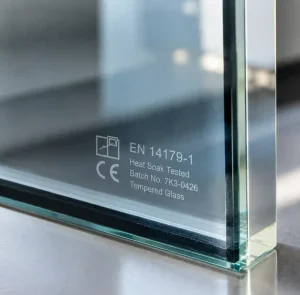
A: Nickel sulfide (NiS) inclusions in tempered glass can cause spontaneous breakage months or years after installation. Heat soak testing exposes panels to 290°C for 2+ hours, triggering NiS-induced breakage before installation. Specify heat-soaked tempered glass per EN 14179-1 for critical applications, though this adds cost and lead time.
Q: Should I use ceramic fritted glass or solar control coatings?
A: Both reduce solar heat gain, but differently. Low-E coatings provide consistent performance across the panel with minimal visual impact, while frits allow graduated patterns and strong design statements. Combining technologies—fritted glass with Low-E coating—delivers maximum solar control for extreme climates or west-facing facades.
Q: How do I specify glass for coastal or corrosive environments?
A: Coastal salt air and industrial pollutants accelerate sealant degradation and coating damage. Specify silicone structural glazing (not polyurethane), marine-grade hardware, and increased drainage provisions. Consider protective coatings on exposed metallic Low-E coatings if used on surface #1. Factory-glazed unitized systems outperform field-glazed stick construction in corrosive environments.
Conclusion
Selecting curtain wall glass requires balancing structural requirements, thermal performance, safety standards, aesthetic goals, and budget constraints. Modern high-performance curtain walls typically specify tempered insulated glass units with Low-E coatings, configured to meet climate-specific thermal and solar control requirements.
Successful projects begin with thorough wind load analysis, climate-appropriate thermal targets, and clear code compliance requirements. Collaboration between architects, structural engineers, curtain wall manufacturers, and glass suppliers ensures specifications match performance requirements while remaining constructible and economical.
As energy codes tighten and sustainability expectations rise, glass selection becomes increasingly critical to building performance. Triple glazing, spectrally selective coatings, and advanced technologies like electrochromic glass are transitioning from premium options to standard practice. Early engagement with experienced curtain wall glass suppliers like Zhongbo Glass helps navigate these complex decisions, ensuring your project achieves optimal performance throughout its service life.