Magnetron sputtering is the industry-standard vacuum deposition method for applying ultra-thin silver-based coatings to architectural glass, enabling Low-E (low-emissivity) performance that can reduce building heat loss by 30-50% compared to clear glass. This process deposits multiple functional layers—silver for infrared reflection, zinc oxide for protection, and titanium dioxide for optical tuning—in precise nanometer-scale thicknesses under controlled vacuum conditions. At Zhongbo Glass, our two magnetron sputtering coating lines can process glass up to 3,300mm × 28,000mm, producing 8,000㎡ of coated glass every 24 hours for projects demanding exceptional energy performance.
What Is Magnetron Sputtering?
Magnetron sputtering is a physical vapor deposition (PVD) technique where target material atoms are ejected by ion bombardment and deposited onto glass in a vacuum chamber. Unlike pyrolytic methods applied at high temperatures, magnetron sputtering operates below 200°C, enabling precise control over film composition and multilayer architecture.
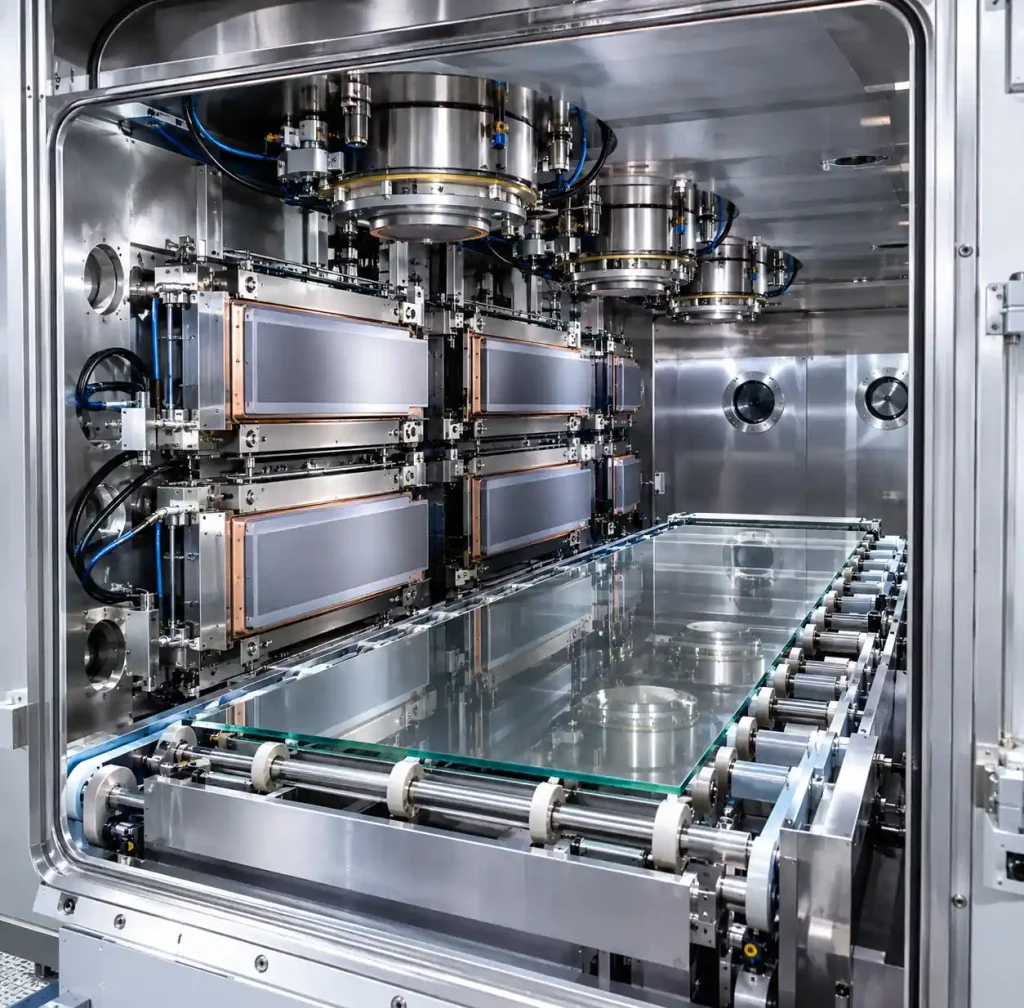
The process uses argon plasma in a vacuum environment (10⁻³ to 10⁻² mbar). A magnetic field traps electrons near the target surface, increasing ionization efficiency. When argon ions strike the target material (silver, zinc, titanium), atoms are ejected and condense on the glass as nanometer-scale films with exceptional uniformity across jumbo panels.
Multi-Layer Coating Architecture
Low-E coatings consist of 10-15 layers totaling 200-400 nanometers. A typical single-silver stack includes:
TiO₂ Base Layer (20-40nm): Anti-reflective optical matching layer maximizing light transmission.
ZnO Barrier (5-15nm): Promotes smooth silver growth and prevents oxidation.
Silver Layer (8-15nm): The infrared-reflective core. Thicker films achieve lower emissivity (0.02-0.05 vs. 0.10-0.15 for thin films).
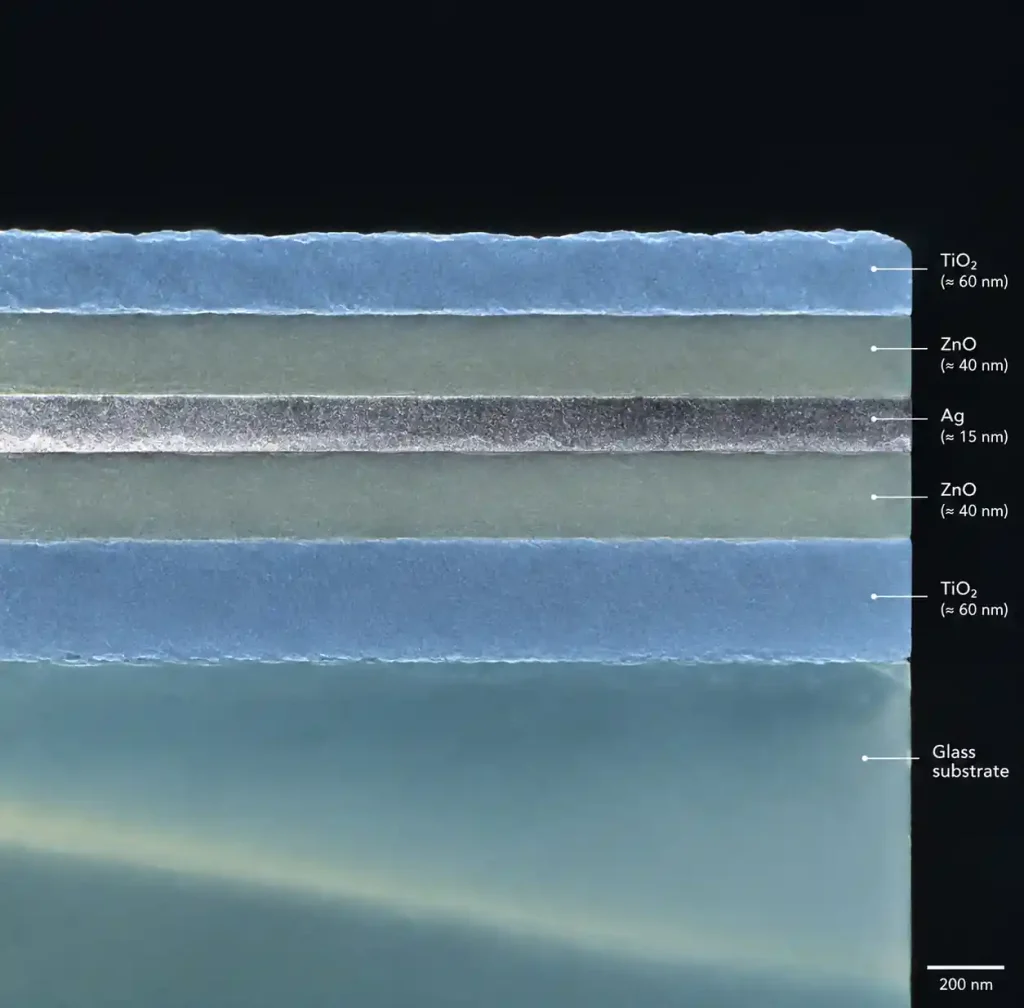
ZnO Protection (10-20nm): Caps silver against oxidation and handling damage.
Top Dielectric (30-60nm): TiO₂ or SnO₂ for optical tuning, color neutrality, and scratch resistance.
Advanced double-silver coatings reach U-values of 0.8 W/m²K, while triple-silver systems achieve below 0.6 W/m²K with extremely low SHGC for solar control.
The Magnetron Sputtering Production Process
Glass Preparation and Chamber Entry
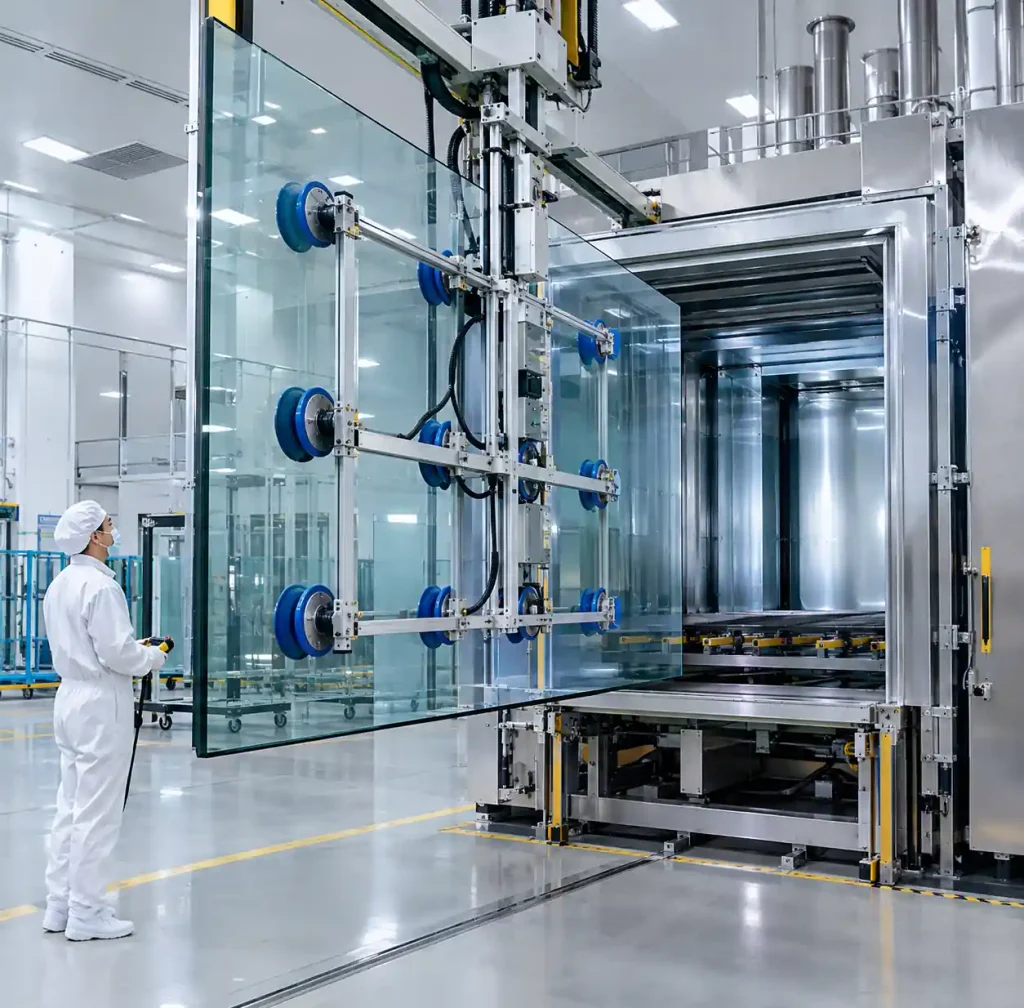
Glass panels are cut, edges ground, and cleaned before entering through a load-lock system. The glass travels through vacuum chambers operating at 10⁻³ mbar—about one-millionth of atmospheric pressure.
Sequential Layer Deposition
Glass passes under multiple magnetron cathodes, each depositing specific materials:
- Titanium targets: TiO₂ base layers in reactive atmosphere (oxygen + argon)
- Zinc targets: ZnO barrier layers
- Silver targets: Metallic silver in pure argon
- Additional cathodes repeat for double/triple-silver stacks
Silver deposits at 5-15 nm/second, while oxide layers form at 2-8 nm/second. Real-time optical sensors monitor thickness, adjusting power and transport speed to maintain specifications.
At Zhongbo Glass, our coating lines process panels up to 3,300mm × 28,000mm with 8,000㎡ capacity per 24 hours, enabling jumbo glass for large-span curtain walls without compromising throughput.
مراقبة الجودة
Coated glass exits through load-locks returning to atmospheric pressure. Inline spectrophotometers measure optical properties, while offline testing verifies emissivity, U-value, and SHGC.
U-Value Optimization: Controlling Thermal Performance
U-value measures thermal transmittance in W/m²K—lower values indicate better insulation. Silver layer thickness directly affects performance.
How Silver Layer Thickness Affects U-Value
| Silver Layer Thickness | Typical Emissivity | Monolithic Glass U-Value | IGU U-Value (16mm argon) |
|---|---|---|---|
| 8-10 nm | 0.15-0.20 | 3.8 W/m²K | 1,6 واط/م²كلفن |
| 12-14 nm | 0.08-0.12 | 3.6 W/m²K | 1,3 واط/م²كلفن |
| 15-18 nm (double-silver) | 0.03-0.05 | 3.4 W/m²K | 0.9 W/m²K |
IGU calculations assume 6mm glass, 16mm argon cavity, Low-E on surface #3
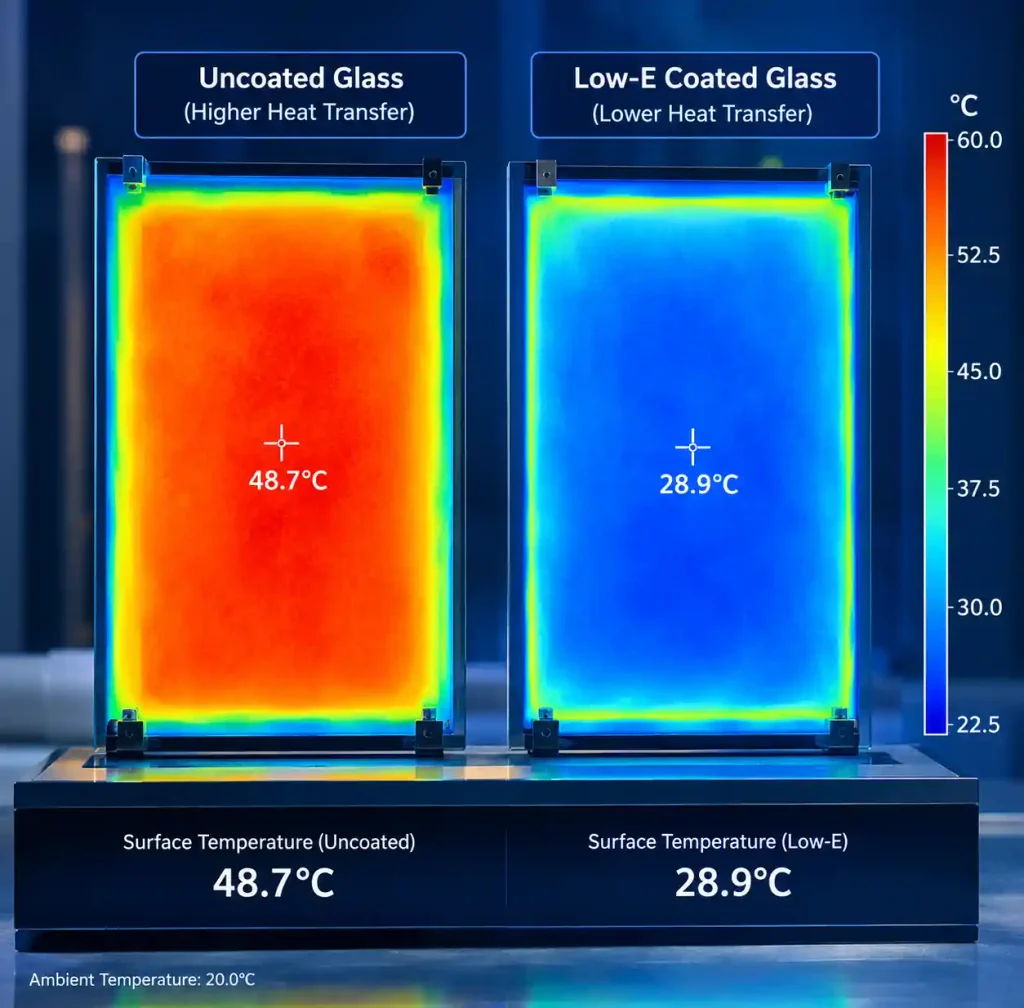
Coating position in IGUs significantly impacts performance. Surface #3 (inside pane, cavity-facing) maximizes insulation while maintaining SHGC flexibility, making it optimal for commercial buildings in mixed climates.
SHGC Control: Managing Solar Heat Gain
Solar Heat Gain Coefficient (SHGC) measures solar radiation entering as heat (0 to 1 scale). Lower SHGC blocks more heat—ideal for cooling-dominated climates.
Silver Layers vs. Solar Control Performance
| نوع الطلاء | نفاذية الضوء المرئي | SHGC | Best Climate Application |
|---|---|---|---|
| Standard Low-E (single silver) | 70-80% | 0.60-0.70 | Cold climates: maximize daylight and passive solar gain |
| Solar Control Low-E (double silver) | 60-70% | 0.35-0.45 | Mixed climates: balance heating and cooling |
| High-Performance Solar Control (triple silver) | 50-60% | 0.25-0.35 | Hot climates: minimize cooling loads |
Advanced systems “tune” coatings by adjusting dielectric layers, achieving spectral selectivity—admitting 60-70% visible light while blocking 60-70% of infrared and UV. At Zhongbo Glass, we optimize coating specifications for specific building orientations, climates, and LEED/BREEAM targets.
Sputtered Low-E vs. Pyrolytic Low-E
| السمة | Magnetron Sputtered Low-E | Pyrolytic Low-E |
|---|---|---|
| الانبعاثية | 0.03-0.15 (excellent) | 0.15-0.25 (moderate) |
| المتانة | Requires IGU protection | Hard, durable surface |
| المظهر | Neutral color, high clarity | Slight haze, possible color |
| التقسية | Must temper before coating | Can temper after coating |
| التكلفة | Higher material cost | Lower material cost |
| الأداء | Superior thermal performance | Good thermal performance |
| التطبيقات | High-performance commercial facades | Residential, budget projects |
Sputtered coatings dominate commercial architecture due to superior energy performance critical for LEED certification and energy code compliance. The IGU requirement suits most commercial glazing applications.
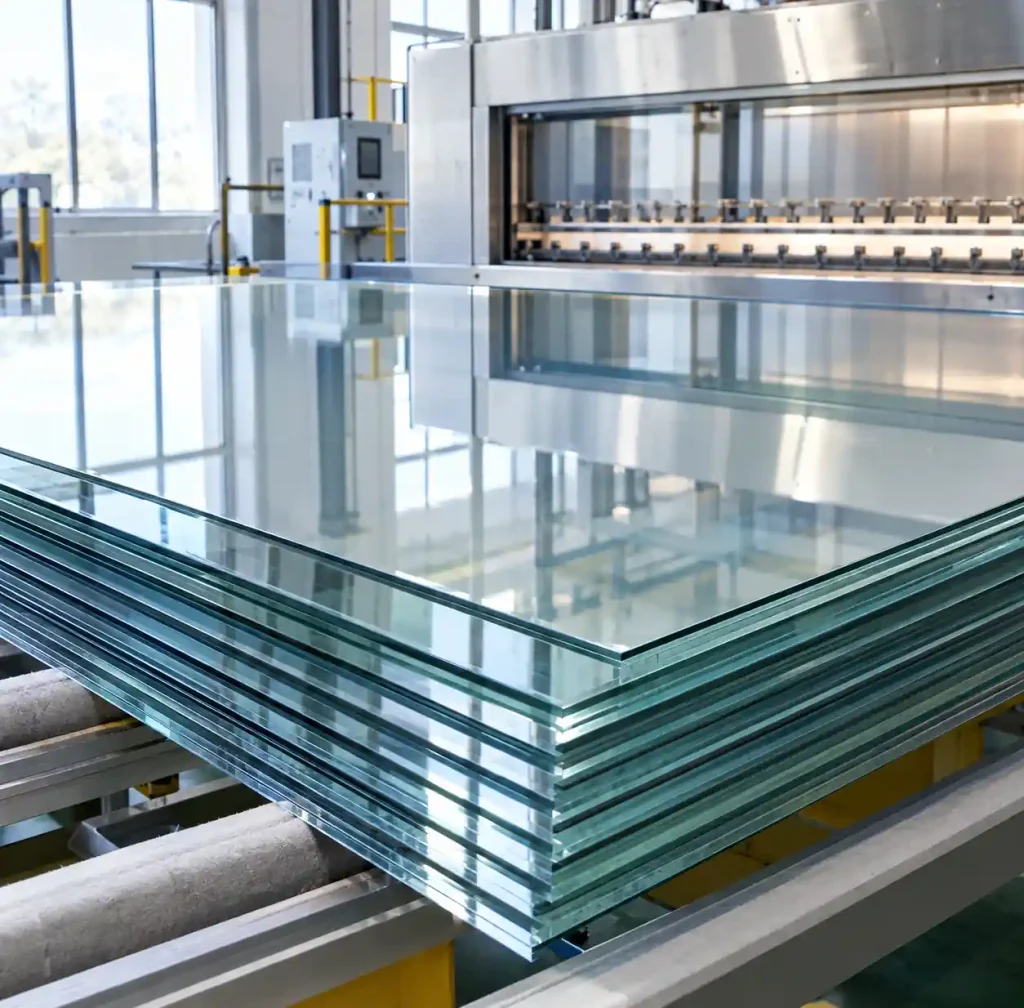
Coating Durability and Quality Control
Magnetron sputtered Low-E coatings are microscopically thin and require careful quality control throughout production.
مراقبة جودة التصنيع
Real-time monitoring tracks chamber vacuum levels (contamination degrades adhesion), cathode power (affects deposition rate), substrate temperature (prevents film stress), and optical properties via inline spectrophotometers. Post-coating testing includes adhesion, humidity resistance, and durability (salt spray, UV exposure).
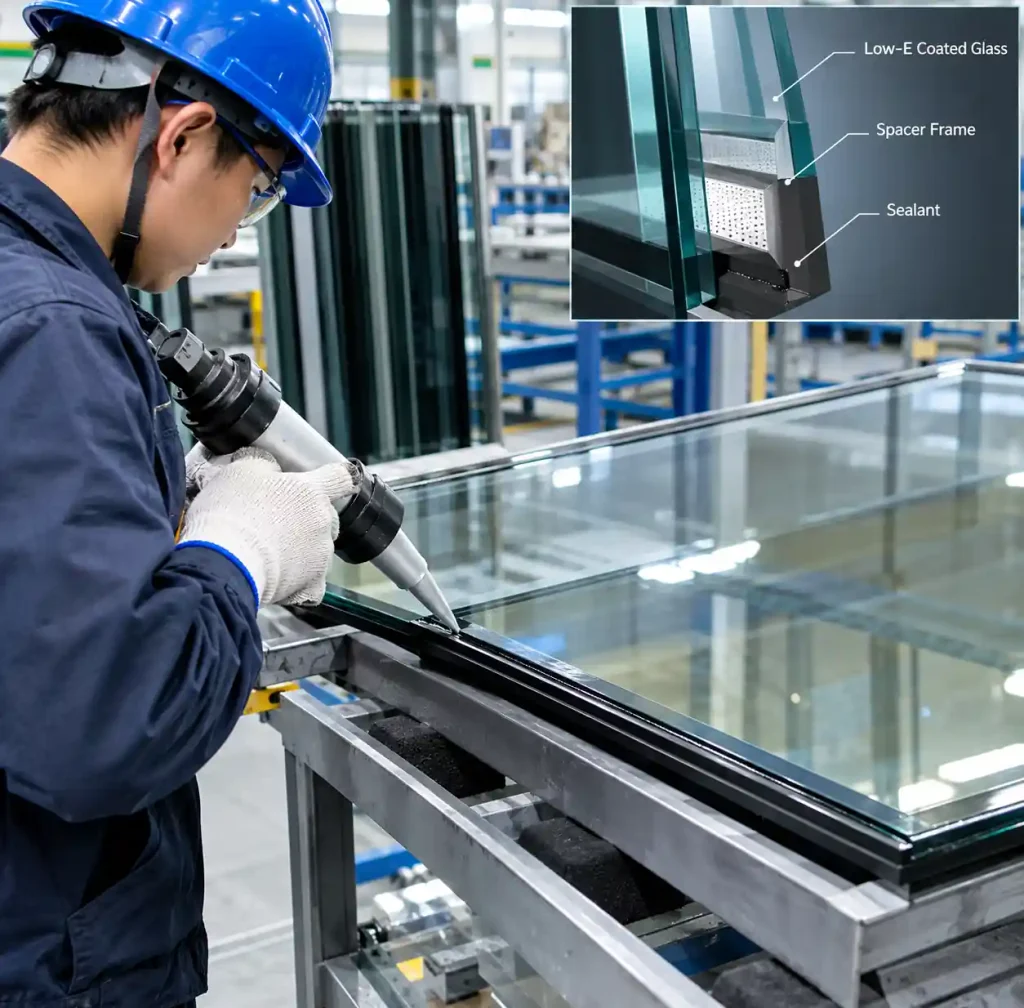
IGU Assembly Protection
Coatings positioned on interior IGU surfaces (surface #2 or #3) are protected from atmospheric exposure. Proper edge sealing prevents moisture ingress that corrodes silver layers. At Zhongbo Glass, our خطوط إنتاج الزجاج العازل use dual-seal systems (polyisobutylene primary, polysulfide/silicone secondary) meeting EN 1279 durability standards.
Real-World Performance: Zhongbo Glass Projects
Qingpu Huawei R&D Center, Shanghai
This research campus features 12,455mm × 2,413mm Low-E insulated glass panels—among the largest coated units we’ve produced. Double-silver magnetron sputtered Low-E on surface #3 delivers 68% visible transmission and 0.32 SHGC, reducing cooling loads by 40% versus clear glass. Precise coating uniformity maintained ΔE < 1.0 across the entire production run.
Baiyun International Conference Center, Guangzhou
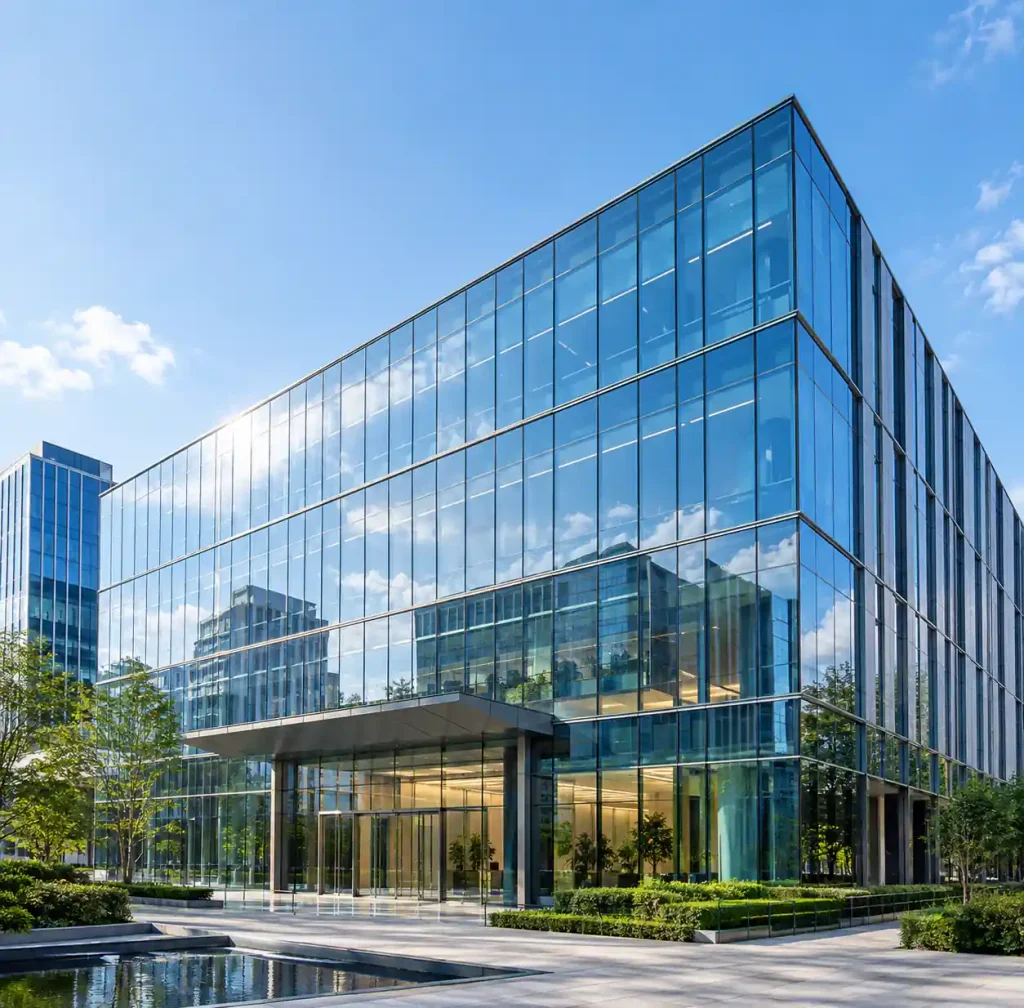
This landmark uses triple-laminated زجاج عازل من نوع «لو-إي» including 8,200mm panels. Magnetron sputtered coatings provided U-value of 1.1 W/m²K and SHGC of 0.38, contributing to LEED Gold certification.
Latest Innovations in Low-E Coating Technology
Dynamic Coating Formulations: Emerging designs incorporate photochromic/thermochromic materials into dielectric layers, enabling glass that automatically adjusts SHGC with sunlight intensity or temperature—potentially reducing HVAC loads by 10-15% in climates with large diurnal swings.
Ultra-Low Emissivity: Experimental quad-silver coatings achieve emissivity below 0.02, enabling IGU U-values under 0.5 W/m²K for arctic construction. Zhongbo Glass explores these formulations for northern Europe and Canada projects.
Sustainable Materials: Research into silver-free alternatives using indium tin oxide (ITO), aluminum-doped zinc oxide (AZO), and graphene aims to reduce silver reliance, though these haven’t yet matched silver’s performance-cost ratio.
الأسئلة الشائعة
How long does magnetron sputtered Low-E coating last?
When properly protected within an insulated glass unit, magnetron sputtered Low-E coatings last the life of the building—typically 25-40+ years. The coating itself does not degrade; failures occur when IGU seals fail and allow moisture to corrode the silver layers.
Can Low-E glass be tempered after coating?
No. Standard magnetron sputtered Low-E coatings cannot withstand tempering temperatures (650-700°C). Glass must be مُقسَّى before coating, or specialized “temperable Low-E” coatings must be used. At Zhongbo Glass, we coordinate tempering and coating sequences to meet project specifications.
Why is Low-E coating more expensive than clear glass?
Magnetron sputtering requires significant capital investment in vacuum coating equipment, uses precious metals (silver), and operates at slower throughput than float glass production. However, the energy savings typically provide payback within 3-7 years in commercial applications.
Does Low-E coating affect visible light transmission?
Minimally. High-performance double-silver Low-E coatings typically transmit 65-70% of visible light, compared to 85-90% for clear glass. The reduction is barely perceptible to building occupants while providing substantial thermal benefits.
What maintenance does Low-E glass require?
For coatings on interior IGU surfaces (standard), no special maintenance beyond normal glass cleaning. Exterior coatings (rare) require non-abrasive cleaning solutions to prevent scratching the coating.
الخاتمة
Magnetron sputtering remains the definitive coating technology for high-performance Low-E glass, enabling architects to design energy-efficient building envelopes without sacrificing transparency or aesthetics. The process deposits precisely controlled multi-layer stacks—silver for infrared reflection, oxides for protection and optical tuning—that reduce heat loss by 30-50% compared to clear glass while maintaining high visible transmission.
At Zhongbo Glass, our two coating lines process up to 3,300mm × 28,000mm panels with production capacity of 8,000㎡ per day, serving projects from commercial towers to museum skylights. As coating formulations evolve with double and triple-silver systems, dynamic materials, and sustainable alternatives, magnetron sputtering will continue advancing the performance frontier for architectural glass solutions.
The future of building energy efficiency depends on these microscopically thin films—and the precision vacuum deposition technology that creates them.