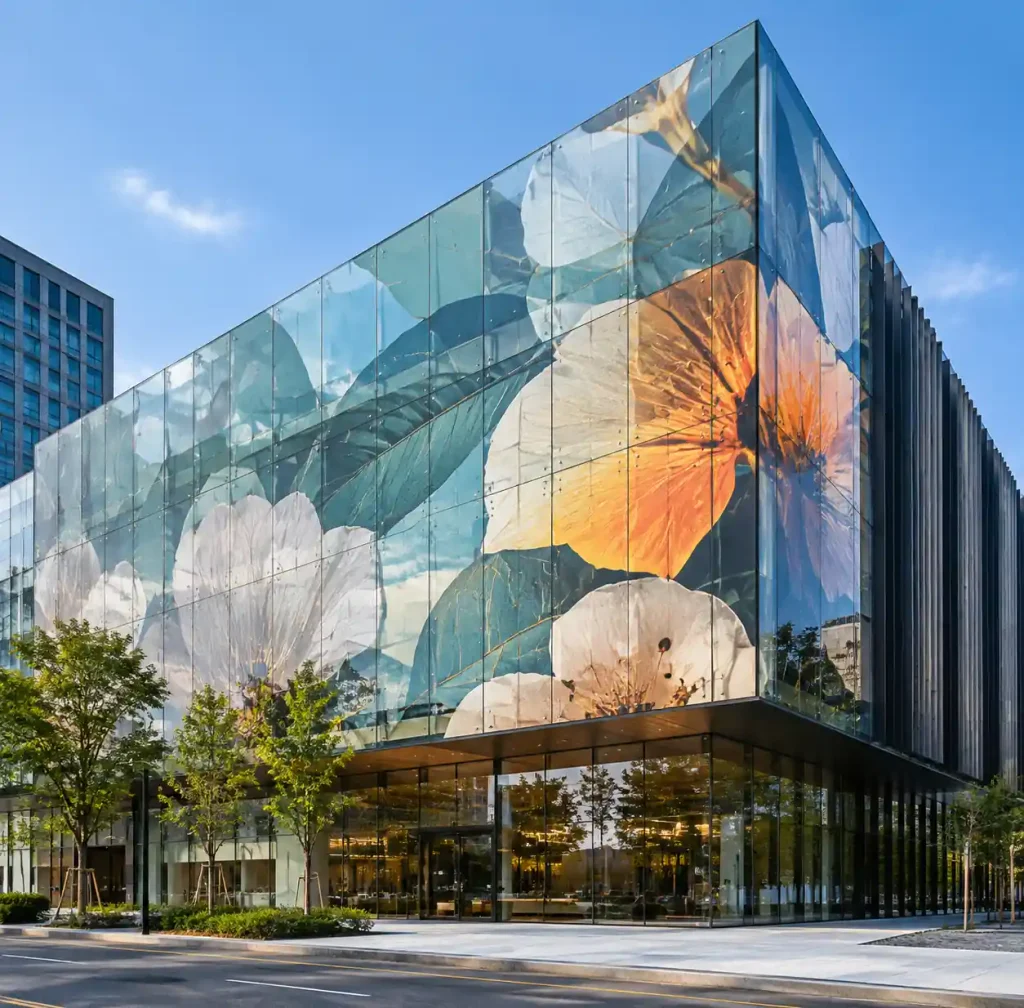
Digital ceramic printing on glass delivers photorealistic patterns, gradients, and custom artwork directly onto architectural glass with permanent, UV-resistant ceramic inks fired at high temperatures. Unlike traditional screen printing, this technology offers unlimited color variations, intricate detail resolution, and the ability to temper the glass post-printing—making it the preferred choice for modern facades, interior partitions, and branded retail spaces. However, production constraints around maximum panel sizes (typically 3.3m × 28m), color matching consistency across large runs, and compatibility with certain glass coatings require careful planning during the design phase.
How Digital Ceramic Printing Technology Works
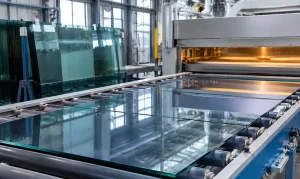
Digital ceramic printing uses industrial inkjet heads to apply ceramic frit particles onto glass surfaces. The process operates at architectural scale with specialized inks formulated to withstand tempering temperatures exceeding 650°C.
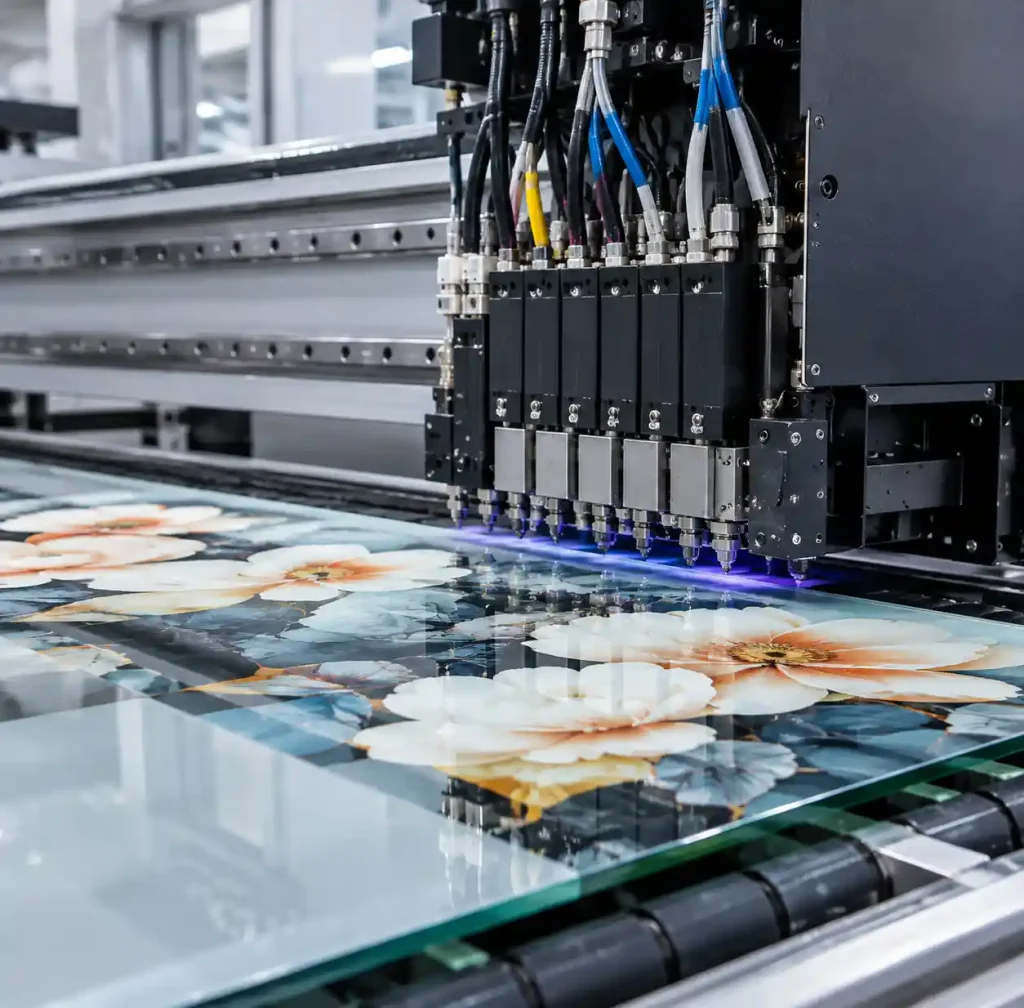
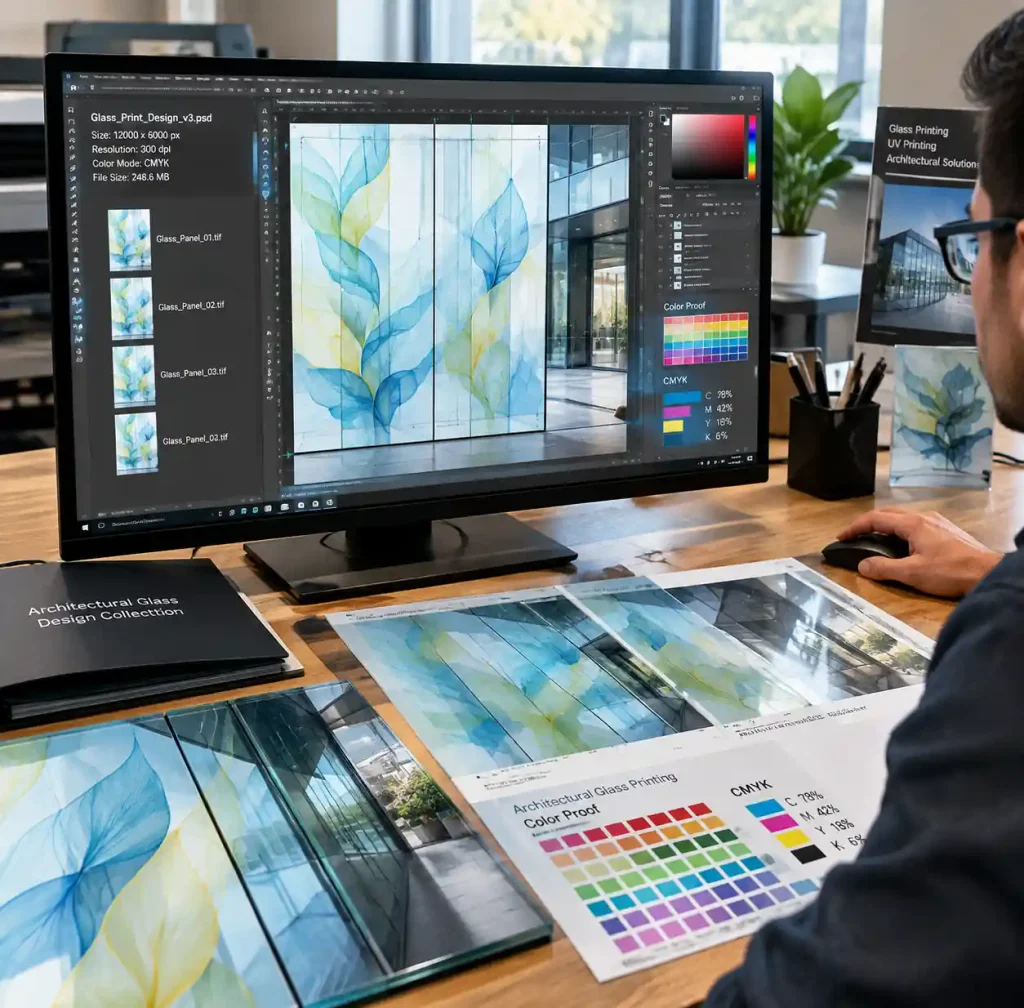
The workflow begins with high-resolution digital files (minimum 150 DPI at actual size). The printer deposits CMYK ceramic inks in controlled patterns, building opacity through multiple passes. After printing, the glass enters a tempering furnace where heat permanently bonds the ceramic particles while strengthening the panel.
At Zhongbo Glass, our digital printing line handles panels up to 3,300mm wide by 28,000mm tall, with 500㎡ per 24-hour capacity. This scale enables full-height curtain wall panels without horizontal seams.
Design Capabilities: What You Can Achieve
Unlimited Color and Pattern Complexity
Traditional ceramic frit printing requires separate screens for each color, making multi-color designs expensive. Digital printing eliminates this constraint—gradients, photographic imagery, and geometric patterns cost the same as solid colors.
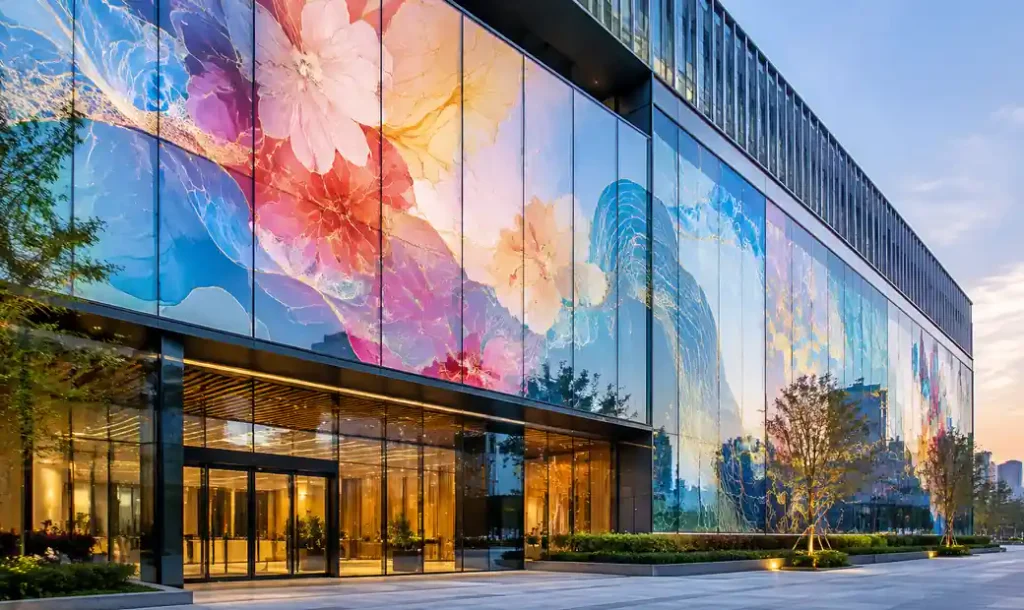
Recent Zhongbo Glass projects demonstrate this range:
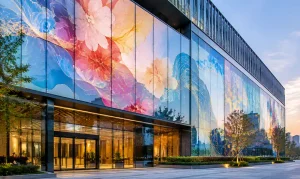
- Luoyang Peony Square: 9-meter panels with photorealistic peony artwork
- OPPO Store Zhengzhou: Brand patterns across 5.5m × 2.3m panels
- Xiaomi Store Nanjing: Curved glass with pattern continuity on complex geometries
Variable Opacity and Light Control
By adjusting ink density, digital printing creates opacity levels from 5% to 95% coverage. This transforms facade design for solar shading, privacy gradients, and daylighting optimization.
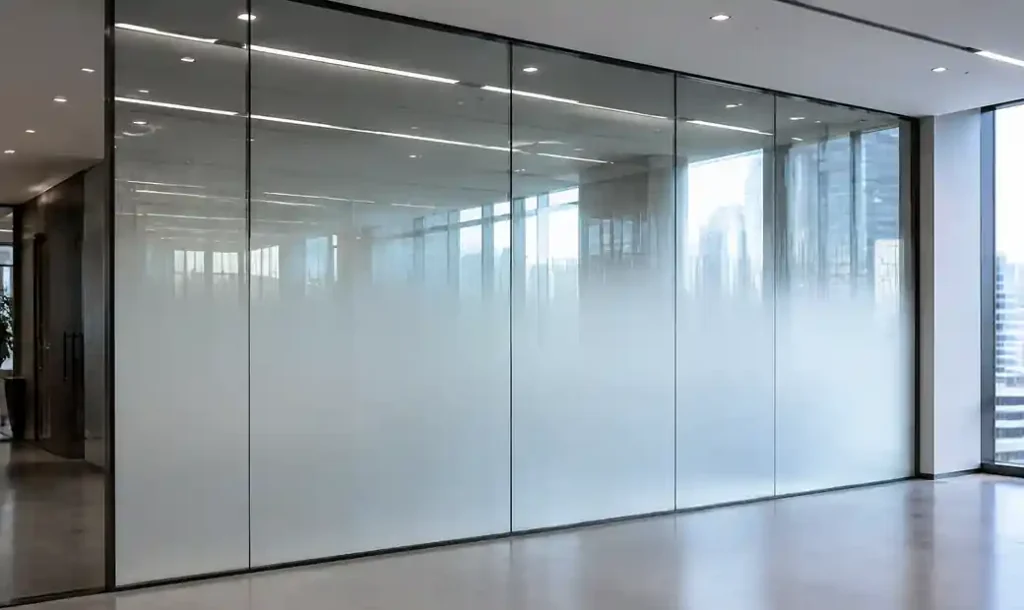
Unlike etched or sandblasted glass, digitally printed opacity maintains sharp edge definition and remains cleanable at any scale.
Integration with High-Performance Glass
Digital ceramic inks survive tempered glass processing, allowing printed panels to meet safety glazing requirements. The inks also withstand heat-soaking treatment for reducing spontaneous breakage risk.
Printing on the interior surface before laminating protects artwork from weathering while maintaining structural benefits—ideal for coastal environments and high-traffic areas.
Technical Limitations You Must Plan For
Maximum Panel Size Constraints
While our 3,300mm × 28,000mm capacity ranks among the industry’s largest, width constrains curtain wall glass projects requiring wider panels.
Solutions for oversized designs:
- Modular patterns where panel joints become invisible
- Strategic mullion placement at pattern transitions
- Mirror-image printing for symmetrical centerline panels
| Panel Dimension | Standard Capability | Workaround Required |
|---|---|---|
| Width ≤ 3,300mm | Direct printing | None |
| Width 3,301-6,600mm | Two-panel solution | Pattern continuity design |
| Height ≤ 28,000mm | Single panel | None |
| Height > 28,000mm | Stacked panels | Horizontal joint concealment |
Color Matching Across Production Runs
Ceramic ink chemistry introduces variables absent in screen printing. Ink batch variations, glass substrate differences, and firing temperature fluctuations can shift color values by 5-10% between production runs.
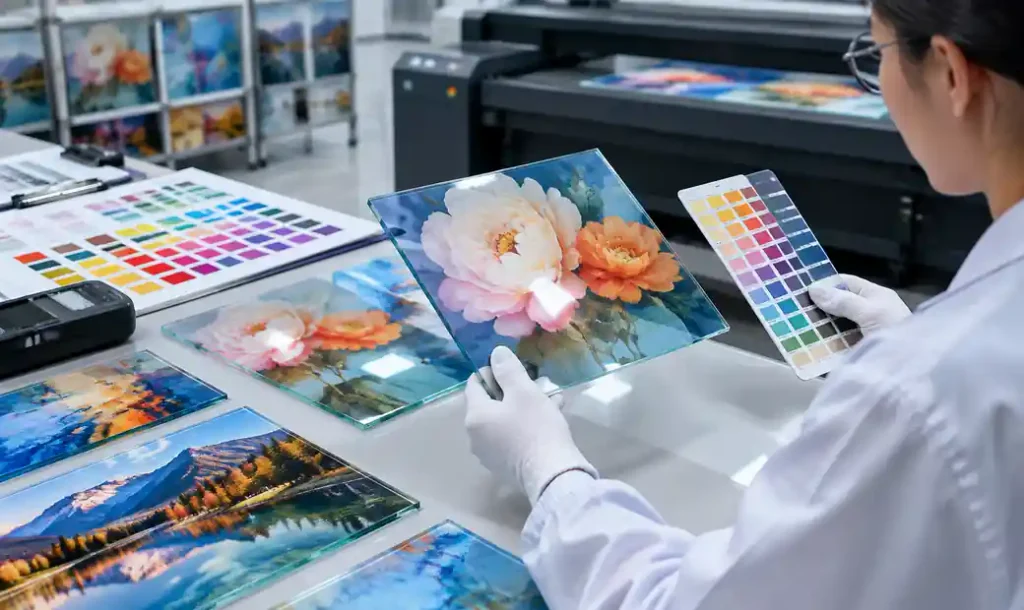
Best practices:
- Produce all glass for a single elevation in one continuous run
- Request samples printed on project-specific glass type
- Specify color tolerances (Delta E < 3 for critical matching)
- Avoid exact Pantone matching without physical testing
For projects like OPPO Store requiring brand precision, we print test panels on the specified glass substrate and adjust ink formulations before production.
Design File Requirements
Poor file preparation causes 60% of production delays. The technology demands higher resolution than conventional printing.
Minimum specifications:
- Raster images: 150 DPI at actual size (200 DPI for viewing < 1m)
- Vector artwork: Outline fonts, convert strokes to fills
- Color space: CMYK (RGB conversion causes shifts)
- File format: PDF, TIFF, or EPS with embedded images
Gradients require high-bit-depth files (16-bit minimum) with dithering to prevent banding at architectural scale.
Digital Printing vs. Traditional Ceramic Frit: Performance Comparison
| Factor | Digital Ceramic Printing | Screen-Printed Ceramic Frit |
|---|---|---|
| Setup Cost | Zero plate costs | $2,000-5,000 per color screen |
| Color Flexibility | Unlimited CMYK combinations | One color per screen |
| Design Changes | Instant digital updates | New screens required ($$$) |
| Minimum Order | Single panel economical | 50-100㎡ to justify setup |
| Detail Resolution | Photographic quality (150+ DPI) | Limited by screen mesh (~85 LPI) |
| Edge Sharpness | Precise to 0.1mm | Ink bleed at edges |
| UV Resistance | 20+ years (ceramic bond) | 20+ years (ceramic bond) |
| Production Speed | 500㎡/24h | 2,000+ ㎡/24h |
| Large-Format Consistency | Requires planning for panel size limits | Easier to scale across multiple panels |
The table reveals why digital printing dominates custom architectural projects while screen printing retains advantages for large-scale repetitive patterns.
Real-World Application Considerations
Facade Design Strategy
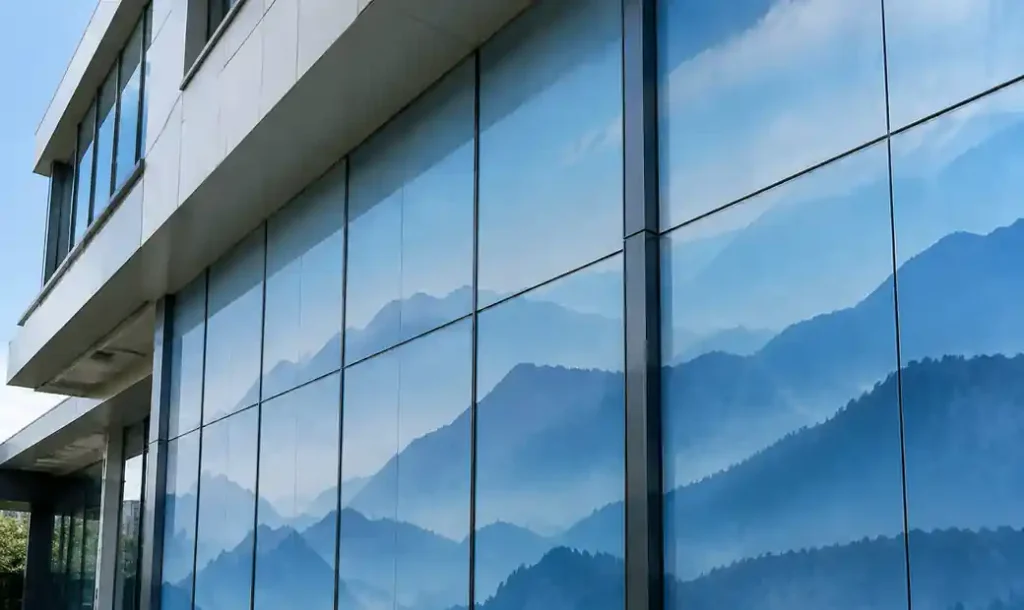
The 3,300mm width limitation shapes elevation design from the outset. Architects solve this through pattern concealment methods:
- Align pattern transitions with structural mullions
- Use random or organic patterns that disguise joints
- Specify gradient fades to zero opacity at panel edges
- Create modular geometric designs with intentional breaks
Interior Partition Applications
Interior applications enable finer detail reproduction (200 DPI), backlit translucent designs, privacy screening with custom patterns, and wayfinding graphics integrated into glass surfaces.
Office buildings increasingly specify digitally printed glass for branded conference rooms where corporate logos require precise execution.
Retail Storefront Branding
Retail clients demand exact brand color matching and design flexibility. Digital printing’s zero-setup-cost model makes store concept refreshes economically viable every 3-5 years.
The Xiaomi Nanjing Store project (curved glass up to 6.2m × 1.7m) demonstrates how digital printing handles complex geometries with patterns that distort digitally to appear correct on curved surfaces.
Common Design Mistakes and How to Avoid Them
Mistake 1: RGB Color Space
Problem: RGB colors shift unpredictably when converted to CMYK ceramic inks
Solution: Design in CMYK from the start; request ink samples on actual glass
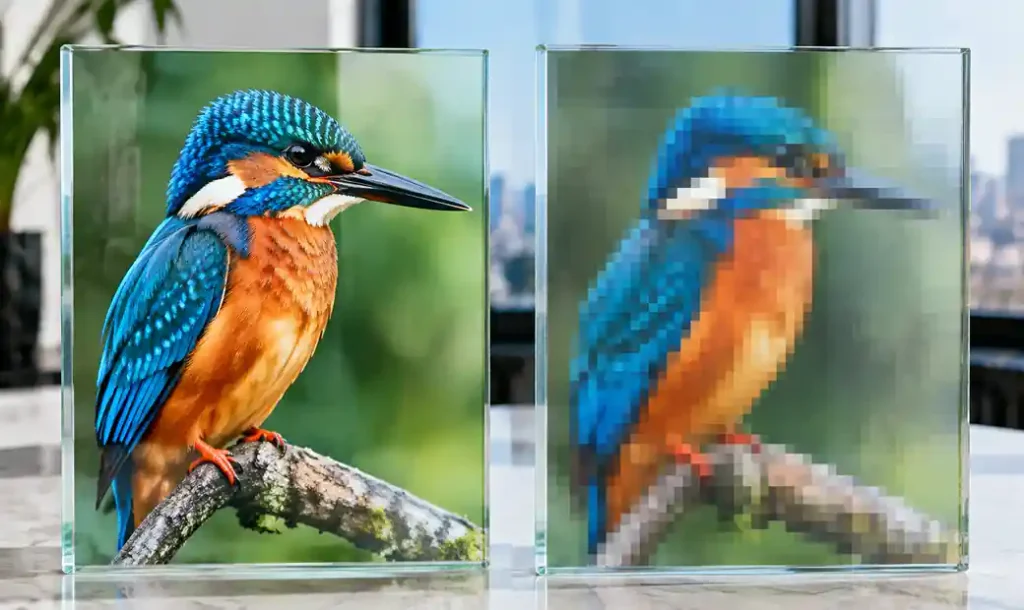
Mistake 2: Undersized Image Files
Problem: Low-resolution images pixelate at architectural scale
Solution: Calculate required DPI at actual size; upsampling cannot recover detail
Mistake 3: Ignoring Panel Joints
Problem: Pattern misalignment across facades
Solution: Overlay panel layout on elevations during schematic design
Mistake 4: Specifying Pantone Without Testing
Problem: Ceramic inks cannot match some colors exactly
Solution: Request physical samples; specify acceptable Delta E tolerance
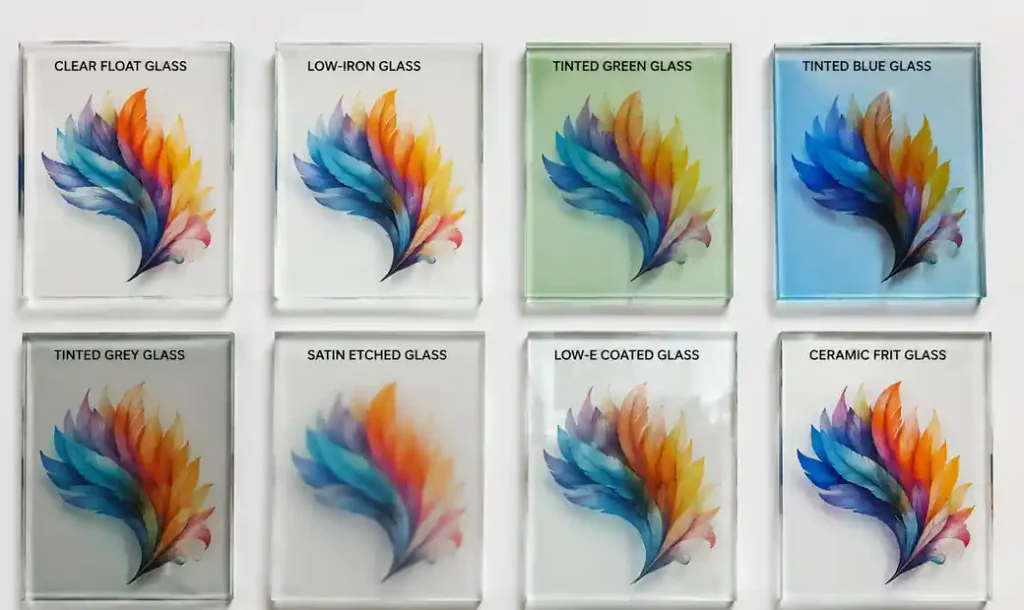
Material Compatibility Matrix
| Glass Type | Digital Print Compatibility | Post-Print Processing | Notes |
|---|---|---|---|
| Clear Float | Excellent | Temper, laminate, IGU | Standard substrate |
| Low-Iron Ultra-Clear | Excellent | Temper, laminate, IGU | Enhances color vibrancy |
| Tinted (Gray/Bronze) | Good | Temper, laminate, IGU | Colors shift; test required |
| Low-E Coated | Limited | Temper only (coating side inward) | Print on non-coated surface |
| Reflective Coated | Not Recommended | N/A | Coating interferes with ink adhesion |
| Acid-Etched | Excellent | Temper, laminate | Print on smooth side |
The matrix guides material selection during specification. Projects requiring low-E performance typically print on surface #2 (interior surface of exterior lite) with the low-E coating on surface #3 in an insulated glass unit configuration.
Quality Control and Testing Standards
Professional installations demand verification beyond visual inspection. Standard testing protocols include:
Adhesion Testing (ASTM C1376)
- Crosshatch adhesion test confirms ink bond strength
- Critical for overhead glazing and high-wind facades
UV Exposure Testing (ASTM G155)
- Accelerated weathering simulates 20-year exposure
- Ceramic inks show zero degradation; organic inks fail within months
Color Consistency Measurement
- Spectrophotometry measures Delta E between panels
- Specify acceptance criteria (typically ΔE < 3 for critical matching)
At Zhongbo Glass, we maintain calibration samples from each production run. When future additions require color matching years later, we reference these archived samples to reproduce formulations accurately.
FAQ
Q: Can digital ceramic printed glass be tempered?
Yes. Ceramic inks withstand tempering temperatures up to 680°C. Print before tempering, and the ink fires permanently during the strengthening process. This allows printed glass to meet safety glazing requirements.
Q: How does digital printing cost compare to screen printing?
Digital printing costs more per square meter for large quantities (typically $40-80/㎡ vs. $25-45/㎡ for screen printing) but eliminates the $2,000-5,000 per color setup fee. For projects under 100㎡ or designs with multiple colors, digital printing proves more economical.
Q: What’s the maximum size for digital printed glass panels?
Our facility handles up to 3,300mm × 28,000mm. Industry-wide, maximum widths range from 2,500mm to 3,660mm depending on equipment. Height capabilities extend to 28,000mm at advanced facilities.
Q: How long does digital ceramic printing last?
Properly fired ceramic inks bond permanently to glass with a service life exceeding 30 years. Unlike UV-printed or vinyl-applied graphics, ceramic printing withstands weathering, cleaning chemicals, and UV exposure without fading or delamination.
Q: Can you print white or metallic colors?
Standard CMYK printing produces colors through subtractive mixing, making true white impossible (you see the clear glass). White ceramic ink requires a fifth print head—available at specialized facilities. Metallic effects use specially formulated inks but appear flat compared to actual metal leaf.
Q: Is it possible to print on already-tempered glass?
No. Ceramic inks require high-temperature firing to bond permanently. Tempered glass cannot be reheated without losing its strength. Always print on annealed glass, then temper if needed.
Conclusion
Digital ceramic printing on glass technology transforms architectural design by enabling mass customization without economic penalty. The ability to reproduce photographic imagery, complex gradients, and unlimited color combinations at building scale—while maintaining the durability and safety performance of ceramic frit—makes it indispensable for contemporary facades and interiors. However, success requires understanding the technology’s constraints around panel sizes, color consistency, and file preparation. Architects who engage manufacturers like Zhongbo Glass during design development—rather than treating printing as a late-stage specification—achieve results that balance creative vision with production reality. As equipment capabilities expand and color management systems improve, digital ceramic printing continues narrowing the gap between what designers envision and what fabricators can deliver at scale.