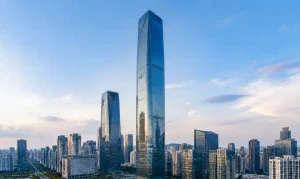
The Guangzhou International Finance Center (IFC) required fire-rated glass assemblies achieving 60 to 120-minute fire resistance ratings across multiple building zones. This 440-meter supertall tower utilized intumescent laminated glass technology with multi-layer SGP construction, manufactured in jumbo panel sizes up to 3660mm × 18000mm. The project demanded rigorous GB and ASTM compliance testing, specialized curtain wall integration, and verification across eight distinct fire compartment classifications—delivering transparent fire barriers without compromising the tower’s signature glass aesthetic.
Project Background and Fire Safety Requirements
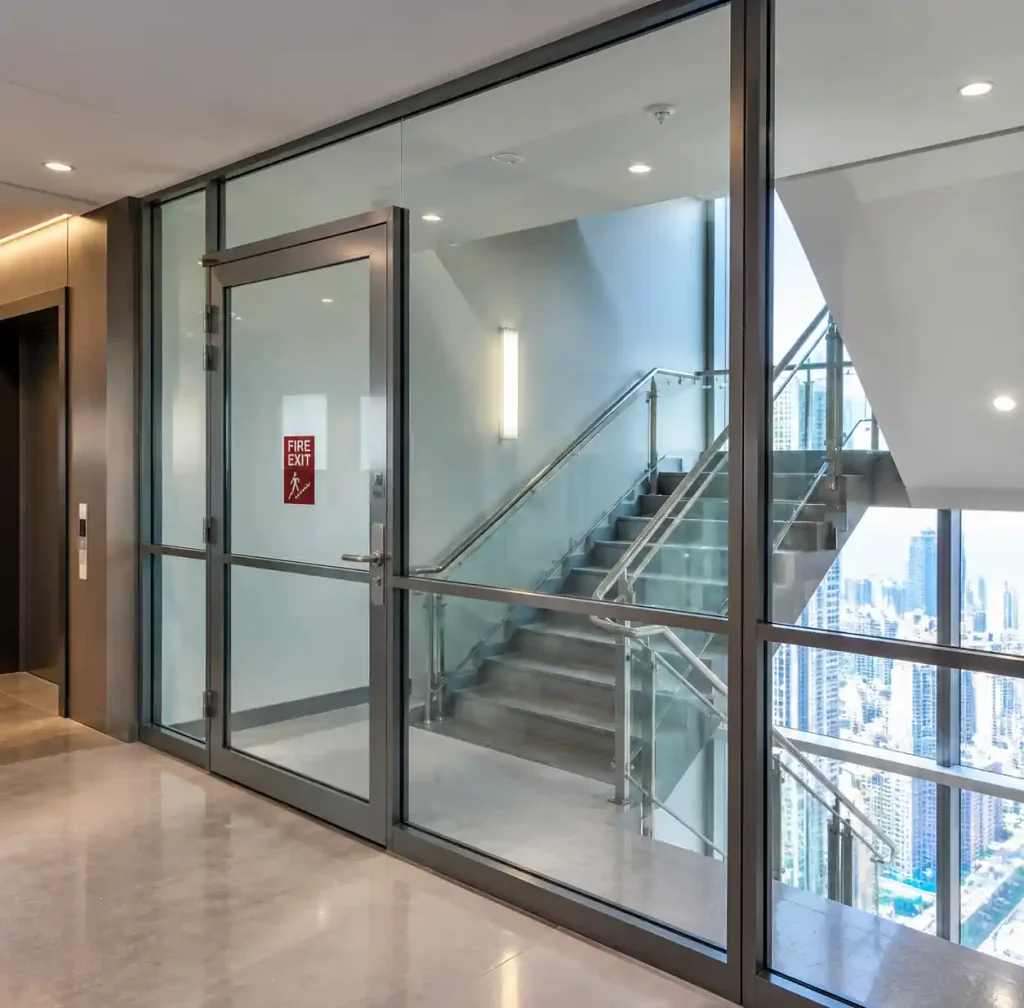
Completed in 2010, the Guangzhou IFC stands as one of China’s tallest mixed-use towers, housing Grade-A offices, luxury retail, and a five-star hotel across 103 floors. The architectural design called for extensive glass facades, but Chinese building code GB 50016 imposes strict fire separation requirements for supertall structures exceeding 250 meters. Fire-rated glazing became critical in three zones: emergency egress stairs, elevator lobby separations, and inter-floor refuge areas.
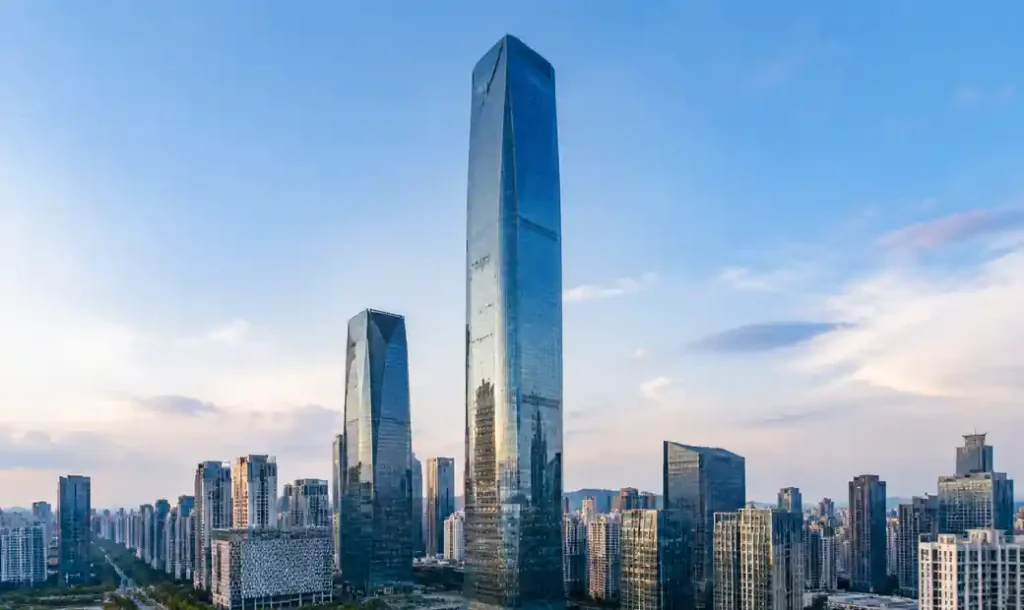
The challenge was balancing transparency with life safety. Standard fire-rated ceramic glass would create visual discontinuity in the all-glass facade. Instead, the project specified intumescent laminated glass—a multi-layer assembly that remains clear under normal conditions but expands when exposed to fire, forming an insulating char layer that blocks heat transfer while maintaining structural integrity. This fire resistant glass technology enabled seamless integration with the tower’s architectural vision.
Fire Resistance Classification and Testing Standards
The Guangzhou IFC project required three distinct fire ratings based on occupancy classification and egress path analysis:
| Fire Rating | Application Zone | Glass Configuration | Testing Standard |
|---|---|---|---|
| 60 minutes | Elevator lobby partitions | 10mm + 2.28mm SGP + 10mm + intumescent layer + 10mm | GB 15763.1 / ASTM E119 |
| 90 minutes | Egress stair enclosures | 12mm + 2.28mm SGP + 12mm + intumescent layer + 12mm | GB 15763.1 / ASTM E119 |
| 120 minutes | Refuge floor barriers | 15mm + 2.28mm SGP + 15mm + intumescent layer + 15mm | GB 15763.1 / ASTM E119 |
Each assembly underwent full-scale fire testing at China’s National Fire Engineering Technology Research Center. The testing protocol followed GB 15763.1-2009 requirements, exposing specimens to controlled temperature curves reaching 1050°C. Critical performance metrics included:
- Integrity (E): Glass must prevent flame penetration throughout the rated period
- Insulation (I): Non-fire side temperature rise limited to 140°C average, 180°C maximum at any single point
- Radiation (W): Heat flux on non-fire side must not exceed 15 kW/m² at 1 meter distance
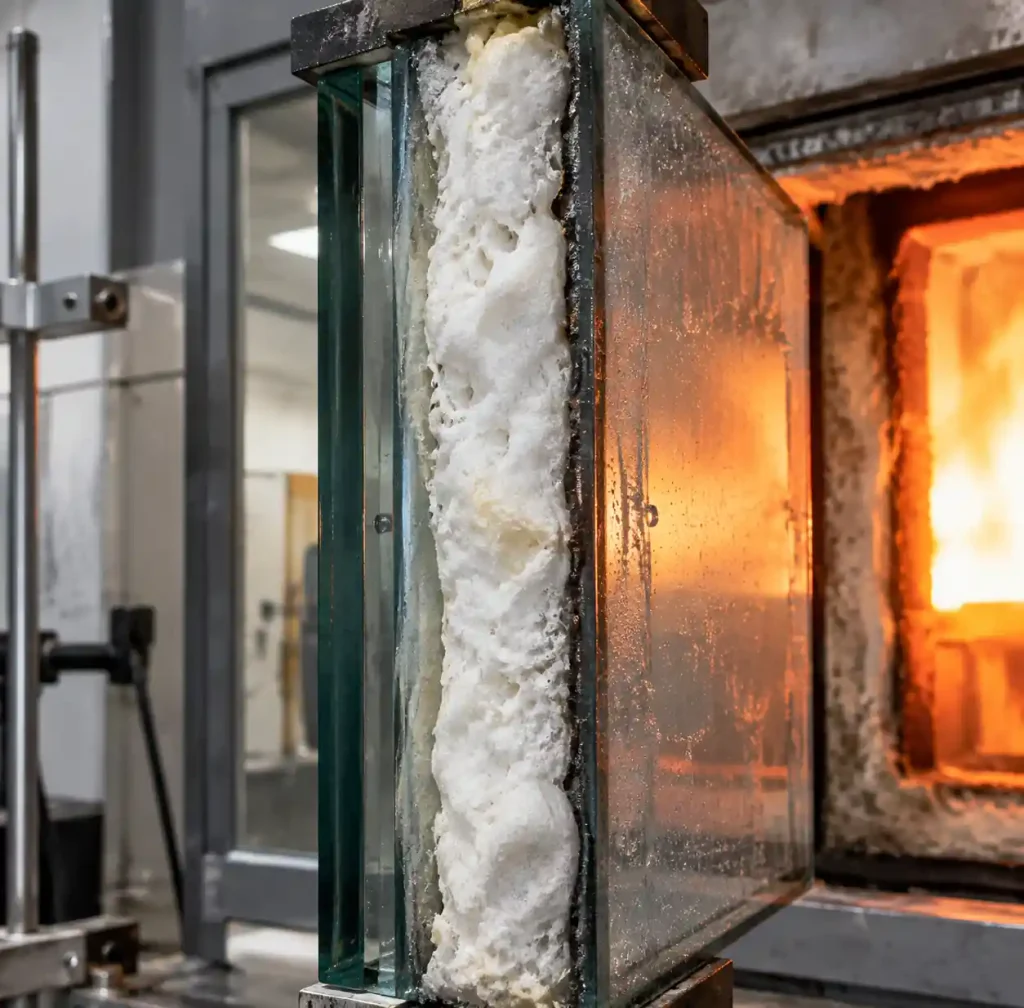
The 120-minute assemblies proved most demanding. At the 90-minute mark during testing, the intumescent interlayer had expanded to approximately 40mm thickness, creating an opaque ceramic foam barrier. Temperature measurements on the non-fire side remained below 110°C—well within the 140°C threshold.
Intumescent Interlayer Technology
Unlike traditional PVB or SGP-only laminated glass, fire-rated assemblies incorporate a specialized intumescent gel layer between glass plies. This transparent hydrogel contains sodium silicate compounds that undergo endothermic chemical reactions when heated above 120°C.
The intumescent activation process occurs in three phases:
- Initial heating (20-120°C): Gel remains transparent and stable, maintaining optical clarity
- Activation phase (120-300°C): Water molecules within the gel vaporize, creating internal pressure that causes the layer to expand 15-30 times its original thickness
- Char formation (300-1000°C): Expanded foam solidifies into a rigid, microporous ceramic structure with thermal conductivity below 0.1 W/mK
This char layer blocks radiant heat transfer—the primary mechanism of fire spread in high-rise buildings. During the Guangzhou IFC fire tests, thermal imaging showed the non-fire side glass surface remained below 65°C even as furnace temperatures exceeded 950°C, demonstrating exceptional insulation performance.
Manufacturing and Size Constraints
Producing jumbo-size fire-rated laminated glass presented significant technical challenges. Zhongbo Glass utilized an oversized autoclave (4200mm × 28000mm) to achieve the required panel dimensions while maintaining uniform interlayer bonding across the entire surface.
| Manufacturing Stage | Process Parameter | Quality Control Measure |
|---|---|---|
| Glass preparation | Tempered float glass, edge quality Ra < 0.8μm | Automated edge scanning, 100% inspection |
| Interlayer assembly | SGP + intumescent gel, clean room class 10,000 | Optical inspection for contamination |
| Pre-lamination | Vacuum bag process, <0.5 mbar pressure | Pressure monitoring, dewpoint verification |
| Autoclave bonding | 145°C, 14 bar pressure, 120-minute cycle | Multi-point temperature logging |
| Post-processing | CNC edge grinding, hole drilling | Dimensional tolerance ±1.0mm |
The largest panels installed at Guangzhou IFC measured 3660mm × 18000mm—approaching the absolute size limits of fire-rated glass production. Panels exceeding 3300mm width require custom autoclave equipment; globally, fewer than 10 facilities can produce fire-rated glass at this scale.
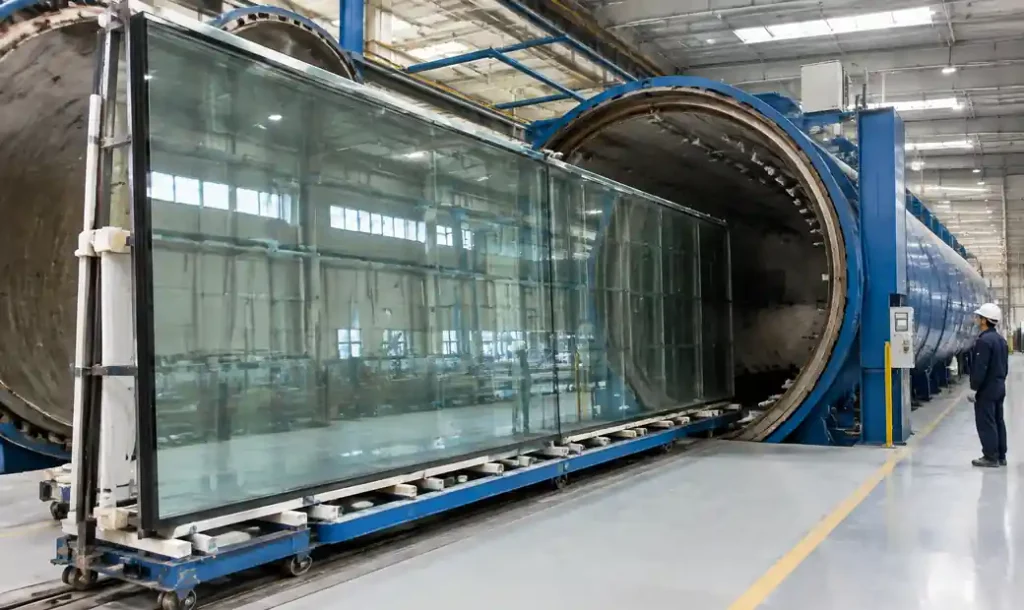
Panel weight became a critical consideration. A 120-minute rated assembly at maximum size weighs approximately 1,850 kg. Curtain wall framing required structural steel reinforcement to support these loads while accommodating thermal expansion (fire-rated glass expands 0.9mm per meter per 100°C temperature differential).
Installation Approach and Curtain Wall Integration
The project employed a unitized curtain wall system with captured glazing pockets specifically engineered for fire-rated assemblies. Standard structural silicone glazing tape couldn’t be used—silicone degrades at temperatures above 200°C, compromising fire integrity.
Instead, the installation utilized a hybrid system:
Perimeter framing: Aluminum extrusions with thermal breaks, reinforced with internal steel channels
Primary seal: Ceramic fiber rope gaskets compressed to 25% of original thickness
Secondary seal: High-temperature intumescent mastic rated to 1000°C
Edge clearance: 5mm nominal gap, filled with compressible ceramic fiber
Structural support: Stainless steel setting blocks at quarter-points
The ceramic fiber gaskets serve dual purposes—they cushion the glass during normal building movement while expanding to seal gaps during fire exposure. At temperatures above 150°C, the intumescent mastic expands to fill any voids, preventing smoke penetration.
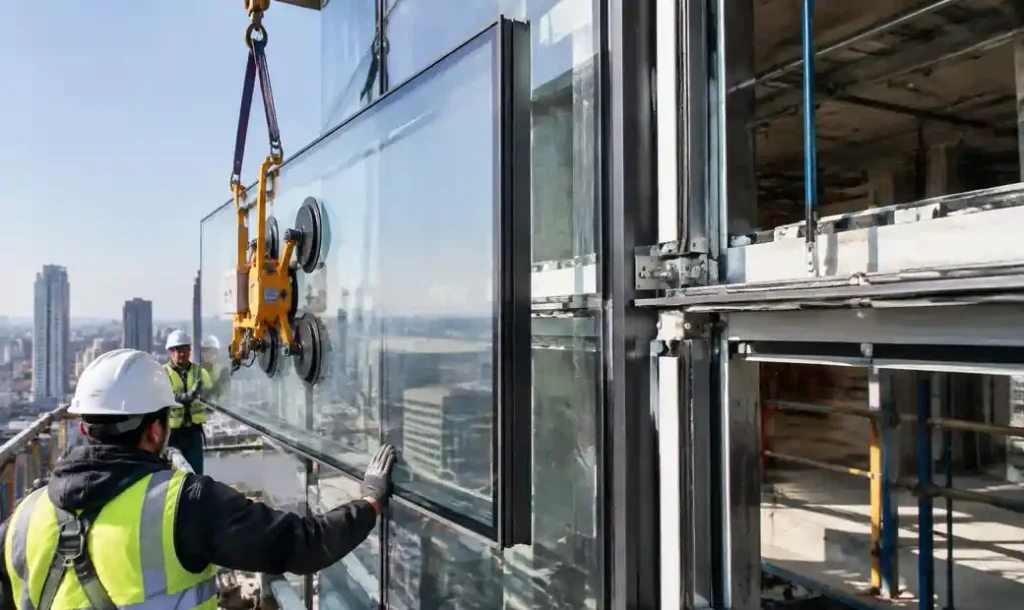
Installation sequencing was critical. Each panel required four-point crane rigging with custom vacuum lifters to prevent edge stress. The installation team positioned panels from bottom to top within each fire zone, maintaining continuous alignment tolerances within ±2mm over 18-meter vertical spans.
Code Compliance and Authority Approval
Chinese fire safety regulations for supertall buildings involve multiple approval authorities. The Guangzhou IFC fire-rated glazing underwent three levels of compliance verification:
1. Product certification: China Certification Center for Fire Products (CCCF) approval based on full-scale fire testing and factory inspections
2. Design review: Guangzhou Fire Bureau review of fire compartment layouts, egress calculations, and material specifications
3. Installation inspection: On-site verification by third-party inspectors during construction, with random panel testing
The most contentious compliance issue involved glazing area limitations. GB 50016-2014 Section 6.7.7 restricts fire-rated glass area in egress enclosures to 30% of total wall area for 60-minute ratings. The design team successfully argued for an exception based on two factors:
- The intumescent glass assemblies achieved insulation (I) ratings, not just integrity (E)—providing superior performance to code minimum requirements
- Sprinkler systems in adjacent spaces created additional fire suppression, reducing heat exposure on the glass
This exception required documentation showing that even if the sprinklers failed, the glass assemblies would maintain their fire rating under worst-case heat flux scenarios. Computational fluid dynamics (CFD) modeling demonstrated peak heat exposure would reach only 85 kW/m²—well within the tested capacity of 100 kW/m².
Performance Testing and Quality Verification
Beyond initial product certification, the project implemented a comprehensive quality assurance program throughout manufacturing and installation:
Pre-production validation: Three full-size mockup panels (3660mm × 6000mm) underwent fire testing to verify manufacturing process capability
Production sampling: 5% of panels received destructive testing for bond strength (>17 MPa required)
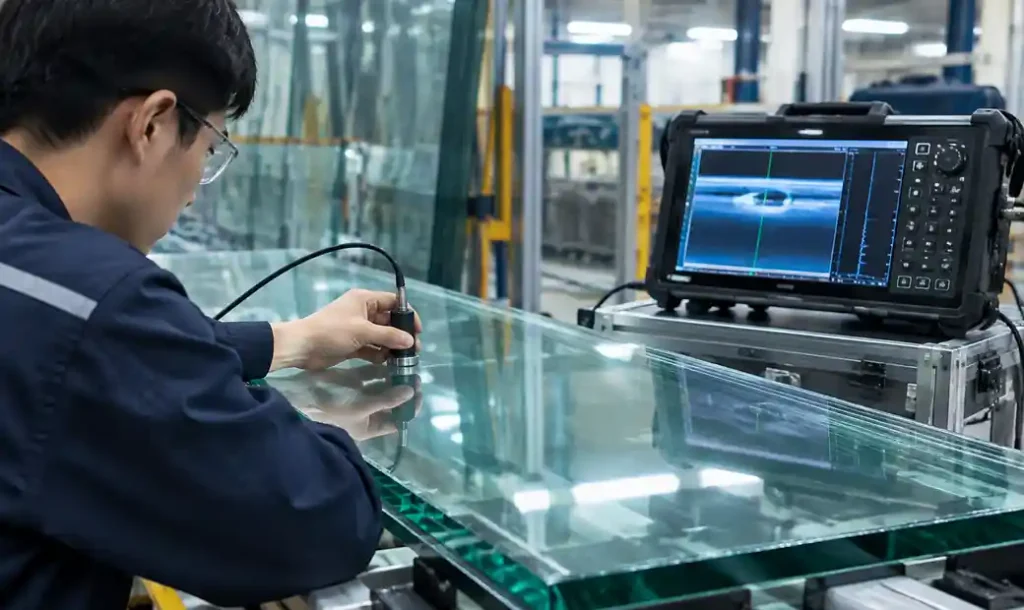
Non-destructive testing: 100% ultrasonic scanning to detect delamination or void defects >3mm diameter
On-site inspection: Laser measurement of installed panel deflection under wind load (maximum 1/200 of span)
The quality program identified two critical issues during production. First, summer humidity above 75% caused incomplete interlayer curing in panels over 15m² area—resolved by extending autoclave dwell time by 20 minutes. Second, panels with drilled holes for hardware attachments showed stress concentrations requiring additional tempering protocols.
Post-installation performance monitoring included:
- Thermal imaging surveys during commissioning to verify uniform insulation values
- Smoke infiltration testing at fire barrier penetrations
- Annual visual inspections for edge seal degradation or delamination
- Deflection monitoring under typhoon wind loads (Guangzhou experiences Category 3+ events)
After 14 years in service, the fire-rated glass at Guangzhou IFC shows no significant degradation. Periodic inspections in 2018 and 2023 documented edge seal conditions, finding less than 2% of panels exhibiting minor cosmetic seal weathering—none affecting fire performance.
Lessons Learned and Industry Impact
The Guangzhou IFC project established several precedents for fire-rated glass in Chinese supertall construction:
Size capabilities: Demonstrated that intumescent laminated glass could be manufactured reliably at jumbo dimensions previously considered impractical
Cost optimization: Unitized curtain wall installation reduced on-site labor by 40% compared to stick-built systems
Regulatory framework: Created approval pathways for exceeding standard glazing area limits when justified by superior performance
Design integration: Proved that fire-rated glass could maintain architectural vision without visual discontinuity
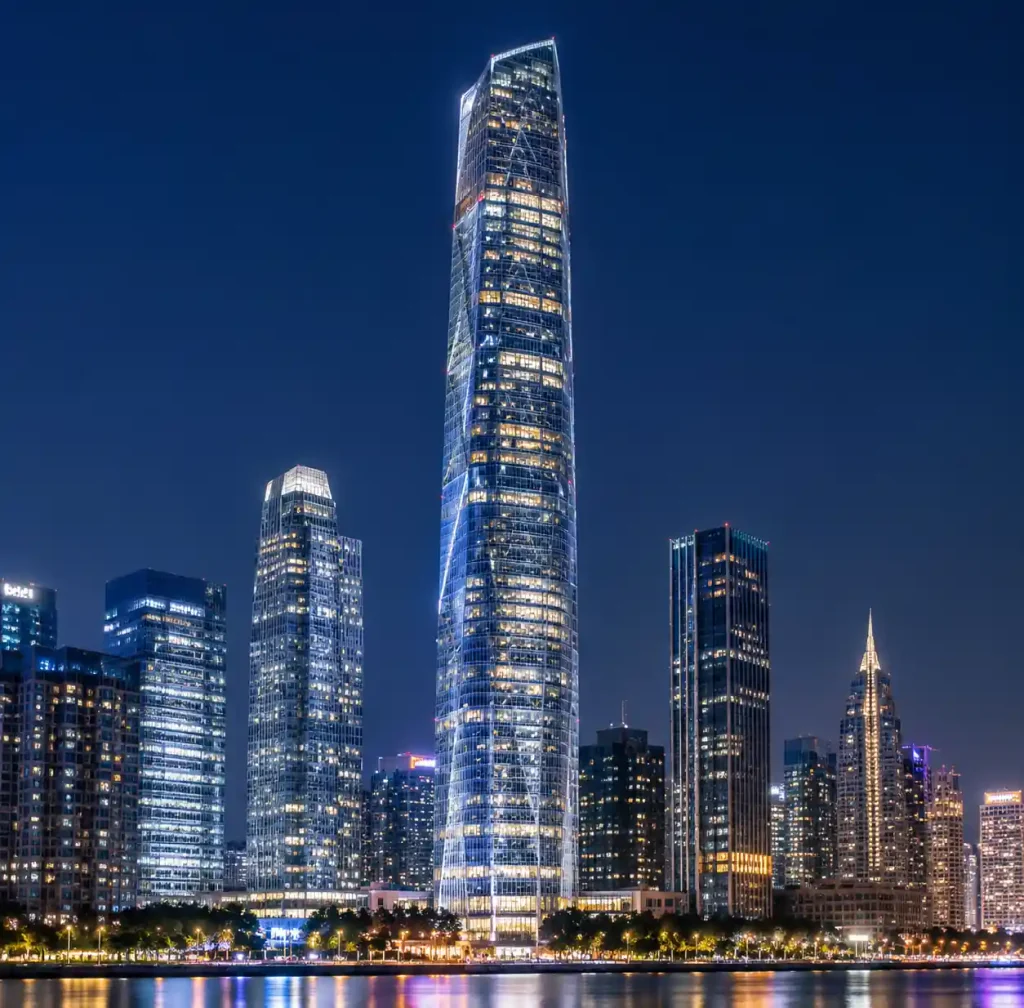
The project’s success influenced subsequent supertall developments across China. Shanghai Tower (completed 2015) and Ping An Finance Centre (completed 2017) both specified similar intumescent laminated glass systems, directly citing Guangzhou IFC’s performance data in their code compliance documentation.
From a manufacturing perspective, the project drove investment in oversized autoclave infrastructure. In 2010, only two facilities in Asia could produce fire-rated glass panels exceeding 3500mm width. By 2025, that capacity expanded to eight facilities, enabling cost reductions of approximately 30% through economies of scale.
FAQ
Q: How does fire-rated glass differ from standard tempered glass in high-rise curtain walls?
A: Standard tempered glass shatters at approximately 250°C due to thermal stress. Fire-rated glass uses intumescent interlayers that expand when heated, creating an insulating ceramic foam that maintains structural integrity and blocks heat transfer for 60-120 minutes at temperatures exceeding 1000°C.
Q: What are the size limitations for fire-rated laminated glass panels?
A: Maximum production size is constrained by autoclave dimensions. Standard capacity reaches 3300mm × 18000mm. Zhongbo Glass operates 4200mm × 28000mm autoclaves, enabling panels up to 3660mm × 18000mm—among the largest fire-rated glass production capabilities globally.
Q: Can fire-rated glass be used in vision areas of fire doors?
A: Yes, but with area restrictions. GB 50016 limits fire-protective glass in fire doors to 0.065m² (100 square inches) for 60-90 minute ratings. Fire-resistive glass meeting insulation (I) criteria can be used in larger sizes subject to authority approval.
Q: How long does fire-rated glass maintain optical clarity in service?
A: Properly manufactured intumescent laminated glass shows minimal optical degradation over building lifespan. UV exposure causes slight yellowing after 15-20 years (visible transmission drops from 87% to 84%), but fire performance remains unaffected. Edge seal weathering is the primary maintenance concern.
Q: What inspection procedures verify fire-rated glass installation quality?
A: Critical checkpoints include: perimeter clearance (5mm nominal), ceramic fiber gasket compression (25% of original thickness), intumescent mastic continuity (no gaps >1mm), and panel deflection under design wind load (maximum span/200). Thermal imaging can detect improper framing insulation.
Conclusion
The Guangzhou International Finance Center fire-rated glass installation demonstrates that life safety requirements need not compromise architectural ambition in supertall construction. By leveraging intumescent laminated glass technology, the project achieved 60 to 120-minute fire resistance ratings across extensive transparent barriers, maintaining the building’s signature all-glass aesthetic while exceeding Chinese building code requirements.
Key success factors included: advanced manufacturing capabilities enabling jumbo panel production up to 3660mm × 18000mm, rigorous testing protocols verifying performance under GB 15763.1 and ASTM E119 standards, specialized curtain wall integration with high-temperature sealing systems, and comprehensive quality assurance throughout fabrication and installation.
The project’s technical achievements established new benchmarks for fire-rated glazing in Chinese supertall developments, influencing regulatory frameworks, manufacturing investment, and design approaches across subsequent projects. Fourteen years of in-service performance validates the durability and reliability of intumescent laminated glass systems in demanding environmental conditions.
For architects and developers specifying fire-rated glazing in high-rise projects, the Guangzhou IFC case study provides practical insights into testing requirements, manufacturing constraints, installation methodologies, and code compliance pathways—ensuring that transparent fire barriers can be implemented successfully from concept through long-term building operation.