Over 1 billion birds die annually from building collisions in North America alone. This preventable crisis has pushed bird-friendly glass from optional sustainability measure to essential architectural consideration. Modern manufacturing technologies now deliver effective collision prevention while preserving design intent.
The core problem is straightforward: birds cannot distinguish glass reflections from actual sky and vegetation, nor perceive transparent barriers. Low-rise buildings (1-3 stories) account for 56% of fatalities, with migration seasons seeing particularly severe collision rates. The solution lies in visual markers that birds recognize as barriers while maintaining transparency for human occupants.

The Science Behind Bird Vision and Glass Perception
Birds interpret reflected vegetation and sky as flyable space, attempting to reach trees mirrored in glass or fly through transparent atriums to habitat beyond. Their visual systems, optimized for natural environments, create vulnerability to modern architecture. This understanding has driven development of pattern systems that interrupt glass surfaces in ways meaningful to avian vision without compromising human aesthetics.
Proven Design Standards: The 2×4 and 2×2 Rules
Flight tunnel testing established the 2×4 rule: pattern elements spaced no more than 2 inches apart horizontally or 4 inches apart vertically prevent most species from attempting passage. The 2×2 rule (2-inch spacing both directions) provides maximum protection for high-risk locations.

Patterns covering just 7% of glass surface area achieve 90-95% collision reduction when properly spaced. Toronto, San Francisco, New York City, and numerous jurisdictions now mandate these standards for new construction.
| Spacing Standard | Horizontal Spacing | Vertical Spacing | Protection Level | Best Application |
|---|---|---|---|---|
| 2×4 Rule | ≤2 inches | ≤4 inches | High (90-95% reduction) | General commercial buildings, standard risk areas |
| 2×2 Rule | ≤2 inches | ≤2 inches | Maximum (95-100% reduction) | Migration corridors, high-risk facades, conservation sites |
Manufacturing Technologies for Bird-Safe Glass
Ceramic Frit Printing
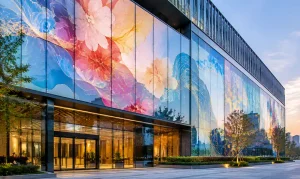
Ceramic frit applies patterns before tempering, fusing designs permanently into glass. The result is scratch-resistant, UV-stable, and maintenance-free for building lifespan. At Zhongbo Glass, our digital printing line (maximum size: 3300mm × 28000mm) enables precise pattern customization while maintaining critical 2×4 or 2×2 spacing. This technology offers permanent integration, exterior visibility, minimal interior impact, and full compatibility with laminated and insulated glass assemblies.
UV Pattern Coatings
UV reflective coatings create patterns invisible to humans but detectable by birds. However, effectiveness depends heavily on lighting conditions—under dawn, dusk, or overcast weather when many collisions occur, pattern visibility decreases substantially. Visible patterns meeting 2×4 spacing provide more reliable protection.
Acid-Etched Glass
Acid-etching creates permanent translucent patterns through chemical surface treatment, achieving required spacing standards with moderate design flexibility compared to digital printing.
Integrating Bird-Friendly Glass in Architectural Design

Highest risk areas include glazing adjacent to vegetation or water, corner windows creating transparency, glass walkways and atriums, locations along migratory flyways, and facades oriented toward greenspace. Strategic placement in these zones maximizes protection, though many projects now specify bird-friendly glass for entire facades to ensure comprehensive coverage.
Performance Comparison: Bird-Friendly Glass Technologies
| Technology | Visibility to Birds | Human View Impact | Durability | Customization | Effectiveness Rating |
|---|---|---|---|---|---|
| Ceramic Frit (visible patterns) | Excellent | Minimal to moderate | Permanent | High with digital printing | 90-95% reduction |
| UV Coatings | Variable (lighting-dependent) | None | Permanent | Limited | 50-75% reduction |
| Acid-Etched Glass | Excellent | Moderate | Permanent | Medium | 90-95% reduction |
| Applied Films/Decals | Good | Minimal to moderate | 5-10 year lifespan | High | 85-90% reduction |
| Exterior Screens/Louvers | Excellent | Moderate to significant | Permanent | Medium | 95-100% reduction |
Building Code Requirements and Compliance
Major jurisdictions now mandate bird-friendly design: Toronto requires bird-safe glazing on first 12 meters of all new development, San Francisco mandates coverage on buildings in hazard locations, and New York City requires bird-friendly materials on 90% of glazing up to 75 feet. Regulations typically reference the 2×4 rule as minimum compliance.

Large-Format Bird-Friendly Glass Manufacturing
Contemporary architecture demands oversized panels with bird-safe treatments. Zhongbo Glass’s laminated glass production line handles panels to 4200mm × 28000mm, while our tempering lines accommodate up to 3660mm × 28000mm. Digital printing integrates with tempering, fusing patterns permanently during heat treatment while maintaining spacing precision across entire surfaces—critical for floor-to-ceiling commercial facades, institutional buildings, and hospitality projects near landscaped areas.

Case Study Applications
Zhongbo Glass has delivered bird-friendly solutions for high-profile projects where collision prevention aligned with architectural vision. The Baiyun International Conference Center incorporated ceramic frit patterns on curtain wall assemblies (maximum 8200mm × 2200mm), maintaining design intent while providing deterrence in sections reflecting adjacent greenspace. The Shanghai Museum East Hall integrated bird-friendly treatments on jumbo panels (up to 12400mm × 700mm structural fins) adjacent to landscaped plaza areas. These demonstrate that bird-safe requirements complement rather than compromise architectural ambition.
Cost Considerations and ROI
Bird-friendly glass typically adds 10-25% to glazing costs. However, regulatory compliance in mandated jurisdictions, liability reduction, LEED certification points (LEED v4.1 Pilot Credit for Bird Collision Deterrence), and reduced maintenance costs improve economic justification.

Installation and Maintenance Best Practices
Visual markers must appear on the exterior surface (surface #1) to remain visible to approaching birds. Ceramic frit bird-friendly glass requires only standard cleaning—the fused ceramic remains effective for building lifespan, unlike applied films requiring 5-10 year replacement cycles.
Aesthetic Integration Strategies
Digital printing enables creative pattern integration: gradient patterns transitioning based on threat assessment, custom designs reflecting building identity, complementary facade coordination, and selective density variations. Architects increasingly view bird-friendly requirements as design opportunities—the pattern process serving collision prevention simultaneously enables customization previously requiring expensive specialty processes.

Testing and Verification Standards
Flight tunnel testing provides rigorous evaluation, measuring avoidance behavior in controlled conditions. The American Bird Conservancy evaluates products using live birds, with threat ratings below 20 (on 0-100 scale) earning recognition as effective deterrents. FLAP Canada research established the 2×4 and 2×2 spacing guidelines now incorporated into building codes. Field monitoring of retrofitted buildings provides real-world validation.

Beyond Glass: Comprehensive Collision Prevention
Comprehensive strategies include lighting management (reducing unnecessary illumination, motion sensors, minimizing upward-directed lights), landscape planning (vegetation setbacks from glazing), and interior placement (keeping plants away from windows to avoid fly-through illusions).
Future Developments in Bird-Friendly Technology
Emerging technologies include dynamic patterns using electrochromic glass activated during high-risk periods, improved UV coatings maintaining visibility under low-light conditions, and integrated smart glass combining Low-E coatings, solar control, and bird-friendly patterns in single products.

FAQ
Q: Does bird-friendly glass reduce natural light or obstruct views?
A: Properly designed patterns typically cover less than 7-10% of glass surface area, maintaining substantial transparency. Digital ceramic printing enables pattern customization that can minimize visual impact from interior perspectives while providing effective exterior visibility to birds. Many building occupants report minimal awareness of properly designed patterns after installation.
Q: Is UV-coated glass as effective as visible patterns?
A: Current research indicates UV patterns have significant limitations. Effectiveness depends on ambient UV index, which decreases under overcast conditions, at dawn/dusk, and on shaded facades—precisely when many bird collisions occur. Visible patterns meeting 2×4 spacing requirements demonstrate more consistent protection across varying conditions.
Q: Can bird-friendly treatments be added to existing buildings?
A: Yes, though options differ from new construction. Applied films and exterior screens can retrofit existing glazing, though these solutions may require periodic replacement unlike permanent ceramic frit options available during manufacturing. Cost-effectiveness and aesthetic considerations vary by building and specific collision problem severity.
Q: What maintenance does bird-friendly glass require?
A: Ceramic frit patterns fused during tempering require only standard glass cleaning maintenance. The patterns are permanent, scratch-resistant, and UV-stable. Applied film solutions typically require replacement every 5-10 years depending on exposure conditions and product specifications.
Q: Are there building types where bird-friendly glass is most critical?
A: Highest priority applications include buildings adjacent to habitat, water features, or greenspace; structures along migratory flyways; and designs incorporating significant glass area, transparency, or reflectivity. However, low-rise buildings (1-3 stories) actually account for the majority of collision fatalities, indicating all building types merit consideration.
Q: How do I specify bird-friendly glass for my project?
A: Begin by identifying threat zones based on building location, surrounding landscape, and facade orientation. Specify visual marker spacing meeting 2×4 rule minimum (2×2 for high-risk applications). Select ceramic frit, acid-etched, or other permanent solution appropriate for project aesthetic and budget. Ensure patterns appear on exterior glass surface and verify compliance with local building codes.
Conclusion
Bird-friendly glass represents the convergence of environmental responsibility and architectural innovation. The collision crisis affecting over 1 billion birds annually demands immediate action from the architectural and development communities. Fortunately, proven solutions now exist that prevent the vast majority of collisions without compromising design vision or substantially increasing project costs.
Digital ceramic printing technology, combined with established spacing standards, enables architects to transform regulatory requirements into design opportunities. As jurisdictions worldwide adopt bird-friendly building codes, early adoption positions projects ahead of compliance curves while demonstrating environmental leadership.
At Zhongbo Glass, our manufacturing capabilities support bird-friendly glass implementation at any project scale, from standard commercial facades to jumbo panel applications requiring specialized production equipment. The technical challenge has been solved—the remaining task is specification and implementation across the building industry.
The question is no longer whether bird-friendly glass works, but rather how quickly the architecture and development sectors will adopt solutions that preserve both avian populations and architectural ambition. The technology exists. The standards are established. The only remaining requirement is commitment to implementation.